
From New Dawn Special Issue Vol 16 No 2 (April 2022)
I began this research inquiry out of necessity. I am by training and inclination a practitioner-scholar of subaltern, or oppressed, spiritualities. I have been studying and practising them since 1994 when, while attending seminary at the Graduate Theological Union in Berkeley, California, I discovered the world-altering purview of women’s spirituality and Paganism.
Although in my undergraduate work I had already identified myself as a feminist, it had never occurred to me that the very religions I was devoting good time and money to studying might be built on the shoulders of other spiritual traditions that in many cases were supplanted – often persecuted into nonexistence – by dominator religions. This was a revelation and I vowed to question and deconstruct every assumption I held about my own spiritual experiences. In short, I became an agnostic mystic with a penchant for Paganism.
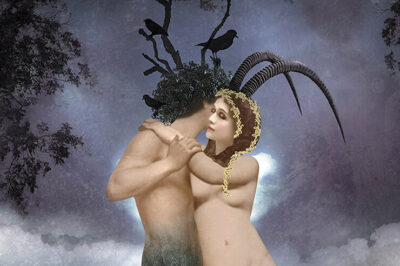
Then in 2002, I began to experience numinous encounters with what seemed to be a spirit lover, primarily in my dreams. Eventually, this spirit lover asked to marry me. What was remarkable about this phenomenon was the felt-sense knowing I had of a separate presence, something extraordinary that felt different from my experiences of other dream figures. I choose not to reduce the presence of a recurring dream being to gestalt or metaphor.
Initially, when these kinds of extraordinary beings first began to show up in my dreams, I did look at how they might represent aspects of myself. Yet over time, I began to determine that these dreams were different from the more psychological dreams I was having – those in which I was rehashing old stories, working out problems, dealing with relationships, and so forth. These extraordinary dreams included visitations, prophecies, lucid consciousness, and other parapsychological phenomena. In addition, they were almost always accompanied by a deep sense of wholeness, heart-opening, and oftentimes, orgasm, which I understand to be Kundalini Shakti rising and releasing.
These experiences led me to an in-depth study of sacred sexuality, also called erotic mysticism. Since then, I have received training in the yogic practices of Shakta Tantra, the Taoist practices of sexual alchemy, and the Western Hermetic practices of sex magick. In 2007 I was initiated as a Ceremonial Magician within a Western Hermetic lineage, and in 2010 I began my apprenticeship as a Faery Seership practitioner. I have also done an introductory study of the African Traditional religion of the Dagara people of Burkina Faso and the folk magic traditions of the American South – known as voodoo, conjure, hoodoo and rootwork. I began exploring these traditions because each one had something to teach me about spirit lovers and spirit marriage.
I take the presence of my dream figures – particularly ones that elicit a somatic response – seriously. I have come to the conclusion that when a spirit contact visits in a dream, it is a bona fide extraordinary being with its own energy signature, felt-sense, attitude, personality, and agenda – just like that of any human person. This is similar to the conclusion that ethnographer Irving Hallowell arrived at in his research with the Ojibwa people. He came to the understanding of “the Ojibwa concept of personhood as relational: persons were not classified according to whether they were human or physical, but rather according to their capacity to engage in relationships with other persons.” (cited in Hunter 2018).
Over the years, I have searched for spiritual and esoteric systems that would help me contextualise this phenomenon. I am particularly interested in those living traditions in which the relationship with a spirit lover is still practised.
The challenge I faced in the early 2000s was that very few books or articles explicitly discussed spirit marriage as a living practice and its importance as a spiritual undertaking. So I decided to undertake that research project both for myself and future practitioners who I imagined might encounter some of the same phenomena I was.
I spent years combing through libraries, bookstores, and online, as well as attending a variety of psycho-spiritual conferences and training, all on the hunt for information about spirit marriage. Then, in 2009, I decided to go back to school to do a PhD, with the intention of writing my dissertation on the subject of spirit marriage. It was time for me to unpack the mystery of being loved and wooed by a spirit and, being a religious studies scholar, I could think of no better way to do it than to surround myself with the discipline and circumspection of an academic institution. It would give me the container, a cauldron, within with I could deeply go into this highly transgressive and oftentimes dismantling material, both academically and experientially, while remaining grounded and sane.
Ultimately, I discovered that spirit marriage is a form of embodied spirituality and a transpersonal phenomenon. To put it as clearly as I can, it is the bonded or intimate relationship between a human and a subtle or discarnate entity such as a deity, spirit, or extraordinary intelligence. In this practice, the consciousness of the practitioner is linked or wedded to a specific entity, and the two beings share a co-creative consciousness forthwith. This practice has appeared in many cultures, among a strikingly large number of religious traditions ranging from African indigenous spirituality to Tantric yoga to Christian mysticism.
The general practice of union with a spirit can manifest in many different forms – channelling, possession, sexual encounters, visitations, and the like. However, spirit marriage tends to be an advanced phase within this range of potential contact, delineated by the fact that most spirit marriage practitioners have gone through a ritual or ceremony of union designed to bond them to a particular spirit, presumably forever.
Spirit marriage has allegedly been with us since the dawn of civilisation. Through folklore and mythology we hear of its ancient roots. We first start to see textual records of the practice in the ancient Mesopotamian sacred marriage, where it is reportedly undertaken to aid humans in the development and expansion of consciousness, both spiritual and everyday.It is said to result in the development of extrasensory perception (ESP), esoteric revelation, and personal and societal transformation.
Based on my twenty-plus years of research and experience, I believe that spirit marriage is a viable means of personal and planetary evolution, even though it has been marginalised and obfuscated throughout history.
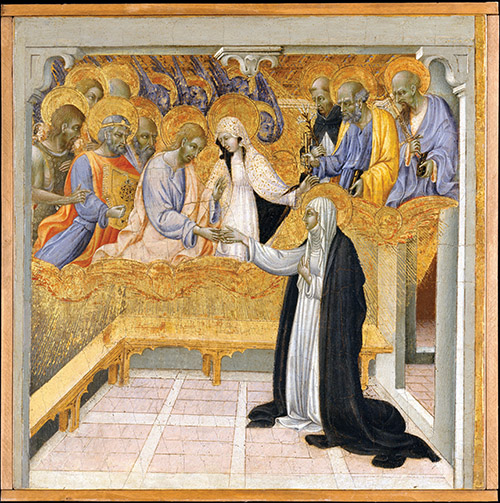
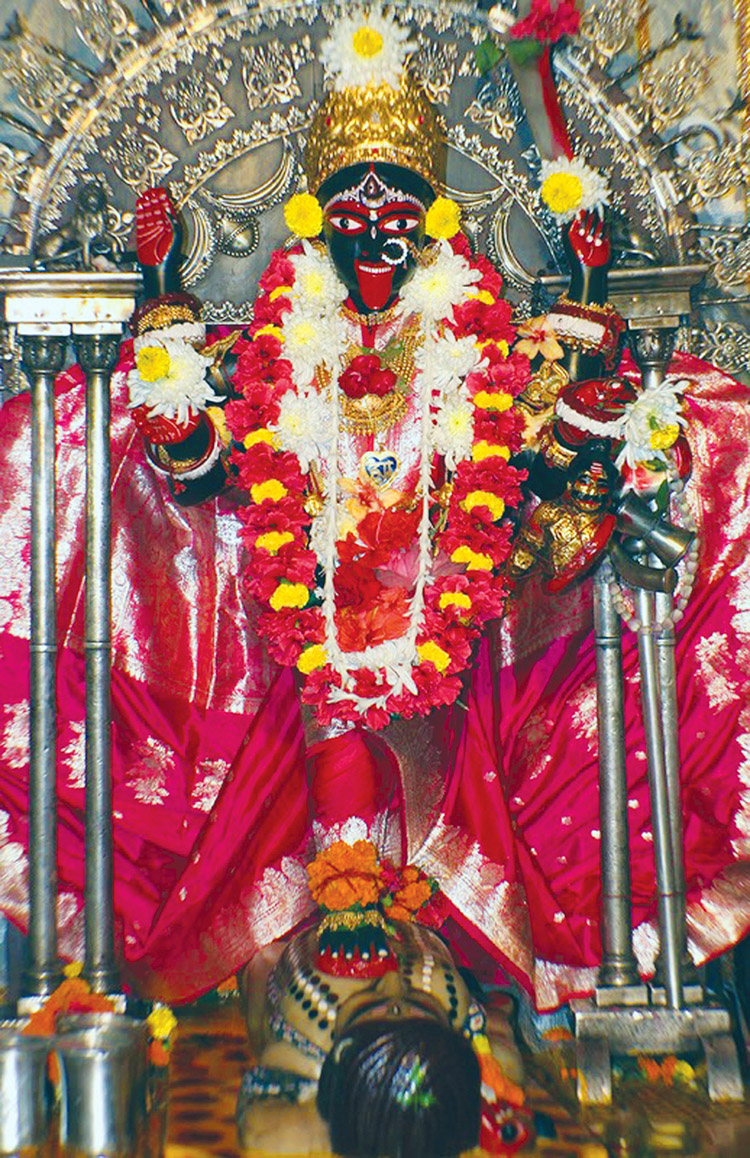
Spirit marriage currently can be found as a living practice in many marginalised spiritual traditions. Most notably, the African Diaspora traditions of Haitian Vodou and New Orleans Voodoo; the folkloric Faery tradition of Faery Seership; the African Traditional religion of the Dagara people in Burkina Faso; the Indo-Tibetan Tantric sadhana; the Norse Heathen practice of the God Spouse, and various Amazonian plant spirit unions. And although I focused my research on marginalised spiritual and religious traditions, the Catholic Rite of Consecration to a Life of Virginity, wherein a woman mystically espouses herself to Christ, also falls within this purview.
Personally, I believe that spirit marriage has the potential to be a kind of liberation spirituality. At crucial moments in history, it seems that it has offered spiritual empowerment, co-creative engagement, and conscious evolution to its practitioners. And in cases wherein dominant religions and their God(s) are mediated by a human oppressor, many have chosen to offer themselves to what they contend are spirits that predate or dwell outside the oppressive regime; beings that are believed to have a higher authority and more power than their human persecutors. In fact, I once had a mentor tell me that if the Gods you’re worshipping don’t seem to be on your side, then you need to choose new Gods!
However, not all spirit marriages are undertaken to free someone from oppression. In fact, most seem to be undertaken at the request of the spirit who wishes to co-create with a human. My research indicates that spirit marriage offers a means to personal agency, individuation of the Self, and an avenue for personal awakening – often against widespread cultural oppression and religious intolerance.
One of my not-so-subtle goals in undertaking this inquiry, particularly from the perspective of a practitioner-scholar, was to offer a much-needed counterpoint to traditional academic scholarship. That type of scholarship tends to invalidate and deny the occurrence of extraordinary spiritual encounters by assuming Western scientistic reality as the norm. Research and reporting from within a colonialist framework tend to devalue the embodied and numinous experience of the practitioners in favour of a psycho-social analysis of the phenomenon.
Therefore, I used a postcolonial indigenous research framework to reclaim the embodied spiritual experience of the spirit marriage practitioners I interviewed for my research, particularly in the subaltern spiritual context. I argued that, in most instances, the practice of spirit marriage involves personal awakening, the establishment of self-worth, and the claiming of sovereignty in a world that in many cases relegates members of marginalised traditions to categories of slave, evil-doer, or subversive influence. Further, I demonstrated that in most cases,the practice of spirit marriage has been upheld predominantly through oral tradition or in the “twilight”or “coded” language of metaphor – only revealed to the trusted initiate – so as to preserve the practice of spirit marriage against the overarching tide of religious and cultural persecution.
I wasn’t interested in answering the question, Are spirits real? Nor was I interested in deconstructing views on reality versus nonreality. Instead, I embraced the worldview of an enchanted universe, which assumes that parapsychological phenomena and transpersonal encounters within an indigenous and ecofeminist framework are valid and worthy of serious study. Following the precedent set by transpersonal anthropologists, ethnographers, and animist psychologists, I assumed that these experiences are completely real for my co-researchers, who deserve the kind of respect that any religious studies scholar would afford a mainstream religion.
As paranthropologistJack Hunter observes, “The ultimate aim of this type of approach, then, is to interpret religious, spiritual and paranormal beliefs and experiences from a perspective that does not, from the very outset, reduce the complexity of the phenomenon or ignore the significance of personal, subjective experience.”(2018) Instead, following American ecofeminist philosopher Caroline Merchant’s clarion call in The Death of Nature (1980), which critiques modern scientific method as a specifically masculinist endeavour, I sought to reclaim the organic and feminist nature of extraordinary experience. I did this through a willingness to listen with an open mind and to enter the extraordinary worldview of the research and those I interviewed as much as possible.
Eventually, through my years of research and practice, I came to the understanding that the primary goal of spirit marriage is not only liberation and transformation of the individual, but ultimately the transformation of society and evolution of the planet. Spirit marriage practices have led and continue tolead to the development of a co-creative consciousness between humanity and divine intelligences – a partnership that helps the human species evolve, through the cultivation of extraordinary powers, acceleration of our evolutionary development, and progression of the human race.
In 2020, just as the world was entering into lockdown, I was invited to turn my dissertation (which I had completed in 2019) into a book. I spent my quarantine years delving back into the stories and transmissions that I had collected over the past ten-plus years to transform them into something new – a magical book written not only by me, but by all the extraordinary beings – human and Otherworldly – who co-created it with me.
Quite frankly, hidden within this research is magic – magic that is meant to please your intellect, delight your senses, and inspire a sense of wonder and awe at the extraordinary capacity of humans to love beyond the bounded notions of what’s deemed “normal” or “real.” And like all works of magic, if you allow it, encountering the topic of spirit marriage can transform you, like it did me, leaving you altered, quickened, and hopefully awakened to the extraordinary nature of your being and the vast intelligence of our beautiful Earth and its many extraordinary beings.
Learn more at SpiritMarriage.com. Megan’s book Spirit Marriage: Intimate Relationships with Otherworldy Beings is available here.
References
Hunter, Jack. 2018. Engaging the Anomalous: Collected Essays on Anthropology, the Paranormal, Mediumship and Extraordinary Experience. Hove, UK: August Night Books.
Merchant, Carolyn. 1980. The Death of Nature: Women, Ecology, and the Scientific Revolution. San Francisco: HarperSanFrancisco.
© New Dawn Magazine and the respective author.
For our reproduction notice, click here.