New Dawn – World's Most Unusual Magazine

Author: Doug Marsh

  • Sacred Sight: Improving Vision Naturally

    Sacred Sight: Improving Vision Naturally

    One, two, buckle my shoe
    Three, four, knock at the door
    Five, six, pick up sticks …And so the nursery rhyme goes. Preschool kids learn to count in many fun ways to give them a head start in arithmetic. Once they enter the formalised school system, the subject matter eventually takes on a more serious “measure.” As the grades advance, the material progresses into more complex and diverse subjects, such as geometry, trigonometry, algebra and calculus.The focus of formalised mathematical education is all about quantity, for numeracy is as important as literacy in our Western world of clocks, commerce and computers. This type of calculation, although very pragmatic, is really only half the equation. The educational system is usually devoid of any reference to the quality of numbers. The ancient traditions of “sacred number” and “sacred geometry” have been largely snuffed out over time. The deeper spiritual aspect – studying the repeating shapes, forms, symbols and patterns in nature – is all but lost in our work-a-day world. We need to bring these esoteric traditions back into view, and what better way to begin than with vision itself.

    Number One

    One touch of nature makes the whole world kin.
    – Shakespeare

    The spiritual side of the computational equation starts at the same point – literally. The ancient Greek mathematical philosophers viewed the number one as unity, a wholeness that provides a divine order to the cosmos. The circle, which is constructed from a central point, is the sacred geometric representation of this wholeness, the One that forms the Many. There exists one unique pattern of the circle, of which all circles share the same principles. But no two circles that arise from the One are identical.

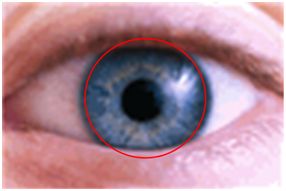
    Circular shapes abound in nature. Of particular significance is the circular shape of the human eyeball, the organ of our most valuable sense of sight. Ralph Waldo Emmerson recognised the first sacred shape in the human form when he wrote, “The eye is the first circle, the horizon which it forms is the second.” Other circles immediately apparent in the eye are the iris, the coloured portion, and the pupil, the black area which dilates and contracts in response to changing light stimuli.

    Deep within the eye, unbeknownst to an observer, the point and the circle play an important role in how we visually perceive the outside world. The inside back portion of the eye (the “retina”) contains numerous light receptors called “cones.” The cones are distributed in such a way that the highest concentration is packed in a very small centre area called the “fovea centralis.” The cones gradually diminish in density as the distance increases from the fovea centralis. The cones are virtually non-existent at the outer periphery, or circumference, of the retina.

    Contrary to what some may believe, we do not see equally clearly within the entire circle of our visual field. The focus is different than that captured on photographic film by a camera. The distribution of cones in the eye means that we see the clearest in the central point of our sight. Objects in the periphery are less clear. Because the cone distribution in the retina follows a geometric pattern similar to the energy distribution in a concentric wave, I call it “concentric focus.”

    Also within the retina are receptors called “rods.” It is believed that the rods sense movement in our peripheral field. The distribution of the rods is essentially the opposite of the cones. The rods are non-existent in the centre and gradually increase in density towards the periphery. That’s why something moving in your peripheral field of vision can abruptly grab your attention.

    Another principle of the circle is the continuous rotary motion of cycles and rhythms. With eyesight, oscillating rhythms are manifest in several ways. One of the most obvious is the continuous blink reflex. Our eyes also respond in cycles by closing at night and opening in the day. During sleep, the eyes have an alternating motion called rapid eye movement (REM), and when awake, they have numerous subconscious micro-movements – some vibrating at the frequency of a strummed guitar string – to key in on objects and maintain focus. The motion is contrary to that of a still camera, for without the continuous rhythmic activity, objects would quickly fade into blur.

    Dr. William Bates was a New York ophthalmologist who pioneered the concept of natural vision improvement almost a century ago. He discovered that the most common types of blurred eyesight, for which glasses are usually prescribed, are actually responses to stress in our environment. The habitual pattern of strained looking causes the eyeball’s natural circular shape to go out of round. By removing strained vision habits, a person can gradually improve one’s eyesight and return to the purity of the One.

    The ancient philosophers considered a true mathematical point within the circle as symbolic. It emerges from the immaterial realm and has no dimensions. Dr. Bates related this concept when he said, “The part seen best when the sight is normal is extremely small… the nearer the point of maximum vision approaches a mathematical point, which has no area, the better the sight.” The idea of concentric focus is a fundamental fact that must be truly appreciated when improving eyesight naturally.

    Number Two

    Tao gives birth to one,
    One gives birth to two
    – Lao Tzu

    SS image 2If the number one represents unity and wholeness, how does a second separate number emerge? The root word for “nature” means “to be born,” and the number two emerges through a birth-like process. Symbolically speaking, this process begins as the circle divides and replicates itself – just as a living cell does. The geometric representation of this replication is two circles of the same diameter each having their centre points touching the circumference of the other. The One projects forth as a reflection of itself and a “true” mathematical line is created from point to point.

    The sacred principle of number two is polarity, whereby the line forms a tensile link between opposite poles. Paradoxically, there is both a separation and an attraction that binds the two, yearning once again for wholeness. It’s the yin/yang principle of Taoist thought, the perpetual rhythmic alternation of all life and the universe. The human body has a left side and a right side, a feminine side and a masculine side, an intuitive side and intellectual side, and so on. The modern left brain/right brain theory suggests the eyes are extensions of the brain’s two hemispheres. Although each eye sees things from a slightly different angle, they must work together seamlessly.

    The concept of “two” in eyesight has further spiritual significance beyond the apparent. In Plato’s Timaeus, eyesight is described as a two-way process; the eye mediates between the inner realm and the external world of objects. The fire of the soul was said to emit a gentle light from within, flow through the eye and meet the outer daylight. Like falls upon like, coalesces and forms the perception of sight. In this philosophical view, the eye acts as a portal, the proverbial “window of the soul.”

    The portal is actually a symbol that arises geometrically from one circle beginning to replicate into two. The fish-shaped vesica piscis is the area of overlap between the linked circles. It has been venerated throughout history by various cultures and nations and dates back to pagan and mystical religions. The early Christians considered it the link between heaven and earth, a bridge between spirit and form. Consequently, much medieval art symbolically depicts Christ within the fish-shaped area. In ancient architecture, particularly in cathedrals and holy temples, the vesica piscis was used extensively in the design of doorways. They were portals which permitted entry from the mundane world of reality into spiritual space.

    Applying the metaphor of a portal to the eyes, one is immediately drawn to the distinct vesica piscis shape which the upper and lower eyelids produce. Within the eye itself, the same pointed oval shape is found when studying the anatomy of the lens from a side view. The lens is the part of the eye where light rays emitted from an external object refract in such a way to form an image on the retina.

    Dr. Bates discovered that visual perception is more than simply a biomechanical process of camera-like parts in the body. The inner and outer aspects of eyesight are linked, as the mind and emotions have a great impact on how well we see external objects. During thirty years of clinical observation, he studied various ways in which people strained to see. He concluded that imagination, memory and sight coincide, and that when one is imperfect, all are imperfect. He encouraged visualisation as a healing technique long before it became in vogue. Perhaps a good mental image is to imagine the gentle light of your soul meeting the external light in the vesica piscis of your eyes.

    The Western, scientific mindset artificially separates objective reality and subjective reality. This creates a tendency to overemphasise the external world of objects, freezing them into a supposed condition of permanence. Greek philosopher Heraclitus apparently equated such an unbalanced view as being stung by a scorpion. This “scorpion vision” paralyses us from seeing the eternal rhythm.

    In a related vein, Dr. Bates cautioned against the forced concentration of staring, claiming it is an attempt to imagine things as stationary. The forced attention of staring immobilises the natural, healthy movements of the eye, and this straining actually has a boomerang effect. Instead of objects coming in more clearly, the objects become more blurred. An essential habit of healthy vision, therefore, is to maintain relaxed seeing by continuously shifting.

    Number Three

    But every tension of opposites culminates in a release, out of which comes the “third,” In the third, the tension is resolved and lost unity is restored.
    – Carl Jung

    SS image 3When our two eyes work together in harmony to fuse a single image, our visual perception restores the “lost unity.” An outcome of this reunion is the emergence of a new number; three dimensional (3D) vision is born. The technical term for 3D vision is “stereopsis,” which is derived from stere, New Latin for “solid,” and opsis, Greek for “vision.” A stereoscopic image is, thus, solid sight that gives us a sense of volume. 3D vision provides depth to our world view, a level of understanding that goes beyond a two dimensional (2D) flat surface.

    The sacred geometrical representation of number three is the triangle, which takes shape from the vesica piscis. An object in our sight is the third point midway between the eyes, the vertex that balances the opposing views of each eye’s unique perspective. The ancient philosophers valued the triad, assigning it qualities such as piety, friendship, harmony, peace, justice, temperance and virtue. It is the symbol of wisdom, for living prudently in the present requires learning from the past and planning for the future.

    In addition to the physical concept of 3D vision, there is another principle of the triad in vision, but in a metaphysical sense. Mystics throughout the ages have spoken of a “third eye” between the brows that is the seat of the spirit. Renowned spiritual scientist and philosopher Rudolf Steiner described humans as a three-fold constitution – body, soul and spirit. Seers have supposedly awakened the eye of the spirit, the highest of the three levels, resulting in clairvoyant vision. The third eye, which remains dormant for the majority of people, may also be responsible for triggering hallucinations and out-of-body experiences. The pinecone shaped pineal gland, about the size of a pea and located between the brain’s two hemispheres, is claimed by some to be the location of the mysterious third eye.

    Awakening the third eye may be highly elusive, but re-awakening a diminished sense of 3D vision is more easily attainable. Lenses prescribed to compensate for blurred vision are a compromise solution. Dr. Bates noted that glasses do provide immediate artificial clarity, but they don’t restore eyesight to a normal state. The lenses, although curved to help light rays converge properly inside the eye for better acuity, act as a barrier. Colours are less intense through the glass and objects are distorted in size. For people wearing glasses for distant viewing, the lenses diminish 3D perception, flattening it almost to the point of 2D vision for those with high strength prescriptions. The condition is reversible, for people who improve their eyesight by natural means invariably notice a marked improvement in their ability to see 3D again.

    Mathematics and geometry are applied with efficient precision in our technological era. A prime example is the science of optics, where good vision is reduced to purely a numerical term, 20/20. Ironically, as the vision industry has grown and prospered, we’re collectively seeing worse, not better. The incidence of vision difficulties in North America signifies the imbalance. Fewer than three percent of children are born with visual defects yet, as they reach adulthood, nearly two thirds will become dependent on prescription eyewear. Non-industrialised nations are virtually free of such widespread vision problems. To help restore a quality outcome, perhaps it’s time we return to the spiritual teachings of sacred number and sacred geometry to understand what really “counts.”
    [alert type=”general” dismiss=”no”]This article was published in New Dawn 111.[/alert]

    [alert type=”success” dismiss=”no”]If you appreciate this article, please consider a contribution to help maintain this website.[/alert]

    © New Dawn Magazine and the respective author.
    For our reproduction notice, click here.


  • Restoring Your I-sight: How the Soul Unites the Senses in Healthy Seeing

    Restoring Your I-sight: How the Soul Unites the Senses in Healthy Seeing

    Much of medical science deals strictly with the body, while denying – or at least largely relegating to the background – our inner soul essence. This view is particularly prevalent in conventional vision treatment where eyesight is considered to be a camera-like process which creates an image that’s either in or out of focus. Such a one-tiered approach results in a lopsided notion of what is normal. Eyeglasses are so commonplace in our culture, they’re considered virtually natural extensions of the human anatomy. People seeing clearly with their own eyes are becoming a rare breed.

    In more recent years, the quest for a novel approach to vision treatment took a technological leap with the advent of refractive eye surgery, also known as laser eye surgery, or by the acronym of LASIK, a popular procedure. In a way, this technology is turning full circle back to Mother Nature’s design, touting 20/20 vision (or very close to it) with a natural appearance and no fuss. According to the industry, these purported outcomes involve minimal risk and have high patient satisfaction rates.

    However, more cases of patients with negative outcomes – ranging in scale from continual annoying symptoms to disabling complications and worsening eyesight – are coming to the forefront in the media and on the Internet. Tragically, a few cases have ended in suicides.The furore prompted the US Federal Drug Administration (FDA) last year to publicly hear statements from affected patients. The FDA panel reiterated that refractive eye surgery, like any surgery, has its risks but has an excellent overall track record. Nevertheless, to bolster the safeguards, they recommended enhanced patient screening methods and further post-operative studies by the industry. (Interestingly, the eye doctor who chaired the FDA panel wears glasses. Although she regularly performs refractive eye surgery, she chooses not to undergo the procedure herself, citing one of the reasons as an aversion to any level of risk.)

    Lost amid the allure and debates over technological treatments is an obscure alternative called natural vision improvement (NVI). As the name implies, it’s a more nature-centred approach, a holistic mind-body method that seeks to reverse an imbalance induced by a response to stress. It introduces a psychological component, counter to most prevailing notions that the physical eyes somehow just “go bad” with no hope of improving. For those attuned to esoteric traditions – or the “Perennial Philosophy” as writer Aldous Huxley put it – the psyche is simply a secular name for the soul.

    To understand how NVI succeeds on the personal soul level, the work of spiritual scientist Rudolf Steiner offers some insights. While embodied within a physical form, our soul is said to be a link between the “lower” physical world and the “higher” world of the spirit in which we simultaneously participate. Steiner further suggested that a portion called the sentient soul is responsible for our experience of sensation. He also distinguished between the terms perception and sensation; perception comes first and is fleeting, but the sensation which follows lasts.

    When external light reaches us, the eyes initially register myriad perceptions from our environment. Then something lights up in the sentient soul when certain perceptions are filtered and sensations come alive with personal vividness and quality. For example, when you behold a red object with your eyes, you initially perceive the colour. However, this colour perception ceases once you look away, but the sensation that it makes upon you continues to linger in your soul. It’s a lasting impression that may be later recalled, whether to ponder its meaning and significance or to rekindle nostalgic sentiments and feelings.

    Because our sensations illuminate internally in a unique and private way, Steiner contended that this soul activity is not a mere brain process. Science can describe the various light, chemical and nerve stimuli along the chain from the eye retina to the brain, but he noted that nowhere can our actual sensations be found in this chain. The sentient soul is said to also partake in the intrinsically private activities of feelings, emotions, drives and instincts, as well as willing, where our soul flows outward through actions.

    Such a perspective of soul activity aligns with other researchers’ distinctions of mind and brain. Neurophysiologist Wilder Penfield once determined that no amount of electronic probing in the various areas of the brain would elicit a person to believe or decide. He concluded that the mind seems to work independently of the brain, analogous to a computer programmer acting independently of the firings within the computer. Penfield suggested that the mind has its own energy that is different from the neurons that travel the pathways within the brain.

    Michael Polanyi, philosopher of science and social science, arrived at the same conclusion when he stated that thoughts and neural processes are two completely different things.

    Religious author Huston Smith concurs, suggesting “the brain breathes mind like the lungs breathe air.”

    We typically think of having five senses – sight, hearing, smell, taste and touch – with sight generally considered to be the most important in its ability to perceive shades of lightness and different colours. However, Steiner recognised that we have at least seven more than these basic senses. By the term sense, he meant a perception which provides us with immediate information without the involvement of a thought process. One of the additional senses he noted was what he called movement, what is nowadays termed proprioception. Movement is that special sense which indicates whether we’re still or moving, providing direct feedback where our joints, tendons and muscles are in space.

    Steiner also recognised how the various senses work together, not in isolation. Although each sense may be categorised for the sake of definitions, our soul reunites the separate perceptions into a unified whole that provides coherent inner meaning. Of particular note, he was well aware that vision encompasses more than the sense of sight. In 1919, he knew the important role that the sense of movement plays in visual sensation:

    We nearly always see things so that when they give the colours to us, they also show us the boundaries of colours, namely, lines and forms. We are not normally aware of how we perceive when we perceive colour and form at the same time…. At first you see only the colour through the specific activity of the eye [sense of sight]. You see the circular form when you subconsciously use the sense of movement and unconsciously make a circular movement… When the circle you have apprehended through your sense of movement rises to cognition, it is then joined with the perceived colour. You take the form out of your entire body when you appeal to the sense of movement spread out over your entire body…. Today, official science is not at all interested in such a refined way of observation, so it does not distinguish between seeing colour and perceiving form with the help of the sense of movement… In the future, however, we will not be able to educate with such confusion. How will it be possible to educate human seeing if we do not know that the whole human being participates in seeing through the sense of movement?

    Decades later, Steiner’s comments appear to have been validated by Alfred Yarbus, a psychologist who studied the eye movements of people looking at natural objects and scenes. In the 1950s and 1960s, he recorded the rapid saccadic eye movements that occur within milliseconds and demonstrated with remarkable images how the eyes subconsciously scan forms and outlines with incredible speed. Figure 2 has examples from Yarbus’ work.

    image006 copy
    Figure 2 – The sense of movement in vision. Rapid eye tracing movements corresponding to images viewed (Yarbus, 1967).

    Steiner’s observations are also quite extraordinary when related to NVI fundamentals of proper vision. William Bates was an eye doctor who broke from the mold of orthodox teachings and single-handedly established the field of NVI back in the early 1900s. Two of Bates’ guiding fundamentals are what he called shifting and apparent movement (also called the swing), both which involve our sense of movement.

    The eyes, which move by different sets of surrounding muscles, must continually shift from point to point to prevent the strain of fixation. Otherwise, the subconscious saccadic movements become sluggish and vision begins to blur within seconds. It’s analogous to grasping a heavy object in your hand and holding it tightly in an extended arm position. The muscle strain cannot be held long before you lose your hold and drop the object. If we fixate for too long in an attempt to “hold” a point in our sight with intense concentration, the effort backfires and we lose the clarity of sight.

    As for oppositional movement, stationary objects in our peripheral field of vision must have the appearance of moving in an opposing direction. This swing is a natural consequence of the first fundamental, the shift.

    Bates explains the illusion of the swing: “Your head and eyes are moving all day long. Imagine that stationary objects are moving in the direction opposite to the movement of your head and eyes. When you walk about the room or on the street, notice that the floor or pavement seems to come toward you, while objects on either side appear to move in the direction opposite to the movement of your body.”

    If one attempts to stop this illusion of oppositional movement, Bates claimed it caused vertigo or dizziness. That’s because our sense of balance also comes into play for effective vision. Coordinated body movements and eye movements depend on good balance, controlled by the organs in the inner ears.

    In more recent years, the role of movement and balance in visual perception has been recognised in a speciality field called developmental or behavioural optometry. They have made the connection between visual difficulties, mental development, and emotional behaviour, with such problems as dyslexia, slow reading and poor comprehension, ADHD and juvenile delinquency. Some children have difficulty reuniting the individual senses as a unified whole, causing a jumbled imbalance of sensations, thoughts and emotions.

    The importance of training which integrates the senses with whole-body movements is a hallmark of this specialised field of optometry. The training typically incorporates bouncing on the trampoline with rhythmic arm and hand movements and visual interaction with special wall charts. Or the child could be instructed to call out answers to rapid-fire mental tasks – like mathematics or spelling – while jumping on the trampoline. Balance beams are also used in combination with sensory, physical and mental tasks.

    In a separate field of study, psychiatrist Harold Levinson treated thousands of cases of learning disabilities and phobias and discovered a common physical correlation. Over 90 percent of his patients who were dyslexic or phobic had a malfunction of the inner-ear system. These more recent findings validate what Steiner suggested back in his day: mental disorders are linked to physiological disorders.

    “But one will find over and again,” he wrote, “that especially in so-called mental illness – which actually has been, as such, incorrectly named – physical processes of illness are present in a hidden way somewhere. Before one wants to meddle. . . with mental illness, one ought actually, with the proper diagnosis, to determine which physical organ is involved in the illness.” Thinking, feeling, and willing – soul activities which follow from our senses – are all interrelated and interdependent.

    image009 copy
    Figure 3 – The sense of balance in vision. The inner ear regulates balanced eye movements.

    In our highly technological era, we are intently centred on the physical realm, bombarded with sense data from the external environment. Such sensory overload may induce responses in an individual’s soul, such as fear and anxiety, while causing overconcentration and staring. The net result can lead to a habitual strain pattern that restricts movement and negatively impacts the healthy functioning of the eye-focusing muscles. School age children are especially prone to such problems and begin to develop vision problems early as a result.

    One of the most fascinating aspects of improving eyesight naturally is a “flash” of near perfect vision that spontaneously occurs from time to time. I experienced flashes several times prior to having any knowledge of the phenomenon. They appear very early in the vision improvement process for many people, even for those with a high degree of initial blur. I liken the experience to a flash of inspiration or intuition from the spiritual realm, a Divine Perfection pouring into the soul, reminding the eyes how to see clearly again without strain. It’s also a reminder to step back from the stressful demands of a society fixated on material ends and become more in touch with our higher spiritual nature.

    Quantum physicist Arthur Zajonc chronicled the scientific study of light and visual optics from the time of the early Greek philosophers to our current age and laments at the gradual demise of artistic and spiritual insights in the endeavour. Throughout the centuries, Plato’s light of the soul in visual perception was eventually excised by science to the point we are today – a pure neurophysical model – even though the nature of light is as enigmatic as ever.

    We’ve become so steeped in material pursuits that we’ve “lost sight” of the spiritual side. If physical light is the counterpart of spiritual light, perhaps the visual blur that’s endemic to modern culture is a manifestation of spiritual myopia?

    Observe the symmetry in the word “eye” itself. I view it as a symbol of our threefold nature. One “e” represents the exoteric, or physical realm, while the other “e” represents the esoteric, or spiritual realm. The “y” in between is the soul with three branches, two linking body and spirit, while the third points to the “I” (pronounced the same as “eye”) that is the centre of our soul. Window of the soul, indeed!
    [alert type=”general” dismiss=”no”]This article was published in New Dawn 114.[/alert]

    [alert type=”success” dismiss=”no”]If you appreciate this article, please consider a contribution to help maintain this website.[/alert]

    Bibliography

    William H. Bates, The Cure of Imperfect Sight by Treatment Without Glasses, New York: Central Fixation Publishing, 1920. Reprint, Pomeroy, Wash.: Health Research Books, n.d.
    William H. Bates, “Perfect Sight,” Better Eyesight, September 1927
    Aldous Huxley, The Perennial Philosophy, New York: Harper and Brothers, 1945
    LASIK Complications website, www.lasikcomplications.com
    Harold N. Levinson, Phobia Free, with Stephen Carter, New York: M. Evans and Company, 1986
    Wilder Penfield, The Mystery of the Mind: A Critical Study of Consciousness and the Human Brain, Princeton: Princeton University Press, 1975. Quoted in Huston Smith, Forgotten Truth: The Common Vision of the World’s Religions (New York: Harper Collins, 1992), 64-65
    Michael Polanyi, Personal Knowledge, Chicago: The University of Chicago Press, 1958. Quoted in Huston Smith, Forgotten Truth: The Common Vision of the World’s Religions (New York: Harper Collins, 1992), 63
    Huston Smith, Forgotten Truth: The Common Vision of the World’s Religions, New York: Harper Collins, 1992
    Rudolf Steiner, A Psychology of Body, Soul, and Spirit: Anthroposophy, Psychosophy, & Pneumatosophy, Translated by Marjorie Spock, Herndon, Va.: Anthroposophic Press, 1999
    Rudolf Steiner, Polarities in Health, Illness and Therapy, Lecture, Pennmenmawr, N. Wales, August 28, 1923. Spring Valley, NY: Mercury Press, 1987. Rudolf Steiner Archive. wn.rsarchive.org/Lectures/Polart_index.html
    Rudolf Steiner, The Foundations of Human Experience, Translated by Robert F. Lathe and Nancy Parsons Whittaker, Herndon, Va.: Anthroposophic Press, 1996
    Rudolf Steiner, Theosophy: An Introduction to the Spiritual Processes in Human Life and in the Cosmos, Translated by Catherine E. Creeger. Herndon, Va.: Anthroposophic Press, 1994
    Alfred Yarbus, Eye Movements and Vision, New York: Plenum Press, 1967
    Arthur Zajonc, Catching the Light: The Entwined History of Light and Mind, New York: Bantam Books, 1993

    © New Dawn Magazine and the respective author.
    For our reproduction notice, click here.