New Dawn – World's Most Unusual Magazine

Tag: Roerich

  • In a Darkened World, is the Sun Rising Over Central Asia?

    In a Darkened World, is the Sun Rising Over Central Asia?

    From New Dawn Special Issue Vol 6 No 1 (Feb 2012)

    In the light of the political upheavals and mass rebellions taking place almost everywhere in the world – in the north African and Near Eastern Muslim states, in Afghanistan and Pakistan, in Europe and America – all the international talk at present is on the clash of global geopolitical forces and how to resolve them. Can we ever expect world peace to materialise out of what amounts to a worldwide battlefield?

    Some observers believe not. They contend that competitive and warlike tensions are endemic to the geopolitical/economic level of the human enterprise, and that the resolution of the present state of chronic international conflict can come about only from above, from the cultural/religious sphere. Commenting on the great natural catastrophes of 2011, as well as the escalating rebel activities in north Africa, Wilhelm Augustat, Austrian president of the European office of the Peace Through Spiritual Culture Association International, said: “It has once again become obvious that solutions for problems of this size and type cannot be derived from the technical and sociopolitical levels of our civilisation, by excluding the spiritual-cultural sphere of human life.”1

    Those who hold to Augustat’s view and see the building of a peaceful worldwide commonwealth of nations as a possibility that must begin at the highest cultural and spiritual level, are turning their attention to Kazakhstan in Central Asia, whose new capital, Astana, hosted the above-mentioned World Forum of Peace through Spiritual Culture in October, 2010. In Kazakhstan they glimpse something immensely hopeful for the rest of the world taking place: the rebirth of principles of civilisation once considered essential for peace and mutual understanding between nations, but now long lost to the world, their very existence forgotten.

    Central Asia ceased to be a part of the Soviet Union in 1991, a large part of it becoming instead the independent nation of Kazakhstan. Now one of the largest countries in the world, this vast new state spreads across the heart of the Eurasian landmass from the shores of the Caspian sea to the Tien Shan mountains and the Altai, uniting East to West. Crisscrossed by ancient trade routes and revealing to archaeologists the ruins of long-buried civilisations, the whole region is now striving to reconstitute its shattered identity as guardian of the world’s oldest traditions of sacred knowledge.

    Tiberio Graziahni, president of the Institute of Advanced Studies in Geopolitics and Auxiliary Sciences, refers to the region that traverses central Asia from the Gobi to the Mediterranean basin as “the hinge of the whole Afro-Eurasian landmass” and as critical to its integration – and to world peace. Widely regarded as the crucible of civilisation, Central Asia is even more than that: it is the generative heart of the planet, a place of evolutionary birthing that has become active again and again throughout history, spawning religions, sciences and civilisations that have fanned out across the world. Here where the ancient Silk Road ran and invading hordes and new religious movements swept to and fro remaking civilisations, history reveals that the influence of a single powerful spiritual source has been radiating out under various names, promoting peace and righteousness to the ends of the Earth for countless millennia.

    From the Karakorum mountains at the western end of the Trans-Himalayas this same spiritual hierarchy gave birth to the Sun religion around five thousand years ago. It sent forth the Sons of the Sun or Sons of Heaven, sometimes known as the Sons of Light, to build a network of temples around the globe that brought knowledge both scientific and spiritual to the people and civilisation to the whole planet. Supplanting Ice age shamanism and the earlier worship of the Pole star in the constellation Draco for that of the Sun, the new faith nevertheless preserved a great deal of reverence for the lofty principles of its predecessor, as indeed is testified by the totemic masks of birds, animals and fish still worn by the neter gods in ancient Egyptian art. This mysterious hierarchy also lay behind the Sun religion of the Shang dynasty in China and the Kibieri of the Celts, and behind the Solar religion of the Egyptian kings of Heliopolis who, as Sons of the Sun, were closely allied to the original Asiatic order.

    Although still culturally devastated by the destructive materialism imposed on them by communist Russia, Kazakhstan’s people preserve the memory of their illustrious past and long for its return. Travellers say that the whole of Central Asia still rings with stories of Shambhala, a place of enlightenment and peace hidden among the most remote mountain valleys, and once known also as the Land of the Living Gods, the Forbidden Land and the Land of White Waters where the culture-bearing Sons of the Sun originated. Faced by the devastation of their ancient culture, the hopes of many of the Central Asian peoples are still high that soon this will be rectified; the king of Shambhala will lead his great band of warriors out to destroy his enemies and reclaim the kingdom as his own, as a Buddhist prophecy has long declared.

    Legend foretold the day when Rigden Jyepo, the king of Shambhala, would come with a great army to destroy the forces of evil and usher in a golden age: the Age of Maitreya. Shambhala, therefore, symbolised the great future, when the Panchen Lama would be reborn as Rigden Jyepo and the reign of Maitreya, the Coming One, would begin.2

    Provocatively, however, the former Library Congress historian and Professor Andrei Znamensky has a somewhat different and less spiritual take on the prophesied Buddhist war of Shambhala. Obviously, he says in his book Red Shambhala, the prophesy is actually directed against Islam and the mlecca – the Mecca people – who have invaded the land.3 However that may be, today there are signs in Kazakhstan of the birth of a Muslim reforming programme that owes nothing to the more combative Buddhist scenario, yet fulfils in every essential way the Shambhala prophecy, promising to usher in a new era and a new sacred society based on culturally enlightened principles.

    The young oil- and gas-rich nation of Kazakhstan, whose geography takes in a majestic panorama of seas, alpine forests, steppes, deserts and snowfields, is home to something like 140 ethnic groups of every possible cultural background and religious persuasion. As well as the indigenous Kazakhs, here are established Nestorian Christian and Sufi communities, indigenous Buddhist groups and shamanic nomads still roaming the steppes, as well as a large population of Jews who fled here after the Romans sacked Jerusalem in the second century CE; besides which there are Jewish converts known as Khazars who have migrated eastward and settled in their thousands in this foreign land.

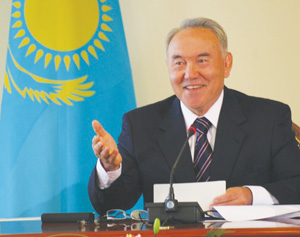
    An ex-Communist with visionary ideals, the President of Kazakhstan Nursultan Nazarbayev seems determined to democratise Islam, although not perhaps in the western style. Breaking the traditional Muslim mould of power-driven dynastic autocracy that featured until very recently in all the Muslim caliphates, he recently rejected a referendum that would give him a further ten years in office, and showed readiness to actually shorten the term of presidential office. He has initiated the People’s Assembly of Kazakhstan, which gives every ethnic group the right to take part in the decision-making congresses associated with the political, cultural and social activities of the country. And his attitude to women is also modern. Schools for girls are a priority, with attention given to getting girls into science and technology.

    The main thrust of Nazarbayev’s initiatives is clearly to bring into international dialogue the various divisive issues that press most heavily on the global community at present. Astana hosts a number of world congresses, including the World Federation of Neurosurgical Societies and a World Conference on Disarmament, while the First Almaty Economic Business Forum may be held in Astana in 2012. But the President’s chief initiative remains one that first materialised in 1992, soon after Kazakhstan’s independence from the Soviet Union. In 2003 the Congress of the Leaders of World and Traditional Religions was held with great success in Astana, and again in 2006 and 2009. Emphasis was laid on the principles that bind religions together rather than those that separate them.

    In October 2010 the World Forum for Spiritual Culture, intended for a more general interdisciplinary gathering, was held in Astana, again chaired by the Kazakhstan President and imbued with the religious tolerance for which the ancient shamanic races of this region, such as the Mongols and also the Sufi orders, have long been famous.4 As the British scholar and philosopher Peter Kingsley notes, “It was no small practical achievement for the Mongol Khans to transform into a major institution the long-standing Central Asian custom of convening formal gatherings made up of representatives from different religions so they could openly discuss their beliefs on an equal footing instead of just killing each other.”5

    According to the same open principle, high-level representatives from about seventy-five countries, “from all cultures, ‘cults’ and worldviews,” attended the historic gathering in Astana. In his Conference report on the International Forum for Peace through Culture, Augustat stated that the world initiative launched by Kazakhstan’s President is based on non-violence, harmony and cooperation between nations. “The core problem of our present time is formed of lethargy, extreme egoism, greed, corruption, purely materialist thinking and so forth – all of which have to be exchanged for real human values.”6

    Similar world gatherings to those in Kazakhstan are of course being held elsewhere, for example in Turkey and Australia very recently. But the key objective of the Executive Committee of Spiritual Culture as proposed by President Nazarbayev strikes another new and even more revolutionary note. It aims at nothing less than the furtherance of an integration of science, socio-politics and religion in one overarching transcendental order. As Kingsley notes, from the very earliest times but now long lost, this idea of a comprehensive divine whole uniting all that exists was also a core principle of the philosophy of central Asian shamanism from which the Sun religion directly emerged, and in which there was a constant overlapping of “spirituality and science, mechanical ingenuity and philosophy, mysticism and military expertise,”7 as well as poetry, gnosis and politics.

    Consequently, one of the most important highlights that came out of the Kazakhstan World Forum, notes Augustat, is the awareness of the necessity of a synthesis of the political and spiritual-cultural as well as scientific spheres in society, and the gradual overcoming of their present entrenched separation. This very postmodern approach, which even today is entertained by only a minority of western thinkers as the necessary basis for a more enlightened world civilisation, characterises the Kazakhstan Executive and raises the interesting question: where is this intellectual initiative coming from? What hidden metaphysical influence is at work here?

    The Sacred Union of the East

    As we shall shortly see, President Nazarbayev’s is not the first attempt in modern times to reestablish in the Eurasian heartland a nation based on enlightened spiritual principles. Seventy years before the birth of the Kazakhstan nation a similar Buddhist attempt was essayed in the Altai in southern Siberia. Nazarbayev’s has been guided, it would seem, by a different star, a gnostic vision from a far more distant time; but nevertheless, the earlier attempt to establish a Buddhist New Country of New Russia in the Altai may well be seen as a rehearsal for Kazakhstan’s more ambitious Muslim experiment.

    After the 1917 Revolution in Russia, says Znamensky, Communism took on a religious quality “typical of religious revitalisation movements in tribal societies.”8 In his book Red Shambhala, he reveals the underground occult agenda of a visionary Russian clique working within the very core of the new Bolshevik State to bring about a political condition impregnated with the Buddhist wisdom of Shambhala. Inspired by Buddhist prophesies, this clandestine group active within the Soviet Secret Police believed that the social ideals of Communism were compatible with those foretold of the Buddha Maitreya, the One to Come, and that with the amalgamation of the two a glorious mystical era of Communism would result that would benefit the whole world. So persuasive was this vision that for a while the movement gathered many Communist adherents, and indeed was to be destroyed only by the later Stalinist purges. But not before a number of expeditions were either planned or actually sent forth from Russia and elsewhere in eastern Europe, with the intention of finding the fabled kingdom and embracing its immortal teachings.

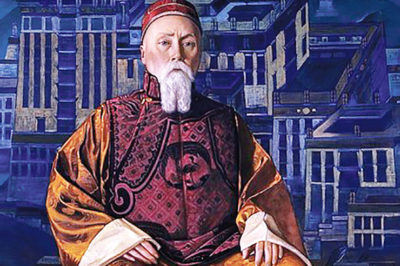
    One of these expeditions – and the most celebrated – was launched from New York by the painter Nicholas Roerich and his wife Helena, White Russian emigres to America and passionate converts to the new Theosophical teachings promulgated by another Russian, Helena Blavatsky. Nicholas established a Master art school in New York and Helena, a mystical clairvoyant, channelled guidance from Masters Morya and Koot Hoomi, the same Mahatmas whom Blavatsky had claimed as her unseen Adepts and spiritual mentors a few decades earlier. (According to recent research, these two Masters were most probably Hindu and Sikh Indians, presumably high initiates in their respective religions.)9 The Roerichs were also strongly influenced by the shamanic teachings and legends of Shambhala that had been trickling into Russia from Russian expatriates in southern Siberia for the past hundred or so years; and in 1923, at the behest of the Master Morya and under his continual guidance, the Roerichs set out for central Asia on an arduous odyssey to find the wondrous kingdom.

    Behind the ostensible reason for the expedition was a hidden agenda of the greatest import, which Master Morya impressed on them was the additional meaning of the prophesy of Shambhala. Shambhala, he said, was “not only the abode of mystical Buddhist learning, it was the guiding principle of the coming cosmic age.”10 Its further meaning would unfold in the establishment of a sacred New Country, a New Russia in the Altai, a mountainous country in southern Siberia lying at the intersection of Mongolia, Kazakhstan and Tibet. There the Roerichs were to found the New Country on the highest Buddhist principles. It was to be governed at a spiritual level by the exiled Tibetan Panchen Lama – whom they were commissioned to find somewhere in Mongolia and bring back to the Altai – and on an administrative level by Nicholas himself, who sometimes wore the robes of the Tibetan Dalai Lama.

    According to Znamensky, the Roerichs envisaged in the Altai a utopian theocracy composed of “a commonwealth of people who would live a highly spiritual life and work as a cooperative – the economic foundation of this new state.”11 In fact the New Country was to be nothing less than a unification of all Inner Asian peoples into a spiritual kingdom. Thus would be established the Sacred Union of the East.

    The project failed. It was naïve, ill-conceived and geopolitically ignorant. The Panchen lama, at that time enjoying a profligate lifestyle in Mongolia, was not interested in the New Country. And visiting Soviet Russia to elicit support for their Great Plan, the Roerichs received only a cautious and limited response from the government while antagonising all the other great powers – Japan, America, Britain and China – at that time mutually competing to gain access to the riches of central Asia. Nicholas and his son George made a further attempt to materialise the Masters’ plans in 1937, but this attempt too failed, and having earned the fury of Franklin D. Roosevelt, the then president of the US who saw their endeavours as a betrayal of US interests, the Roerichs were obliged to retire to India for the rest of their lives.

    Nevertheless, we can glimpse in the Roerichs’ Altaic project a foreshadowing, a rehearsal or preliminary model of what is presently happening in neighbouring Kazakhstan. But there are significant differences. For one thing, and an important one, in the Buddhist venture Nicholas Roerich laid no discernible emphasis on interdisciplinary unification, a reform of the utmost importance to Kazakhstan’s President. Nor is there any indication that Nazarbayev draws to any degree on the mythology of Shambhala. Indeed the warlike outlook that lurks behind the Altaic venture and plays such a large part in the Buddhist prophecies of Shambhala – leading Nicholas and Helena to regard themselves as “Shambhala warriors” – is entirely absent from Nazarbayev’s idealistic programme. To trace the bond that does undoubtedly seem to exist between these two regional ventures seventy years apart, we must delve more deeply into the nature of the ancient spiritual hierarchy that lies at an even more hidden level beneath Shambhala’s folk mythology.

    The Rising Sun in Asian History

    What then is the source of Kazakhstan’s unusual and potentially revolutionary geopolitical objectives? To find a precedent for them we have only to turn back to the great days of the Sun religion that peaked during the third millennium BCE.

    As the Solar impulse spread globally into a honeycomb of separate national cults, each with its own sacerdotal hierarchy, the priesthoods of low rank, concerned mainly with ritual and dogma, separated out, everywhere dissolving into polycentric and insular attitudes towards each other, very much in the modern divisive manner. But in the higher prophetic ranks we find a counterbalancing trend of a quasi-clandestine nature that preserved the original unicentric Solar policy, even to maintaining an overseeing brotherhood with its headquarters remaining in Central Asia.

    In this way, by preserving their cohesion the prophets contributed an underlying unity and strength to society that universally balanced the equally divisive tendencies of popular religion. A hierarchic philosophy in the higher Solar echelons balanced a democratic one in the lower, leading to a spirit of accord and international harmony unprecedented to this day, yet at the same time allowing ideological differences to flourish creatively in the lower levels of the religion.

    Furthermore, these higher-ranking adepts were men and women of learning as well as spirituality; sages, but also astronomers, engineers, scientists, doctors and architects, who combined the various secular disciplines at all times with their metaphysical interests. Even as the Earth and the stars of the firmament were seen as related elements of one transcendental order, so that divine Whole was believed to be inclusive of, and to bring into relationship all areas of human knowledge, whether they be religious, psychosocial or physical. Two famous historical figures who fall into this category are Visvakarma of the Arunachala temple in India, a renowned expert in geometry and number, and Imhotep, ancient high priest of Heliopolis in Egypt, an engineer and architect who famously built the step pyramid at Saqqara. By means of this policy of multidisciplinary integration which brought together at all levels the opposite poles of human knowledge, those of the spiritual and natural orders, societies were unified at a high overall level, but without stifling the creative potential that lies in the challenges of diversity and opposition.

    Thus it was the operation of the two key principles of religious tolerance and multidisciplinary unity maintained in a high state of ideological tension that, while they lasted, rendered the Sun religion the greatest civilising force the world has ever known. But in time, as the initial impulse spread ever more widely throughout the Old and the New Worlds and discord inevitably increased, the religion increasingly found expression in various more esoteric orders bearing different names but inherently the same liberal principles. One of these orders was the international Order of Melchizedek, widely believed to be involved in the beginning of all three Semitic religions, Judaism and Christianity as well as Islam.

    Melchizedek, king of Righteousness, is a mysterious figure who threads his way through the Hebrew Bible as high priest in perpetuity of the Canaanite Sun God El-Elion. He is said within occult circles to head a Righteousness Order whose secret headquarters, even to the present day, preserve in the mountains of central Asia an organisation of great antiquity and influence in religious affairs with branches in many countries and throughout many epochs. Superior to any local cult or priesthood and steeped in the wisdom of shamanic gnosis, the order claims to be, like the Sun religion, an underground spiritual stream, itself invisible and timeless, from which all our disparate belief systems ultimately stem.

    In Genesis (14-18) Melchizedek initiates the prophet Abraham, the ancient ancestor of all the Semitic tribes, into the Solar worship of God Most High after Abraham had defeated a coalition of kings. “And Melchizedek, king of Salem, caused bread and wine to be brought; and he was priest of God Most High (El Elion). And he blessed Abram, saying: ‘Blessed be Abram, he of God Most High, possessor of Heaven and Earth; and blessed be God Most High who has delivered your enemies into your hands’. And Abram gave him the tithe of all he had taken.” As the esotericist René Guénon notes, “the whole episode enacts a true ‘investiture’, almost in the feudal sense of the word, but with the difference that it is a spiritual investiture, wherein is found the exact point of union between the Hebraic and the great primordial tradition.”12 As a consequence of the rite Abram acquired the new name of Abraham.

    Andrew Welburn, a Fellow of New College, Oxford, suggests a continuity throughout history of the rites of the Israelite kings and the older Mystery practices connected with the ancestral king and high priest of the Sun God El.13 Thus, Welburn says, since Judaism was primarily a lunar religion, these Solar initiations would have been strictly esoteric Mystery events. The Letter to the Hebrews (5-6) in the New Testament implies a similar distinction in Christianity, for the writer, Apollonius of Alexandria, declares that Jesus Christ too has been given the office of high priest of God Most High. Here, says Welburn, we meet again the old Canaanite priest-king Melchizedek, who was so central to Essene and Gnostic teachings and whose name is linked to the hidden Solar symbolism that runs through the lunar religion of Judaism.14

    In the case of Islam, although Muhammad’s Arabic Qraiysh clan was the only one to have abstained from polytheism and remain loyal to El, the traditional High God of the Arabs whom Muhammad called Allah,15 the connection with the Melchizedek Order is not as direct as in Judaism and Christianity: yet it is there. Although nowhere stated in the Koran, not only would Muhammad therefore have come automatically under the tutelage of El’s high priest Melchizedek, but also it is an Arabic tradition that Abraham, as the first of Islam’s prophetic lineage passed the wisdom he had received from Melchizedek down the line to the prophet Muhammad and his Islamic reformation. And there in Islam it was preserved by the Sufis, a spiritual order that had existed long before Islam.

    In The People of the Secret, the Sufi author Ernest Scott elaborates the idea that Sufism, which he says originated in northern Afghanistan, shares a common origin with other ancient religious forms.16 Like the Sons of the Sun and the Righteousness adepts, the Sufis were direct heirs of neolithic shamanism and more than any other religious system of the day carried forward the two key principles of the Sun religion. For a time Sufism became a powerful democratic influence wherever Islam spread, constellating especially along the Afro-Eurasian “hinge” referred to by Tiberio Grazianhi.

    As a consequence, by the eleventh century CE the Sufis had welded Islam into the greatest force for civilisation at that time known. Active behind the various national caliphates, they resurrected Greek knowledge at a time of calamitous cultural decline in the West and extended to western powers friendship and learning in equal measure. For centuries the Sufis ensured that Jews, Christians and Muslims lived at peace with each other, extending the boundaries of knowledge and together rebuilding the cultural wealth that had been lost after the demise of the Roman empire. And Sufism also ensured that in the Fatimid caliphate of the eleventh century a mosque became the first university in Islam in which theological expertise united with that of chemistry, astronomy and medicine, mathematics and geometry in an overall metaphysic of great intellectual force.

    There can be no doubt whatever that this underground Sufi input, even in a time of greatest Muslim intolerance towards it, still operates clandestinely along the Afro-Eurasian “hinge.” But it is in Kazakhstan that it is arguably causing what may well become a fully flowering Muslim cultural renaissance of the highest order, a rising of the Sun of gnosis which will affect the whole of Islam.

    In President Nazarbayev’s gatherings of eminent representatives of all the religions on Earth, and in his insistence on bringing together the various spiritual and scientific disciplines in one comprehensive embrace, something quite unique may be happening in Central Asia that will have important consequences for the peace and harmony not only of Islam but of the rest of the world.. This is a time of critical challenges and perhaps only time will tell.

    [alert type=”general” dismiss=”no”]This article was published in New Dawn Special Issue Vol 6 No 1.[/alert]

    [alert type=”success” dismiss=”no”]If you appreciate this article, please consider subscribing to help maintain this website.[/alert]

    Footnotes

    1. From Wilhelm Augustat’s Report on Astana World Forum of Spiritual Culture International for New Dawn 126, May-June 2011, 4.

    2. Ruth A. Drayer, Nicholas and Helena Roerich, Quest Books, Illinois, 2005, 84.

    3. A. Znamensky, Red Shambhala, Quest Books, Illinois, 2011, xii.

    4. Peter Kingsley, A Story Waiting to Pierce You, The Golden Sufi Center, California, 2010, Note 29, 162.; also J.G. Bennett, The Masters of Wisdom, London, 1977, 145, 150.

    5. Ibid., 163.

    6. Wilhelm Augustat, op. cit., 4.

    7. Kingsley, op. cit., 155.

    8. Ibid., 104.

    9. K. Paul Johnson, The Masters Revealed, State University of New York Press, 1994, 5-6.

    10. Drayer, op.cit., 84.

    11. Znamensky, op. cit., 166.

    12. René Guénon, The Lord of the World, Coombe Springs Press, London, 1983, 33.

    13. Ibid., 127.

    14. Ibid., 124.

    15. Jay Weidner & Vincent Bridges, The Mysteries of the Great Cross of Hendaye, Destiny Books, Vermont, USA, 2003, 102.

    16. Ernest Scott, The People of the Secret, Octogon Press, London, 1983, 191.

    © New Dawn Magazine and the respective author.
    For our reproduction notice, click here.

  • Red Star Over Shambhala: Soviet, British and American Intelligence & the Search for Lost Civilisation in Central Asia

    Red Star Over Shambhala: Soviet, British and American Intelligence & the Search for Lost Civilisation in Central Asia

    From New Dawn 109 (Jul-Aug 2008)

    On his way across the wastes of Mongolia in 1921, Polish writer and refugee Ferdinand Ossendowski witnessed some strange behaviour on the part of his Mongol guides. Stopping their camels in the middle of nowhere, they began to pray in great earnestness while a strange hush fell over the animals and everything around. The Mongols later explained that this ritual happened whenever “the King of the World in his subterranean palace prays and searches out the destiny of all people on Earth.”1

    From assorted lamas, Ossendowski learned that this King of the World was ruler of a mysterious, but supposedly very real, kingdom, “Agharti.” In Agharti, he was told, “the learned Panditas [masters of Buddhist arts and sciences] write on tablets of stone all the science of our planet and of the other worlds.”2 Whoever gained access to the underground realm would have access to incredible knowledge – and power.

    Ossendowski was not exactly a casual listener. As noted in a previous article [The “Bloody” Baron von Ungern-Sternberg: Madman or Mystic?, New Dawn No. 108 (May-June 2008)], during 1921 he would become a key adviser to “Mad Baron” Roman von Ungern-Sternberg who established a short-lived regime in the Outer Mongolian capital of Urga.3 A self-proclaimed warrior Buddhist who dreamed of leading a holy war in Asia, the Baron allegedly tried to contact the “King of the World” in hopes of furthering his scheme.

    Ossendowski’s credibility later was assailed by the likes of Swedish explorer Sven Hedin.4 Among other things, Hedin accused the Pole of plagiarising the story of Agarthi from an earlier work by French esotericist Joseph Alexandre St.-Yves d’Alveydre.5 To one extent or another, that probably was true, but Hedin, a veteran seeker after lost cities, did not dismiss the possibility of a hidden Kingdom; indeed, he likely harboured the aim of finding it himself.

    In any event, Ossendowski did not invent the story of a fabulous land secreted somewhere in – or under – the vastness of Central Asia, be it called Agharti, Agarttha, Shangri-la, or, most commonly, Shambhala.6 Some believed it to be a physical, subterranean realm inhabited by an ancient, advanced race, while to others it was a spiritual dimension accessible only to the enlightened. The Shambhala legend is firmly grounded in Buddhist tradition which vaguely puts the Kingdom somewhere to the north of India. The legend also proclaimed that a time would come when the King of Shambhala and his mighty hosts would come forth to vanquish evil and usher in a golden age guided by pure Dharma. As noted, Baron von Ungern-Sternberg envisioned himself as the initiator of this “Shambhala War.” So would others.

    The tantalising possibility of a hidden trove of advanced knowledge and technical know-how did not just pique the curiosity of explorers and occultists. The practical advantages to be gained by accessing and exploiting such knowledge was not lost on certain politicians and intelligence officers, above all in Soviet Russia. But whatever attracted the attention of the Bolsheviks was bound to draw British curiosity as well, and where both those powers were concerned, the Americans, Germans and Japanese were unlikely to be far behind.

    This article focuses on the activities of three men, two Russians and one American: Aleksandr Vasil’evich Barchenko, the so-called “Bolshevik professor of the occult,” the artist-mystic-explorer Nicholas Roerich, and the man often cited as the real-life model for Indiana Jones, Roy Chapman Andrews. While, so far as can be told, none of the trio ever met, all were involved with expeditions roaming the deserts of Mongolia and the high valleys of the Himalayas in search of lost civilisation and ancient man. In the case of Barchenko and Roerich, the specific object was Shambhala. As we will see, these explorations were only the tip of a clandestine iceberg of intrigue and hidden agendas which included secret societies and a host of spies. Just who was doing what for whom – and why – remains uncertain.

    “Bolshevik professor of the occult” Aleksandr Barchenko

    A.V. Barchenko was born in Elets in 1881 and manifested an early interest in the “paranormal.” Part occultist, part scientist, part explorer, and maybe just a bit of a charlatan, Barchenko was, above all, a seeker. His interests came to focus on recovering the lost knowledge of a prehistoric civilisation, remnants of which he thought might still survive. It was in medical school, c. 1901-1905, that Barchenko gravitated to Masonic and Theosophist circles and their esoteric doctrines. One of his professors was acquainted with the above Saint-Yves d’Alveydre, and so introduced his pupil to the legend of Agarttha/Shambhala.

    D’Alveydre’s works also promoted the mystical-political doctrine of Synarchy, a system supposedly perfected by the denizens of the hidden Kingdom. Loosely defined, Synarchy signifies “rule by secret society” or enlightened elite. In the late 19th century, the idea was picked up by yet another French occultist, Gerard Encausse, better known as Papus, who combined it with another mystical current, Martinism, to form the quasi-Masonic Ordre Martiniste et Synarchie.7 During 1900-1905, Papus visited Russia where he established cells of his new order and even recruited members among the Romanovs.8 More intriguing are suggestions that Papus simultaneously functioned as a French “agent of influence” to counter German intrigue among the Russian elite and, more secretly, to foster social revolution. One associate of Papus later claimed that Martinism was the “germ of Sovietism.”9

    Prior to World War I, Barchenko embarked on a career as journalist and writer. At the same time, he joined the Martinist Order and the “Kabbalistic Order of the Rose & Cross.”10 His ever-widening interest in the occult came to include palmistry, the Tarot, alchemy, hypnosis, “radiant energy,” astrology and mind-reading. In 1911 he wrote an article for Priroda i liudi (“Nature and People”) on “thought transference.”11 His literary outpourings included two “fantastic” novels, Doktor Chernyi (“Dr. Black”) and Iz mrak (“From the Darkness”). His literary alter ego, Dr. Aleksandr Nikolaevich Chernyi, had spent years in India and Tibet studying arcane knowledge at the feet of mysterious mahatmas. Barchenko dreamed of doing the same.

    After brief service in World War I, Barchenko returned to Petrograd (the renamed St. Petersburg) where he moved deeper into occult circles. One self-proclaimed master of Eastern mysticism who frequented Petrograd in this period was George Gurdjieff. Whether Barchenko had direct contact with him is uncertain, but he was well-versed in Gurdjieff’s teachings and the two would be linked in curious ways in the years ahead.

    While Barchenko welcomed the overthrow of Tsar Nicholas in 1917, he was not enamoured of Lenin’s Bolsheviks. Still, to earn a living in the post-October environment, he began giving lectures on esoteric subjects to the revolutionary sailors of the Baltic Fleet. He used Shambhala as an example of a “primeval communist society,” which had been part of a prehistoric “great universal federation of peoples.”12 Such Bolshevik-sounding sentiments contrasted with his more private affiliations. In the “Sphinx” society, Barchenko associated with Martinists, Theosophists and “Christian pacifists” who were out-and-out enemies of Soviet power. He later confessed that the group harboured “conspiratorial quarters of the White Guards” and connived with militant anti-Bolsheviks such as Boris Savinkov.13 Savinkov, in turn, actively conspired with British and French agents, among them Ace-of-Spies Sidney Reilly who helped concoct an abortive effort to overthrow Lenin in the summer of 1918.14

    One result of that failed plot was the “Red Terror,” a wave of bloody reprisals spearheaded by the Bolshevik secret police, the Cheka. So, when Barchenko received a summons to the office of the Petrograd Cheka (P-Cheka) in the fall of 1918, it was an ominous sign. However, he found there a cadre of fellow Martinists and students of the occult who had no interest in shooting him as a counter-revolutionary.15

    The most important of these chekisty was Konstantin Konstantinovich Vladimirov, a self-described “psychographologist” who would do much to promote Barchenko and his ideas within the Soviet establishment. On the surface, it would appear that Vladimirov recruited Barchenko as an informer in occult circles, but things may not have been so simple.

    Vladimirov’s own loyalties are questionable. He soon was involved in the case of two Britons, Harold Rayner and G.H. Turner, arrested for supposed involvement in the August 1918 assassination of the chief of P-Cheka, Moisei Uritsky. The actual gunman was a follower of the above Boris Savinkov. Even more interesting, Vladimirov and comrades apparently nabbed the wrong men. Then, instead of being executed, one somehow managed to evade proletarian justice and make it back to England.
    Finally, Vladimirov became romantically involved with the widow of the second Englishman, a woman also identified as a British spy. As a result, he found himself booted from the Cheka, but somehow managed to get himself reinstated. However, in 1927 Vladimirov was again arrested and ultimately shot as an English spy, exactly as his protégé Barchenko would be a decade later.16 So, did Vladimirov recruit his fellow occultist to spy for the Cheka in 1918, or was he even then a British agent who enlisted the like-minded Barchenko into another, more secret conspiracy?

    One more twist is that some insist Vladimirov was identical with another clandestine operative, Yakov Blumkin.17 That they were one and the same is demonstrably untrue, but Blumkin and Vladimirov did move in the same murky circles in 1918. Through those same circles, Blumkin also came to know Barchenko. Thus, there is reason to suspect, if no more, that Blumkin was another British double-agent. As a supposedly renegade chekist, he assassinated the German ambassador in Moscow in July 1918. Nevertheless, like Vladimirov, he soon found his way back into the good graces of Soviet intelligence. A year after Vladimirov’s demise, however, Blumkin would stand before a firing squad as a Trotskyite conspirator.

    Barchenko also found friends in Soviet academia. With such backing, during 1921-22, he led an expedition to the remote Kola Peninsula, north of the Arctic Circle, where he found ancient petroglyphs and megalithic structures.18 This reinforced his belief in an advanced prehistoric civilisation linked to mysterious Shambhala.
    As early as 1920, Barchenko sought permission to mount a “scientific-propagandistic” expedition into Mongolia and Tibet to search for “Red Shambhala.”19 Recovery of its ancient science and wisdom, he argued, would expand Moscow’s influence throughout Asia. This early lobbying came to naught, though it may have influenced Moscow to dispatch two Baltic sailors, Barchenko’s former “pupils,” on a secret mission to Tibet in the early 20s.20

    At the same time, Barchenko founded a “Masonic” lodge dubbed the Edinoe Trudovoe Bratstvo, ETB, or the “United Labor Brotherhood.” The new Brotherhood included Vladimirov and numerous other current or former chekists. Closely associated with the ETB, if not a formal member, was Yakov Blumkin, back in the saddle as a special agent of Soviet intelligence.

    The Lodge’s name bears a curious resemblance to an earlier group formed by Gurdjieff’s followers, the Edinoe Trudovoe Sodruzhstvo (“United Labor Fellowship”), and at least one prominent member of ETB, P.S. Shandarovskii, was a devotee of Gurdjieff.21 Another link may have existed through Soviet sculptor Sergei Merkurov, who was Gurdjieff’s cousin.22 Interestingly, Gurdjieff had alleged ties to British intelligence, including the charge that he had for years served as a British asset in Central Asia and the Near East.23 What is undeniable is that among Gurdjieff’s pupils in pre-Revolutionary Russia was English composer Sir Paul Dukes, a man whose interests included not only Gurdjieff, but also esoteric Buddhism and Tibet. Dukes joined MI1c (MI6) during World War I and for much of 1919 headed the British spy network in Petrograd.24 Could Barchenko and Vladimirov have been linked to this?

    By far the most important brother of the ETB was chekist bigwig Gleb Ivanovich Bokii. Bokii, a veteran Bolshevik, had an equally venerable involvement in the occult. Among other things, he was a pre-Revolutionary member of the “Kabbalistic Order of the Rose & Cross.” Curiously, his advancement in that Order was approved by none other than Aleksandr Barchenko.25 More curious still, Bokii took over the P-Cheka after Uritsky’s death and was running the show when Barchenko was “recruited” in late 1918. Nevertheless, both men later swore that they never met until the early 1920s. Bokii would confess that for him the Revolution died with Lenin in early 1924. Growing disillusionment led him to oppose Stalin and to support Barchenko’s schemes, schemes that, he admitted, included espionage.26

    By 1924, Bokii sat in control of the OGPU’s (the renamed Cheka) Spetsotdel, or “Special Department.” This outfit handled codes and included an elite outfit, the 7th Section, which delved into paranormal issues ranging from hypnotism and ESP to the Abominable Snowman.27 The Spetsotdel also guarded the so-called “black dossiers,” the personal files of the Soviet leaders which included sexual kinks and, undoubtedly, any association with things occult.28

    Besides personal curiosity, Bokii had practical incentive to pursue paranormal research. Telepathic communication offered a perfect means to send and receive messages from agents abroad. Likewise, what we today call Remote Viewing offered the ability to spy on the imperialist enemy without leaving Moscow. Unlocking the secrets of hypnotism and mind control had potential application in propaganda. To explore such matters, Bokii put Barchenko in charge of a special “neuroenergetics” lab within the All-Union Institute for Experimental Medicine.29

    Still, the primary aim of Barchenko and the ETB was establishing direct contact with Shambhala. To this end, he exploited Bokii’s help and made common cause with other esoteric groups, most notably the “Great Brotherhood of Asia.” He connived with at least two members of the Brotherhood, a Tibetan lama, Naga Naven, who claimed to be a direct representative of Shambhala, and a Mongolian official, Khayan Khirva, future chief of the Mongolian secret police.30 In that role, Khirva would work side-by-side with Yakov Blumkin.

    In the spring of 1925, thanks to Bokii’s access to secret funds, the Shambhala expedition seemed set to go. Bokii picked Blumkin to head the expedition’s secret intelligence angle.31 But the plan ran into opposition. Dark rumours painted Bokii as a dangerous degenerate who drank human blood.32 A leading opponent was Mikhail Trilesser, head of the OGPU’s foreign intelligence branch (INO). He naturally felt that any activity outside the USSR fell into his bailiwick. By summer, Barchenko’s Shambhala expedition was dead. Or was it?

    In September 1925, a humble Muslim pilgrim crossed the Pamir passes into British-controlled Kashmir. In fact, the pilgrim was Yakov Blumkin who was on his way to even more remote Ladakh to rendezvous with an expedition led by Nicholas Roerich. Roerich’s aim was to enter Tibet and contact Shambhala. However, soon after crossing the frontier, tribal police seized Blumkin. Apparently, someone had tipped-off the British. The crafty chekist soon gave his captors the slip, and assuming a new guise as a Mongol lama, pressed on towards Roerich. Anyway, that is how Blumkin later told the story. There could be another explanation. The brief arrest and fortuitous escape also gave Blumkin convenient cover to check-in with British intelligence prior to joining Roerich.

    Russian Painter, Theosophist and Philosopher, Nicholas Roerich

    Born in St. Petersburg in 1874, Nicholas (Nikolai) Konstantinovich Roerich is best known today as a painter and tireless advocate of Yoga and Buddhism in the West. He definitely was a Theosophist and probably a Martinist.33 He also became a secret Soviet agent-of-influence. Some of his admirers vociferously dispute this, and it may be true that Roerich used the Bolsheviks as much as they used him. Nevertheless, his ties to Soviet intelligence are too extensive to be denied.34
    By the time the Revolution hit Russia, Roerich had left the country, and he initially showed no interest in the Great Socialist Experiment. By 1920, he was in London where he joined the local Theosophist scene dominated by Annie Besant. Besant and her followers were outspoken supporters of Indian independence which brought them under the scrutiny of British security. By the early 20s, Moscow had become the main benefactor of anti-British agitation in Asia and in the view of MI6’s Desmond Morton (later one of Churchill’s most trusted spies) “nearly all these theosophist and theosophical societies are connected in some way with Bolshevism, Indian revolutionaries and other unpleasant activities.”35

    Roerich came to see British influence over Tibet as an evil he must combat, and during 1920 other things pushed him further towards Moscow. Roerich’s wife Elena (Helene), a medium, began receiving messages from an entity calling himself Master Morya, or Allal Ming, who claimed to be a member of the Great White Brotherhood and “spiritual teacher of Tibet.”36 Allal Ming convinced Roerich that he was the key to the fulfilment of a “Great Plan” which would end with creation of a vast, pan-Buddhist state that would encompass Tibet, Mongolia, parts of China, and much of Siberia. The first stage would be the “Shambhala War,” the end result of which would be the “earthly expression of the Invisible Kingdom of Shambhala.”37 The Plan is virtually identical to the one envisioned by Baron Ungern at almost the same time. However, whereas Ungern aimed to build his New Order by making war on the godless Bolsheviks, Roerich’s guide encouraged him to see the Soviets as allies and Lenin as a harbinger of a new, enlightened age. Perhaps the King of the World was hedging his bets.

    At the same time, Roerich acquired a new follower in the person of a young Russian Theosophist, Vladimir Anatol’evich Shibaev. Shibaev also happened to be an agent for the Communist International (Comintern) working with Indian nationalists. He introduced the Roerich’s to other Soviet officials and encouraged their plans to move to India as a first step in realising the Great Plan. London’s MI5 kept a close eye on Shibaev and his dealings with Roerich.38

    The Roerich’s moved to New York in October 1920. They thus evaded the hostile scrutiny of British authorities and secured support among wealthy Americans. One such benefactor was Wall Street broker Louis Levy Horch who helped found the Roerich Museum and became the Mystic’s financial manager and mainstay. Naturally, Horch, too, had a secret life. A successful businessman with important connections in American politics, he also was an underground operative for the Cheka/OGPU.39

    The Roerich’s next relocated to Darjeeling, India in late 1923. This put them under the watchful eyes of Frederick Marsham Bailey, the British “political resident” in nearby Sikkim, and a man intimately familiar with Russian activities in Central Asia.

    In spring 1925, Roerich was ready to launch his expedition into the Himalayas and beyond. The synchronicity with Barchenko’s plan seems more than coincidental and doubtless had something to do with the scuttling of that effort. Travelling under the American flag and backed by Yankee money, Roerich had the advantage of not being a blatant Soviet cat’s paw. Still, it is interesting that Bokii’s and Barchenko’s pal Blumkin should materialise at Roerich’s side. Whatever his connection to the British, did Blumkin maintain communication with his friends back in Moscow? Regardless, he and Roerich would roam the fringes of Tibet (never reaching Lhasa), and press on into Sinkiang and Mongolia. There was even time for a side-trip to Moscow where Roerich hob-nobbed with more Soviet officials. In fact, his expedition was Moscow-managed from beginning to end, whether Roerich fully realised it or not.

    That fact was not lost on the British. During this period, MI6 monitored Red activities in Asia through one of its men in the Moscow embassy, Arthur V. Burbury. In 1928, persons in London concluded that Roerich had been “illuminated” as to the “excellence of the Union of Soviet Socialist Republics.”40

    Real-Life Model for Indiana Jones, Roy Chapman Andrews

    In contrast to Barchenko and Roerich, American Roy Chapman Andrews had no obvious interest in the occult and paranormal.41 Of course, given his curiosity about natural mysteries, he must have harboured a little about supernatural ones. Born in Wisconsin in 1884, Andrews evidenced an early lust for knowledge and adventure. By World War I, he had acquired a degree from Columbia University, membership in the exclusive Explorer’s Club and employment at the American Museum of Natural History (MNH).

    His early explorations took him to China, which doubtless accounted for a new assignment that came his way in 1918. He travelled as a “naturalist” but he was really an officer of the US Office of Naval Intelligence (ONI) assigned to the American Legation in Beijing.42 Befitting a good spy, Andrews was subsequently very mum about what he did there, but he made at least two “reconnaissance” trips into turbulent Mongolia, visiting its capital of Urga (where Baron Ungern would soon take charge) and venturing into Siberia where the Russian Civil War raged.43 Andrews subsequently compiled a map of the “Southern Boundary Region of Asiatic Russia” which found its way to the US Army’s Military Intelligence Division (MID).44 In his travels, did Andrews hear the same whispers of Agharti/Shambhala that reached the ears of Ossendowski, Roerich, and Barchenko?

    Andrews left the Navy in the spring of 1919, but no sooner did he return to the States that he offered his services to the Army’s MID. His former boss in Beijing, US Naval Attaché Commander I.V. Gillis, vouched for Andrews as someone “who in case of emergency could be depended upon to do work with required skill and nerve,” and a colleague at the Museum of Natural History assured MID that Andrews was the “only American who is at all familiar with Mongolian.”45

    Between 1922 and 1930, Andrews led five expeditions into the Gobi Desert and adjoining regions of Mongolia. All were sponsored by the MNH and made notable fossil discoveries, including the first dinosaur eggs. However, the original goal of the explorations was not animal fossils, but evidence of early man. Andrew’s boss at the Museum, Henry Fairfield Osborn, was convinced that the origins of the human race lay somewhere in Eastern or Central Asia. Some of his theories echoed those of the Theosophists, or so thought the Theosophists.46

    From our perspective, the most interesting of Andrews’ forays was the one that commenced in early 1925 and took him and his companions deep into western Mongolia. The “mapmaking” team consisted of a US Army officer, Lt. Fred Butler, and a British officer, Lt. H.O. Robinson, detached from His Majesty’s Legation in Beijing.47 Butler’s later report also went to MID.48

    Andrews might have gleaned information about Roerich’s activities from another explorer then roaming the wastes of Central Asia, Ossendowski’s nemesis, Sven Hedin. The Swede told Andrews that his expedition was a “reconnaissance” of a projected Lufthansa air route across Central Asia to Beijing, but it may have been something more.49In any case, Andrews dutifully reported his conversation with Hedin to MID.

    In the end, Shambhala remained hidden, or so it seems. Roerich and Andrews went on to live out full lives and pass on, respectively, in 1947 and 1960. Barchenko, Bokii and the brethren of ETB were not so fortunate. All perished in the purges of the late 1930, condemned for crimes they did not – or did – commit.

    [alert type=”general” dismiss=”no”]This article was published in New Dawn 109.[/alert]

    [alert type=”success” dismiss=”no”]If you appreciate this article, please consider subscribing to help maintain this website.[/alert]

    Footnotes

    1. Ferdinand Ossendowski, Beasts, Men and Gods (New York: E. P. Dutton, 1922), 300.
    2. Ibid., 311.
    3. Richard Spence, “The ‘Bloody’ Baron von Ungern-Sternberg: Madman or Mystic?” New Dawn, No. 108 (May-June 2008), 31-36.
    4. Sven Hedin, Ossendowski und die Wahrheit (Leipzig: Brockhaus, 1925).
    5. Joseph Alexandre St.-Yves d’Alveydre, Mission de l’Inde (1910). D’Alveydre, arguably, was in turn influenced by two other works: Edward Bulwer-Lytton’s The Coming Race (1870) and fellow Frenchman Louis Jacolliot’s Les Fils de Dieu (1873).
    6. See, e.g., Jason Jeffrey, “Mystery of Shambhala,” New Dawn, No. 73 (May-June 2002), and Joscelyn Goodwin, Arktos: The Polar Myth in Science, Symbolism and Nazi Survival (Kempton, IL: Adventures Unlimited Press, 1996), 95-104.
    7. Ostensibly a school of mystical Christianity, Martinism takes its name from the 18th century French esoteric philosopher, Louis-Claude de Saint-Martin.
    8. Markus Osterrieder, “From Synarchy to Shambala: The Role of Political Occultism and Social Messianism in the Activities of Nicholas Roerich,” Paper presented at the conference on The Occult in 20th Century Russia, Berlin, March 2007, 11, n. 68.
    9. Ibid., 11, n. 67.
    10. Oleg Shishkin, Bitva za Gimalai ( Moscow: Eksmo, 2003), 31.
    11. Anton Pervushin, Okkul’tnyi Stalin (Moscow: Yauza, 2006), 133.
    12. Aleksandr Andreev, Okkul’tist Strany Sovetov (Moscow: Yauza/Eksmo, 2004), 101.
    13. Ibid., 74.
    14. On the intrigues of Reilly and Savinkov, see Richard Spence, Trust No One: The Secret World of Sidney Reilly (Los Angeles: Feral House, 2002), especially, Chapter Nine.
    15. Pervushin, 143-144.
    16. Andreev, 91.
    17. Aleksei Velidov, Pokhozhdeniia terrorista: Odisseia Yakova Bliumkina (Moscow: Sovremnik, 1998), 243.
    18. Pervushin, 144-152. The expedition centred on the region of Lovozero-Seidozero.
    19. Aleksandr Andreev, Soviet Russia and Tibet: The Debacle of Secret Diplomacy, 1918-1930s (Leiden: Brill, 2003), 108-109.
    20. Andreev, 101.
    21. Shishkin, 105-106.
    22. Ibid., 259.
    23. E.g., Peter Roberts, “Gurdjieff’s Origins,” www.promart.com/g.origins.html, (12 May 2008).
    24. See: Sir Paul Dukes, The Story of “ST 25”: Adventure and Romance in the Secret Intelligence Service in Red Russia (London: Cassell, 1938).
    25. Shishkin, 31.
    26. Protokol dopros [Interrogation] of Bokii, 18-18 May 1937, in Andreev (2004), 360-361.
    27. Shishkin, 177.
    28. Ibid., 367.
    29. Shishkin, 179, Pervushin, 171-173, and “Barchenko, Aleksandr Vasil’evich,” Liudi i sud’by, http://memory.pvost.org/pages/barchenko.html.
    30. Protokol dopros [Interrogation] of Bokii, 17-18 May 1937, in Andreev (2004), 354-355.
    31. Shishkin, 197.
    32. Ibid., 203.
    33. Osterrieder, 12 and n. 78.
    34. Ibid., 1 and n. 3, and Shishkin, passim.
    35. Gill Bennett, Churchill’s Man of Mystery: Desmond Morton and the World of Intelligence (Routledge: London, 2007), 72.
    36. Osterrieder, 2, 4 and n. 8.
    37. Ibid, 1.
    38. Shishkin, 48.
    39. Shishkin, 68.
    40. UK, Foreign and Commonwealth Office, notes on July 1928 exchange between India Office and Foreign Office.
    41. On Andrews, see: Charles Gallenkamp, Dragon Hunter: Roy Chapman Andrews and the Central Asiatic Expeditions (New York: Penguin Books, 2001).
    42. Andrews US Passport application, 18 June 1918.
    43. Gallenkamp, 72-73.
    44. US National Archives, Records of the Military Intelligence Division, MID, 10989-H-12/8, MID to George H. Sherwood, 20 Jan. 1922.
    45. MID, 2338-H-12/39, Report from N.A. China, 5 July 1921, and MID 2657-H-158/2, Clarence A. Manning to MID, 8 Nov. 1921.
    46. G. de Purucker, Theosophy and Modern Science, Pt. I [Reprint] (Whitefish, MT: Kessinger, 2003), 101.
    47. Gallenkamp, 188.
    48. MID, 2055-632-5, C of E to G2, 5 April 1926.
    49. MID, 2657-D-935/2, HA, 29 April 1927.

    © New Dawn Magazine and the respective author.
    For our reproduction notice, click here.

  • The Secret of Eurasia: The Key to Hidden History and World Events

    The Secret of Eurasia: The Key to Hidden History and World Events

    From New Dawn 68 (Sept-Oct 2001)

    Beneath the broad tide of human history there flow the stealthy undercurrents of the secret societies, which frequently determine in the depths the changes that take place upon the surface.
    – A.E. Waite1

    Have secret societies and occult brotherhoods been active behind the scenes of world events for thousands of years? Do these guardians of secret wisdom shape the growth of human consciousness and influence the destiny of nations? Are hidden masters of occult knowledge empowering and infiltrating certain political, cultural, spiritual and economic movements, in fulfilment of an ancient plan? Could it be that man’s great upheavals, wars, and revolutions, as well as his pioneering discoveries in science, literature, philosophy and the arts, are the result of a ‘hidden hand’? Can we decode history and find the mysterious interface between politics and occultism, thereby uncovering the real movers and shakers in our modern world?

    The German philosopher Oswald Spengler warned of a “mighty contest” between groups of men of “immense intellect” who the “simple citizen neither observes nor comprehends.” Back in 1930 Ralph Shirley, the editor of the London Occult Review, Britain’s leading journal of esoteric sciences, endorsed “the suspicion that the ranks of occultism are secretly working for disintegration and revolution. Positive proof in the shape of a group of occultists working with this objective in view recently came under the notice of the present writer.”

    This article appeared in New Dawn 68 which significantly was released over the period Sept-Oct 2001.

    Major-General Fuller, a former disciple of Aleister Crowley, who had links to British military intelligence, wrote about an insidious force using “Magic and Gold” striving “to gain world domination under an avenging Messiah as foretold by Talmud and Qabalah.” Fuller’s former chief Crowley worked as a secret agent for both Britain and Germany, although his British handlers noted his ‘unreliability’ warning he should only be used in espionage operations with the utmost care. During the First World War the German Foreign Office secretly requested the occultist Gustav Meyrink to write a novel blaming the Freemasons of France and Italy for the outbreak of war.

    Madame Blavatsky believed the Catholic society of Jesuits had transferred their headquarters from the continent to England where they plotted to plunge man into passive ignorance and institute “Universal Despotism”. The founder of the Theosophical Society, a woman of immense intellect and first hand experience of secret societies, warned:

    Students of Occultism should know that while the Jesuits have by their devices contrived to make the world in general, and Englishmen in particular think there is no such thing as Magic and laugh at Black Magic, these astute and wily schemers themselves hold magnetic circles and form magnetic chains by the concentration of theircollective WILL, and when they have any special object to effect or any particular and important person to influence.2

    The French Revolution, one of Europe’s most important political upheavals, was largely the work of Masonic lodges dedicated to the overturning of the monarchy and an end of the established Catholic religion. In Proofs of a Conspiracy (1798), John Robison showed that the political clubs and correspondence committees during the revolution, including the famous Jacobin Club, sprang from these Masonic lodges.

    The influence on history of mysticism, the occult and secret societies is generally dismissed by Western academics. Mainstream historians choose to ignore this aspect because they believe it has no real significance to world politics. In fact it is only through acknowledging the role and influence of the ‘occult underground’ that important world events can be fully understood and placed in their real historical perspective.

    Atlantism Verses Eurasianism

    Secret societies and the teachers of occult wisdom consistently trace their origins back to the very dawn of civilisation. Within Judeo-Christian culture, the secret schools speak of Adam, Seth, Moses and the Patriarchs as initiates of a divine wisdom carefully passed from one generation to the next. Other occult groups look back beyond ancient Egypt and the Mystery schools of Greece, to the lost continent of Atlantis. Still others trace their lineage to Sumeria or Babylon and the mysterious plains of Tartary.

    Examining mankind’s myths, legends and arcane stories we encounter countless references to a vanished primordial civilisation. The brilliant French metaphysician Rene Guenon wrote of a great Hyperborean culture that flourished around the Arctic Circle and of its outposts Shambhala in the East and Atlantis in the West. Plato wrote of Atlantis, describing it as the heart of a great and powerful empire which, due to the indiscriminate mixing of “the sons of God” with “the children of men,” suffered “violent earthquakes and floods” and “disappeared beneath the sea”. According to occult tradition, Atlantis came to an end after a lengthy period of chaos and disaster brought about, in the words of Madame Blavatsky, because the “Atlantis-race became a nation of wicked magicians.” Atlantis was destroyed by a conspiracy of evil magicians who had seized control of the mighty continent.

    Long before the final end of Atlantis, great migrations took place to different centres of the earth. In one legend we are told of a righteous remnant journeying from the Arctic Circle to Shambhala, in the remote fastness of Central Asia. Other legends suggest Atlantean survivors established the ancient Egyptian civilisation.

    Victoria LePage, the author of one of the most comprehensive studies of Shambhala explains how Atlantis and Shambhala are more than mere geographic locations:

    In folklore Atlantis and Shambhala are implicitly linked together as charismatic images of heart’s desire, two shining mirages that lie on the farthest horizon of human longing, unattainable, always receding as we reach for them; at best no more than ideal states of consciousness never realized. But their association seems to have a far more real and historically concrete basis than that. Initiatic tradition affirms they have both genuinely existed, one in the western sea, the other in the eastern mountains, as lynchpins of what was once a network of Wisdom centers located on a great power-grid extending around the globe. Further, Shambhala still exists within a framework that awaits reactivation.3

    In order to identify the historical activities of secret societies we need to appreciate the origin of a most powerful idea. Occult lore speaks of Shambhala as the positive centre of the Brotherhood of Light, and Atlantis the negative centre of the evil magicians, the Brothers of the Shadow. Wherever we look we see the division of secret societies and occult endeavours into these two opposing ‘Orders’. All occult movements and teachings inevitably serve either the “Order of Eurasia” or the “Order of Atlantism”, with their respective symbolic centres of Shambhala and Atlantis. Concealed behind a multitude of different forms and represented by an array of unsuspecting agents of influence, these two centres – Shambhala and Atlantis – represent two different impulses in human evolution.

    Viewed from the perspective of sacred geography, in our present historical cycle, Atlantism is the triumph of the most destructive and diabolical elements in the civilisation of the West. One modern authority on sacred geography and geopolitics observes:

    Sacred geography on the basis of “space symbolism” traditionally considers the East as “the land of Spirit”, the paradise land, the land of a completeness, abundance, the Sacred “native land” in its fullest and most perfect kind. In particular, this idea is mirrored in the Bible text, where the eastern disposition of “Eden” is treated.

    Precisely such understanding is peculiar also to other Abrahamic traditions (Islam and Judaism), and also to many non-Abrahamic traditions – Chinese, Hindu and Iranian. “East is the mansion of the gods”, states the sacred formula of the ancient Egyptians, and the same word “east” (“neter” in Egyptian) meant at the same time “god”. From the point of view of natural symbolism, East is the place where the sun rises, Light of the World, material symbol of Divinity and Spirit.

    The West has the opposite symbolical meaning. It is the “country of death”, the “lifeless world”, the “green country” (as the ancient Egyptians called it). West is “the empire of exile”, “the pit of the rejected”, according to the expression of Islamic mystics. West is “anti-East”, the country of decay, degradation transition from the manifest to the non-manifest, from life to death, from completeness to need, etc. West is the place where the sun goes, where it “sinks down”.4

    Russia & the Magical Universe

    Russia, geographically the largest country on earth, occupies a unique position in the study of human history furnishing us with a window into the world of secret societies, occult teachers, and subterranean political currents.

    Ideas and practices drawn from magic and the occult have always been a part of Russian life. In the sixteenth century Tsar Ivan IV consulted magicians and was aware of the occult significance of the precious stones set in his staff. His reign was the culmination of the dream of building a prophetic, religious civilisation in the Eastern Christian tradition of Byzantium. Surrounded by secret orders of apocalyptical monks, Ivan saw himself as heir to the Israelite kings and attempted to transform Russian life in accord with his magical view of reality. Ivan was convinced the Russian nation had a special mission to accomplish, nothing short of the redemption of the world.

    In 1586, Tsar Boris Godunov offered the huge salary of 2000 English pounds a year, with a house and all provisions free, to John Dee, the English magus and spy master, to enter his service. Dee’s son Dr. Arthur Dee, who like his father was an alchemist and Rosicrucian, went to Moscow to work as a physician. Mikhail Romanov, the first Tsar of the Romanov dynasty, allegedly ascended the throne with the help of Dr. Arthur Dee and British agents. Before their rise to power the Romanovs were accused by their enemies of practising magic and possessing occult powers.

    Saint Germain

    The legendary Count of Saint Germain, described as an alchemist, spy, industrialist, diplomat and Rosicrucian, became involved in several political intrigues in Russia and was, according Nicholas Roerich, “a member of the Himalayan brotherhood.” In 1755 he traveled throughout Eurasia to study occult teachings, and may even have visited Tibet. It is said that while studying occultism in Central Asia the Count was introduced to the secret rites of Tantric sex magic which provided him with a technique to prolong his youth. He also engaged in spying operations against the notorious British India Company. Saint Germain founded two secret societies called the Asiatic Brethren and the Knights of Light. As early as 1780 he warned Marie Antoinette that the French throne was in danger from an international conspiracy of ‘Brothers of the Shadow’. Rumours continued to circulate for many years after his alleged death that Saint Germain was still alive working behind the scenes in European politics or studying occult doctrines in Central Asia.

    West Meets East

    Occult powers seem to be a matter of national temperament… Russia tends to produce mages – men or women who impress by their spiritual authority; no other nation has a spiritual equivalent of Tolstoy and Dostoevsky, or even of Rozanov, Merezhkovsky, Soloviev, Fedorov, Berdaev, Shestov. Certainly no other nation has come near to producing anyone like Madame Blavatsky, Gregory Rasputin or George Gurdjieff. Each is completely unique.
    – Colin Wilson, The Occult

    The process of synthesis of the occult traditions of East and West is seen in the work of Helena Petrovna Blavatsky, founder of the Theosophical Society and the author of the magnus opus The Secret Doctrine. Born Helena von Hahn, the daughter of a Russian military family and cousin to the future Russian Prime Minister Count Witte, she is a true emissary of the Eurasian Order. Nevill Drury says of the Russian occultist:

    Her main contribution to mystical thought was the manner in which she sought to synthesise Eastern and Western philosophy and religion, thereby providing a framework for understanding universal occult teaching.5

    Helena Petrovna Blavatsky

    Madame Blavatsky traveled throughout Asia and Europe, joined Garibaldi’s national revolutionary militia, fighting in the battle of Mentana, in which she was severely wounded. In the late 1870s, shortly after the publication of her first book Isis Unveiled, a compelling indictment of contemporary Western religion as spiritually bankrupt, she moved from the United States to India where the headquarters of the Theosophical Society remains until this day.

    In 1891 the future Tsar Nicholas II, in the company of the mystic Eurasian scholar Prince Ukhtomsky, visited the headquarters of the Theosophical headquarters at Adyar. Prince Ukhtomsky’s description of the society is revealing:

    At the insistence of H.P. Blavatsky, a Russian lady who knew and had seen much, the idea sprang up of the possibility, and even the necessity, of founding a society of theosophists, of searchers for the truth in the broadest sense of the word, for the purpose of enlisting adepts of all creeds and races, of penetrating deeper into the most secret doctrines of oriental religions, of drawing Asiatics into true spiritual communion with educated foreigners in the West, of keeping up secret relations with different high priests, ascetics, magicians, and so on.6

    Madame Blavatsky wanted to unite Central Asia, India, Mongolia, Tibet and China, in order – with the involvement of Russia – to create a grand Eurasian power able to oppose British ambitions. Traveling across India Blavatsky agitated against British rule and found herself accused by the colonial authorities of being a Russian spy. Prince Ukhtomsky saw support for Eurasia in the “readiness of the Indians to group themselves under the banner of the strange northern woman.” He believed Madame Blavatsky had been forced to leave India by “the suspiciousness of the English.”

    As early as 1887 H.P. Blavatsky had become a topic of debate in “mystic Petersburg” and received the prestigious support of Ukhtomsky’s friend the mysterious Tibetan Dr. Badmaev, soon to become notorious for the favour he received at the Russian imperial court and his relationship with Rasputin. Madame Blavatsky’s sister insisted that the Russian Orthodox Metropolitan of Kiev had recognised the young Helena’s psychic gift, and admonished her to use her powers with discretion, as he felt sure they were given her for some higher purpose.

    Dr. Stephan A. Hoeller, a scholar of comparative religion and a Gnostic Bishop, reminds us that Blavatsky,

    was a true daughter of Mother Russia. Some feel that her life and character correspond strongly to the archetype of the traditional Russian wandering holy person, known as the staretz (literally ‘old one’), denoting a wandering, non-clerical ascetic, or pilgrim, who travels about the countryside, exhorting people concerning spiritual matters, sometimes in a decidedly unorthodox manner.7

    After H.P. Blavatsky’s death in London in 1891, the Theosophical Society came under the firm control of the English occultists Annie Besant and C.W. Leadbeater, a confirmed British imperialist. The Eurasian orientation given to early Theosophy by H.P. Blavatsky was compromised by the influence of British Masonry and Leadbeater’s esoteric High Anglicanism. In the great struggle of the magicians the Eurasian impulse found new historical agents in the West, among them the celebrated French magus Papus.

    Grand Battle of the Magicians

    When the 19th century will have come to an end, one of the Brothers of Hermes will come from Asia to unite humanity again.
    – Nostradamus

    Papus

    Papus, together with Oswald Wirth and De Guaita, dreamed of uniting occultists everywhere into a revived Rosicrucian brotherhood, an international occult order in which they hoped the Russian Empire would play a leading role as the bridge between East and West.

    Papus was the pseudonym of Dr. Gerard Encausse (1865-1916), a disciple of Joseph Saint-Yves d’Alveydre (1842-1910), an initiate of the French Gnostic Church and often the instigator of many of the occult groups of his time. One of the most famous turn-of-the century occultists, he was the founder of the Hermetic School in Paris, which attracted many Russian students, and directed the leading French occult review, L’Initiation. Papus was also the head of two secret societies, the L’Ordre du Martinisme and the L’Ordre Kabbalistique de la Rose-Croix.

    When the Russian Tsar and Tsarina visited France in 1896, it was Papus who sent them a greeting on behalf of “the French Spiritualists,” hoping that the Tsar would “immortalise his Empire by its total union with Divine Providence.” This greeting was reminiscent of the hopes of mystics at the time of Tsar Alexander I’s Holy Alliance.

    Tsar Nicholas II

    Papus made his first visit to Russia in 1901 and was introduced to the Tsar. He quickly set up a lodge of his Martinist Order in St. Petersburg with the Tsar as the president of the “Unknown Superiors” who controlled it. The historian James Webb says Papus “was merely reviving a devotion to a philosophy that had flourished in Russia at the turn of the 18th and 19th centuries before being suppressed.”

    As the foremost student of Saint-Yves d’Alveydre, Papus knew of the key role to be played by Russia in unifying Eurasia and her occult destiny as the Empire of the End, the outward manifestation of the enigmatic power of ‘Northern Shambhala’.

    Through Papus the Imperial family became acquainted with his friend and spiritual mentor Master Philippe (Nizier Anthelme Philippe). A sincere Christian mystic, he was given rank and honours by the Russian Tsar, and maintained contact with the imperial court until his death in 1905.

    Papus returned to St. Petersburg in 1905 where it was rumoured he, in the presence of the Imperial couple, evoked the spirit of the Tsar’s father, Alexander III, who offered practical advise on handling a political crisis.

    Both Master Philippe and Papus played an important political role at the Russian court. They not only advised the Tsar on affairs of state but maintained contact with influential Russian initiates of the Martinist Order, among them two of the Tsar’s uncles and numerous relatives. The German occultist Rudolf Steiner, who had his own disciples among the German General Staff, followed the mission of the two Frenchmen, disturbed by Papus’ “extensive influence in Russia”. A strong advocate of the alliance between France and Russia, Papus warned the Tsar of an international conspiracy aimed at world domination.

    He believed that the vast Russian Empire was the only power capable of thwarting the conspiracy of the ‘Shadow Brothers’. He also urged the Tsar to prepare for the coming war with Germany, then being engineered by sinister forces in Berlin. According to one account, he promised the imperial family that, the Romanov monarchy would be protected as long as he, Papus, was alive. When the news of his death reached Alexandra in 1916, she sent a note to her husband (at the time commanding the Russian armies at the front in World War I) containing the words ‘Papus is dead, we are doomed!’8

    Papus promoted his Martinist Order as a counter to the Masonic lodges which, he believed, were in the service of British imperialism and the international financial syndicates. From his papers it is known that he furnished documentation to the Russian authorities about Masonic activities in Russia and Europe. Papus condemned Freemasonry as atheistic in contrast to the esoteric Christianity of the Martinist Order. He castigated “our epoch of scepticism, adoration of material forms, so vitally in need of a frankly Christian reaction, independent of all priesthoods.” Shortly after returning from his first visit to Russia in 1901, a series of articles appeared in the French press for which Papus was largely responsible. They warned of a “hidden conspiracy” the existence of which the public was totally unaware and of the machinations of a sinister financial syndicate trying to disrupt the Franco-Russian alliance. The public is blind to the real forces of history:

    It does not see that in all conflicts whether arising within or between nations, there are at the side of the apparent actors hidden movers who by their self-interested calculations make these conflicts inevitable….

    Everything which happens in the confused evolution of nations is thus prepared in secret with the goal of securing the supremacy of a few men; and it is these few men, sometimes famous, sometimes unknown, who must be sought behind all public events.

    Now, today, supremacy is ensured by the possession of gold. It is the financial syndicates who hold at this moment the secret threads of European politics…

    A few years ago there was thus founded in Europe a financial syndicate, today all-powerful, whose supreme aim is to monopolise all the markets of the world, and which in order to facilitate its activities has to acquire political influence.

    The Papus inspired articles in Echo de Paris revealed the role of the British Secret Service, which was exposed as being behind British Freemasonry, to isolate and weaken Russia. In France British agents concentrated on anti-Russian propaganda, while in Russia they used “financial trickery” to infiltrate all levels of society. Every effort was required “to preserve the Russian Emperor – so loyal and so generous – from the evils… [of ] the syndicate of financiers… which at present controls the destinies of Europe and the world.”

    The Mysterious Tibetan

    St. Petersburg… in 1905 was probably the mystical centre of the world.
    – Colin Wilson, The Occult

    Shamzaran (Pyotr) Badmaev was a Buriat Mongol who had grown up in Siberia and converted to Russian Orthodoxy with Alexander III acting as his godfather. He gained considerable influence at the Ministry of Foreign Affairs and the Tsar granted him the title of Privy Councillor. Badmaev was renowned as a doctor of Tibetan medicine, herbalist, and healer, who treated high society patients at his fashionable ‘Oriental Medicine’ clinic in St. Petersburg. Described by a Russian historian as “one of the most mysteries personalities of the day,” and a “master of intrigue”, Badmaev enjoyed a close association with the mystic healer Rasputin.

    Shamzaran (Pyotr) Badmaev

    Known as ‘the Tibetan’, Badmaev dreamed of the unification of Russia with Mongolia and Tibet. He involved himself in endless projects aimed at the creation of a great Eurasian empire. Russia’s historic mission, he believed, lay in the East, where she was destined to unite the Buddhist and Muslim peoples, as a counter to Western colonialism. Badmaev outlined his vision in a 1893 report to Tsar Alexander III entitled ‘The Tasks of Russia in the Asiatic East’. His considerable political expertise secured the support of the Mongol tribes in the Russo-Japanese War.

    In a letter of 19 December 1896, Badmaev wrote to Tsar Nicholas II: “…my activities have the aim that Russia should have greater influence than other powers upon the Mongolian-Tibetan-Chinese East.” Badmaev expressed particular concern over the influence of England in the East, stating in a special memorandum:

    Tibet, which – as the highest plateau of Asia – rules over the Asiatic continent, must without doubt be in the hands of Russia. By commanding this point, Russia will surely be able to make England more compliant.

    Badmaev knew of the legend, popular in Mongolia, China and Tibet, about the ‘White Tsar’ who would come from the North (from ‘Northern Shambhala’) and restore the now decadent traditions of true Buddhism. He reported to Tsar Nicholas II how “Buryats, Mongols and especially lamas… were always repeating that the time had come to extend the frontiers of the White Tsar in the east….”

    Badmaev had a close association with a highly placed Tibetan, the lama Agvan Dordzhiyev, the tutor and confidant of the 13th Dalai Lama. Dordzhiyev equated Russia with the coming Kingdom of Shambhala anticipated in the Kalachakra texts of Tibetan Buddhism. The lama opened the first Buddhist temple in Europe, in St. Petersburg, significantly dedicated to the Kalachakrateaching. One of the Russian artists who worked on the St. Petersburg temple was Nicholas Roerich, who had been introduced to the legend of Shambhala and Eastern thought by lama Dordzhiyev. George Gurdjieff, another man of mystery who had an impact on Western mysticism, knew Prince Ukhtomsky, Badmaev, and lama Dordzhiyev. Was Gurdjieff, accused by the British of being a Russian spy in Central Asia, a pupil of the mysterious Tibetans?

    “I am training young men in two capitals – Peking and Petersburg – for further activities,” Dr. Badmaev had written to Tsar Nicholas II.

    Mystical Anarchism

    The sway of ‘the Tibetan’ reached beyond the Imperial court into the Russian intelligentsia and further still to the subterranean world of espionage and revolutionary politics. One of the intellectual movements at the time of the 1905 political upheavals was called “Mystical Anarchism”. Two of its leading exponents were the poet and writer Viacheslav Ivanov and George Chulkov, both associates of Dr. Badmaev. Chulkov, like ‘the Tibetan’, is described as an unconscious medium transmitting mysterious forces.

    A radical political doctrine aimed at reconciling individual freedom and social harmony, Mystical Anarchism drew on the ideas of Friedrick Nietzsche. This is not surprising when we consider Nietzsche’s positive view of Russia as the antithesis of the decadent West, and the German philosopher’s appreciation of Buddhism and Oriental culture.

    According to the historian Bernice Glatzer Rosenthal, Mystical Anarchists, convinced “that unseen forces are guiding events here on earth, believed that political revolution reflected realignments in the cosmic sphere, and that a new world of freedom, beauty, and love was imminent.”

    Advocating the abolition of all external authorities and all constraints on the individual – government, law, morality, social custom – they were indifferent to legal rights as merely “formal freedoms” and opposed constitutions and parliaments in favor of sobornost’. By sobornost’ they meant a free community united by love and faith whose members retain their individuality (as distinct from individualism, self-affirmation apart from or against the community)….

    They grounded this ideal in their notion of the “mystical person,” the soul or the psyche, which seeks union with others and recognizes itself as a microcosm of the macrocosm, as distinct from the “empirical person,” the I or the ego, which asserts itself apart from or against others. Evoking and developing this “mystical person” would make feasible a “new organic society” united by invisible inner ties of love (eros, not agape), “mystical experience,” and sacrifice – the very opposite of liberal society, based on the social contract and mutual self-interest and characterized by rational discourse.9

    Mystical Anarchism is a thoroughly Eurasian sociopolitical idea. Here we have a most arcane motif in a modern form: The great struggle of the empirical, plutocratic Western civilisation, against the mystical, sacrificial culture of Eurasia. In occult terms it is the conflict of the impulse of ‘Shambhala’ with the renegades of ‘Atlantean civilisation’. The Brotherhood of the Northern Light battling it out with the Brothers of the Shadow, external manifestation of the long war between the agents of Being and Non-Being.

    Nicholas Berdyaev, Dmitri Merezhkovsky, Zenaida Hippius, Valerri Briusov, Mikhail Kuzmin, Alexandre Blok, Vasili Rozanov, along with a host of other Russian poets, writers and artists, transmitted different aspects of Mystical Anarchism and the Eurasian vision. When in the years before the Revolution the Sufi Master Inayat Khan visited Russia, he found much to commend in “the Eastern type of discipleship which is natural to the nation.”

    Merezhkovsky saw the possibility of evolving a “new religious consciousness” from the two peculiarly Russian types represented by Tolstoy and Dostoievsky. Tolstoy stood for a pantheistic mysticism of the flesh, and Dostoievsky for the more ascetic spiritual values. “In this Russia the ‘Man-God’ shall be manifested to the Western world, and the ‘God-man’ for the first time to the Eastern, and shall be, for those whose thinking already reconciles both hemispheres the ‘One in Two.’”

    After the Bolshevic Revolution, Blok contrasted the new Russia with the West. He called Russia the “Scythian,” i.e., the young, fresh nation whose destiny it was to challenge the decaying West:

    We are the Scythians, we are the Asians… Centuries of your days are but an hour to us, Yet like obedient slaves, We’ve held a shield between two hostile races – Europe, and the Mongol hordes… From war and horror come to our open arms, The embrace of kin, Put the old sword away while there’s time, Hail us brothers… Ah, Old World, before you have perished, join our fraternal banquet.

    The poet Nikolai Kliuev and his young friend Sergei Esenin featured occult images and Eurasian themes in their work. At the end of 1917 Kliuev (1887-1937), a prophet and emissary of Eurasia, wrote:

    We are the host of sunbearers.
    On the hub of the universe
    we will erect a hundred-story, fiery house.
    China and Europe, the North and the South
    Will come to the chamber in a round-dance of playmates
    to match together Abyss and Zenith.
    Their godfather is God Himself and their Mother
    is Russia.

    Kliuev’s protege, Esenin (1895-1925), longed for the end of the old world and its replacement by a new one, and even proclaimed a new religious trend called “Aggelism,” with clear roots in Russian Gnosticism. He hailed both Christ and Gautama the Buddha as geniuses because they were men of “word and deed”. In a letter to a friend, Esenin wrote:

    People, look at yourselves, did not Christs emerge from you, and can you not be Christs? Can I with will-power not be a Christ…? How absurd all our life is. It distorts us from the cradle, and instead of truly real people some kind of monster emerges.

    Nikolai Kliuev (left) and Sergei Esenin in Petrograd. 1915

    He warned the United States, to him the symbol of all non-Russian and rationalist sources, not to commit the mistake of “unbelief” and ignore the new “message” from Russia, as the way to the new life is only through Russia. A friend wrote how Esenin and his fellow ‘Scythian’ poets wanted a “deepening of the political revolution to the social” and came to regard Russian Marxism as “coarse”. Before his death Esenin became convinced ‘evil forces’ had usurped the Revolution and the Bolshevics betrayed Russia’s mission.

    The famed poet Nikolai Kliuev knew both Dr. Badmaev and Grigory Rasputin, and like the latter had been initiated into a secret school of Christian sexual mysticism with similarities to Tibetan Tantra and Indian Shivaism. “They called me a Rasputin,” Kliuev wrote in a 1918 poem. Kliuev’s spirituality was deeply rooted in the tradition of the Russian religious dissidents like the Old Believers, the Khlysty and Skoptsy, who formed a veritable subterranean river among the common people. Kliuev admitted how challenged by a Khlyst elder to “become a Christ,” he was introduced to the secret community of “Dove brethren”. With the help of “various people of secret identity”, Kliuev traveled all over Russia participating in secret rituals and imbibing the occult traditions of the Russian East.

    In his poems Kliuev sought to convey the mystic spirit of Eurasia. He was a prophet of Belovodia, the name given by Russian Old Believers to the awaited earthly paradise similar to Shambhala. Kliuev envisioned a radical transformation of Russia that would bring about a classless society where peasant culture would triumph over industrialism, capitalism, and the general mechanisation of life. He expressed his concern about the dangers of soulless Western civilisation in a 1914 letter to a friend:

    Every day I go into the grove – and sit there by a little chapel – and the age-old pine tree, but an inch to the sky, I think about you… I kiss your eyes and your dear heart… O, mother wilderness! Paradise of the spirit… How hateful and black seems all the so-called civilised world and what I would give, what Golgotha I would bear – so that America should not encroach upon the blue-feathered dawn… upon the fairy tale hut.

    Nicholas Berdyaev

    The Russian philosopher Nicholas Berdyaev articulated the vision shared by pre-revolution Russian thinkers as well as the cultural elite, when he wrote of the end of Western rationalism and the birth of a new era of the spirit which would witness the struggle of Christ and Antichrist. He saw the popularity of mystical and occult doctrines as proof of the approach of this New Era, and called for a “new knighthood”. “Man is not a unit in the universe, forming part of an unrational machine, but a living member of an organic hierarchy, belonging to a real and living whole.” Berdyaev’s attacks on Western materialist values only reflected a view widely held by Russian society. Writing in exile in the early 1930s he observed:

    Individualism, the ‘atomisation’ of society, the inordinate acquisitiveness of the world, indefinite over-population and the endlessness of people’s needs, the lack of faith, the weakening of the spiritual life, these and other are the causes which have contributed to build up that industrial capitalist system which has changed the face of human life and broken its rhythm with nature.

    Journey to Shambhala

    Nicholas Roerich was a man who brought glory to our [Russian] people; he is a representative of our civilisation and of its culture, one of its pillars.
    – Mikhail Gorbachev

    Nikolai Roerich with a lama, 1933.

    Nikolai Konstantinovitch Roerich (1874-1947) had been introduced to the idea of Shambhala while working on the construction of the first Buddhist temple ever to be built in Europe. Personally acquainted with Russia’s pre-revolution intelligentsia, Roerich became a highly respected and prolific artist. A student of Madame Blavatsky’s works, Roerich believed in the transcendent unity of religions – in the notion that one day the Buddhist, the Muslim, and the Christian would realise their separate dogmas were husks concealing the truth within. Between 1925 and 1928, Roerich undertook five remarkable expeditions through Central Asia, focusing on the mysterious region between the Urals and the Himalayas, the area regarded as the heart of Eurasia. The traditions and legends encountered by Roerich in his travels are described in the books Altai-HimalayaHeart of Asia and Shambhala.

    In the tradition of Tibetan Buddhism, Shambhala is the hidden land in which the teachings of the Kalachakra (‘Wheel of Time’) Tantric school are kept in their purest form. Roerich discovered that the Shambhala of Tibetan Buddhism is not too different from the legend of Belovodia preserved by Russian Christian mystics. An elder of the Old Believer sect confided to Roerich:

    In distant lands, beyond the great lakes, beyond the highest mountains, is a sacred place where all truth flourishes. There one may find the supreme knowledge and the future salvation of mankind. And this place is called Belovodia, meaning the white waters.10

    Nicholas Roerich wrote how on a visit to the Mongolian capital Ulan-Bator in the 1920s, he heard soldier-revolutionaries singing:

    The war of Northern Shambhala.
    Let us die in this war
    To be reborn again
    As Knights of the Ruler of Shambhala.

    By ‘Northern Shambhala’ is meant Russia-Eurasia. In his book Heart of Asia, Roerich defined Shambhala not so much as a coming kingdom but an event – a new epoch for humanity of which Shambhala and Belovodia are timeless symbols:

    You have noted the concept of Shambhala corresponds to the aspirations of our most serious Western scientific research…. In their striving, the Eastern disciplines of Shambhala and the best minds of the West, which do not fear to look beyond the outworn methods, are uniting.

    Roerich never doubted the crucial role Russia would play in bringing together the noblest wisdom of both the East and the West. In Russia a new synthesis would emerge and a new day dawn for humanity, neither exclusively Western nor wholly Eastern, but truly Eurasian. In 1940, as the world found itself plunged into war, Roerich discerned the first glimpses of a New Era and wrote:

    The Russian people have piled together great stones. To the admiration of everyone they have built no tower of Babel but a Russian tower. A Kremlin of Sun-bearers with a hundred towers!… Listen – that is the future, and how radiant it is!”

    A year later in 1941 he commented:

    The whole world is rushing towards Armageddon. Everyone is confused. Everyone is unsure about the future. But the Russian people have found their course and with a mighty flood are streaming towards their radiant future.

    ‘You Must Pay Attention to Me, In Order to See Me’

    Humanity’s radiant future, like Shambhala, stands at the threshold. An invisible college of men and women in every age and nation have glimpsed it and responded to the impulse. Living in the first years of a new millennium we are witnessing the unfolding of an ancient plan. Just as there is no day without night, so too there is no authentic New Era without its counterfeit. And as the darkness must give way to the new dawn, so our present Dark Era will pass away in the great light of ‘Northern Shambhala’.

    Behind the tangle of present day events the ancient battle is being concluded. “In wartime,” said the emissary of Atlantism Winston Churchill, “truth is so precious that she should always be attended by a bodyguard of lies.” Empowered by the wicked Magicians of Atlantis, Western secret societies are in a state of occult warfare with the Order of Eurasia.

    We await the arrival of the New Era of Shambhala, the casting out of the Brothers of the Shadow from the governmental and financial centres of the earth, and the end of the evil karma inherited from the darkness of Atlantis.

    Alice Bailey, who described Shambhala as “the vital centre in the planetary consciousness” and related it to the Second Coming of the Christ, also prophesied Russia’s special role in bringing in the true New Era:

    Out of Russia… will emerge that new and magical religion about which I have so often told you. It will be the product of the great and imminent Approach which will take place between Humanity and the Hierarchy. From these two centres of spiritual force, in which the light which ever shineth in and from the East will irradiate the West; the whole world will be flooded with the radiance of the Sun of Righteousness. I am not here referring, in connection with Russia, to the imposition of any political ideology, but to the appearance of a great and spiritual religion, which will justify the crucifixion of a great nation and which will demonstrate itself and be focused in a great and spiritual Light which will be held aloft by a vital Russian exponent of true religion – that man for whom many Russians have been looking, and who will be the justification of a most ancient prophecy.11

    [alert type=”general” dismiss=”no”]This article was published in New Dawn 68.[/alert]

    [alert type=”success” dismiss=”no”]If you appreciate this article, please consider subscribing to help maintain this website.[/alert]

    Footnotes:

    1. Arthur Waite, The Real History of the Rosicrucians
    2. Letters of H. P. Blavatsky as quoted in The Occult Establishment by James Webb
    3. Victoria Le Page, Shambhala: The Fascinating Truth Behind the Myth of Shangri-la
    4. Alexander Dugin
    5. Nevill Drury, Dictionary Of Mysticism And The Esoteric Traditions, 1992
    6. As quoted in The Harmonious Circle by James Webb
    7. Stephan A. Hoeller, “H.P. Blavatsky: Woman of Mystery and Hero of Consciousness,” The Quest, Autumn 1991
    8. Stephan A. Hoeller, “Esoteric Russia”, Gnosis Magazine, No.31, Spring 1994
    9. The Occult in Russian And Soviet Culture, edited by Bernice Glatzer Rosenthal
    10. Nicholas Roerich, Heart of Asia
    11. Alice Bailey, Prophecies by D.K.

    © New Dawn Magazine and the respective author.

    For our reproduction notice, click here.