
From New Dawn 157 (Jul-Aug 2016)
Every July, thousands gather in Queensland, Australia, for one of the Southern Hemisphere’s largest medieval festivals. But past the jousting and pageantry lies a far stranger reality: the site was originally built as an esoteric sanctuary. Founded by Cambridge scholar and mystic J.S.M. Ward, the Abbey was created to safeguard sacred relics and ancient stained glass rescued from a collapsing Europe. Decades on, the Abbey stands as a rare, tangible link to preserved ancient wisdom.
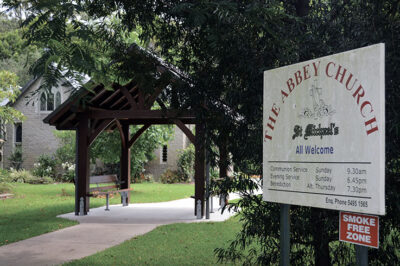
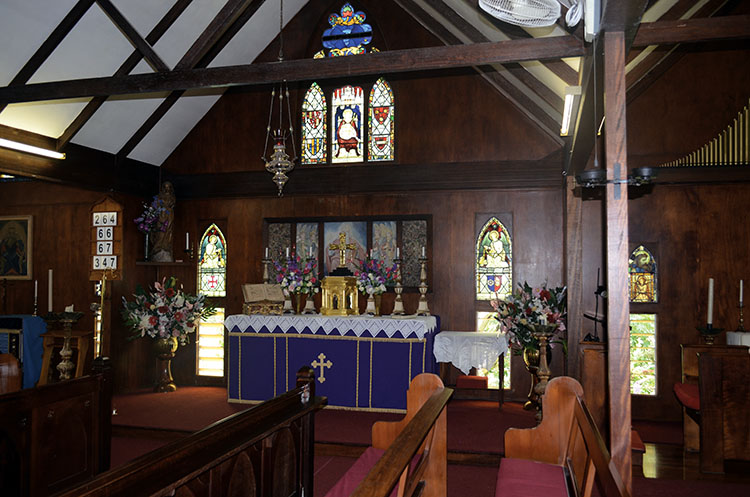
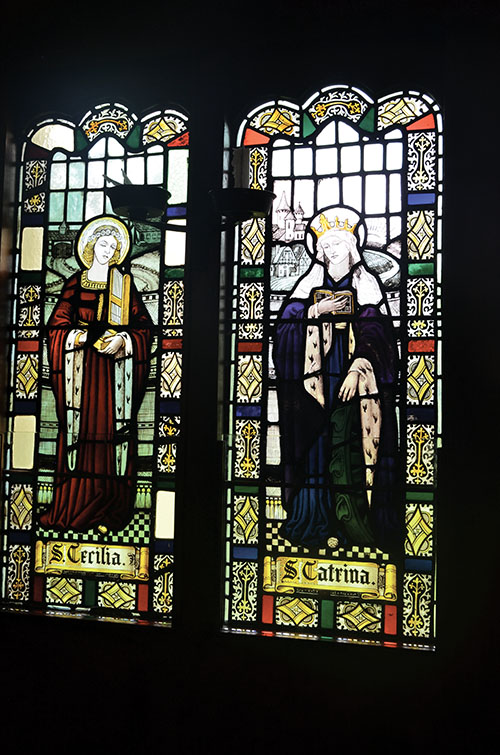
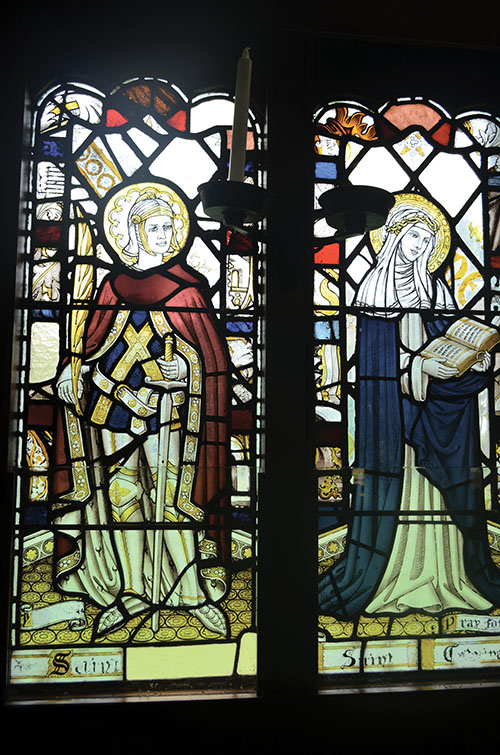
On a 135 hectare property 60 km north of the Queensland state capital Brisbane, a religious community maintains a museum, church and college. Many Brisbane residents are familiar with the annual Medieval Tournament and Banquet held on its grounds every winter, and the Abbey Museum is well-known and loved by school students and local history buffs alike. While the small Abbey Church, boasting windows that contain imported historical stained glass panels (including fragments from Winchester Cathedral), is a popular choice for weddings, baptisms and funerals, not all of its admirers are aware of its fascinating heritage.
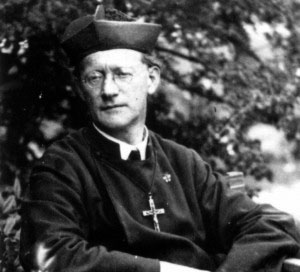
Known today as the Orthodox Catholic Church of Christ the King, the Confraternity is linked to the Great Schism of the Western and Eastern Orthodox Churches in the 11th century, thus featuring a blend of Eastern and Western Rites. However, the Abbey represents something more than just an East/West mix, having been established by the followers of J.S.M. Ward, an enigmatic Englishman who drew his inspiration from Christianity, Freemasonry, Spiritualism and a number of other esoteric traditions.
JSM Ward – A Complex Character
The Abbey owes its existence to the vision and dynamism of John Sebastian Marlow Ward. This snippet taken from his autobiographical recollections less than two years before his death, and quoted in the final pages of Geoffrey Ginn’s insightful book on Ward’s life, captures a glimpse into his background:
I was born in Belize, British Honduras in Central America on Dec. 22nd 1885. What terrible changes have taken place, since I was born, in world affairs. My lifetime has seen the decline and fall of Europe and her leadership in the world, particularly is this true of her loss of control in Asia.1
He referred, of course, to the two World Wars and he especially lamented the apparent unravelling of the British Empire. He enjoyed a stint as a headmaster in Burma just as World War I broke out, and was saddened at its independence from Britain in 1948, the year before he died.
John’s father, an Anglican minister, had returned to England from Belize with his wife and young son in 1888, just prior to the birth of their second child, Rex. Growing up in the culturally stimulating atmosphere of Victorian times, John developed a love of history and heritage buildings, amassing a large collection of artefacts and natural curiosities during his boyhood.
His dutiful Christian upbringing gave rise to a sense of enquiry, which would later broaden to encompass Mysticism, Spiritualism, Theosophy and Metaphysics. It was during his time at Cambridge University, at the age of 20, that he was initiated into Freemasonry, which was considered quite a respectable step to take for a modern middle class man, in what was by then the Edwardian Era. This would provide valuable introductions into the social and professional arenas, while also satisfying Ward’s attraction to the intrigue of the esoteric underground of the day. Soon after graduating in 1908, he took up teaching history and literature, and also married his cousin Carrie.
Psychic occurrences, which were to guide John throughout his adult life, first began five years later with the regular visitation of his late uncle (also Carrie’s father), Henry Lanchester (HJL), to him during lucid dreams. The visions would occur at regular times of night on set days of the week and provided personal messages as well as information about the afterlife. Contact with the astral plane expanded to include his brother Rex who died in 1916 (identified in John’s writings as RLW); it later became a dominant feature of his life and work, with his introduction to the angelic ‘Master of the Work’.
Carrie, although a believer in her husband’s visions, did not share his preoccupation with spiritual matters and this led to their separation in 1923. John had already met the woman who would prove to be his soul-mate, the schoolmistress and Theosophist Jessie Page, with whom he had co-founded a publishing imprint to promote his own works a couple of years earlier. The couple married soon after Carrie’s death in 1926, embarking on a lifelong partnership during which they shared their prophetic visions. They actually began to participate in one another’s dreams when, it is claimed, “they both dreamt that they were summoned into the presence of a great Angel, told that Christ was about to begin His Descent through the Celestial Planes to the Earth and asked to help in the Preparation for His Coming. This great Angel, of the order of the Thrones, was to become their constant Guide and helper in the years ahead.”2
John Ward’s beliefs and practices comprised elements that many Christians today would feel uncomfortable with. We should keep in mind that Spiritualism was popular in England a century ago. During the onset of World War I, Ward spent time teaching in Burma where he took a keen interest in Buddhism, Hinduism and Eastern traditions, strengthening his own convictions about reincarnation. It was these esoteric influences, combined with his sometimes turbulent association with Freemasonry, that paved the way for what he came to consider his life’s mission.
Freemasonry Woven into the Rich Tapestry
John Ward was born into a world of blossoming spiritual exploration and experimentation. The esoteric landscape of late Victorian England was dotted with communities devoted to Eastern mysticism, the Kabbalah and Hermetic texts, as well as scores of Rosicrucian and Theosophist groups. Geoffrey Ginn points out: “Although Freemasonry was not generally seen as occult, initiates were able to use its lodge meetings and reading groups to pursue esoteric topics and interests. Consequently, active Freemasons were in the vanguard of the occult revival at the end of the nineteenth century.”3 A number of Masonic researchers argued that the symbols and rituals of the Craft derived their roots from ancient Egyptian mystery cults. With the objective of establishing this claim, John became the founding secretary of the Masonic Study Society (MSS) in 1921. It was a pursuit he relished, continuing to attend the MSS meetings even after he later severed other links to Freemasonry and delivering more than a dozen papers to them over the next fifteen years.4
Not only did Ward appear untrue to his Christian origins as he delved deeper into ancient mysticism, he also succeeded in alienating many of his fellow Masons. He saw in Freemasonry the characteristics of, “The ancient Egyptian Mysteries, the Eleusinian Mysteries of Greece, the Mithraic Mysteries of Persia, the Adonaic Mysteries of Syria, the Cabiric Mysteries of the island of Samothrace, the Druidic Mysteries of primordial Britain, and the Gnostics of the early Christian era…”5 For him, these mysteries concurred with the knowledge of the afterlife imparted to him by his beloved departed relatives, HJL and RLW.
It was in 1929 that John and Jessie Ward began their ‘public work’ as religious leaders, establishing the original ‘Confraternity of the Kingdom of Christ’ and setting up an altar in a spare room in their house. John adopted the title ‘Reverend Father’ and celebrated communion in the traditional Christian manner, at the same time conducting a group of devotees in prayers and hymns that he had written himself. Jessie would come to be known by their followers as ‘Reverend Mother’. Notwithstanding the use of Christian titles, their practices continued to embrace the essence of Hinduism and Buddhism, mingled together with the doctrines of Spiritualism and reincarnation.
The small band of founding members – some of whom stayed in the Confraternity for the rest of their lives – pooled their assets and, when John resigned his job of twelve years and could add his generous separation bonus of seven hundred and fifty pounds, they purchased Hadley Hall on London’s northern outskirts. This mansion had been designed as two houses under one roof and sat on three acres of gardens. One of these dwellings now became The Abbey of Christ the King.
The Original Abbey in England
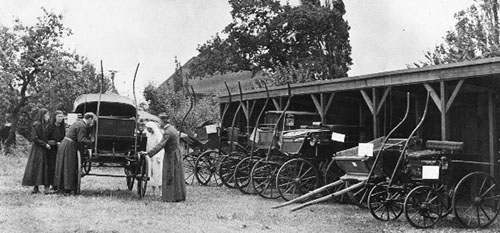
Life at London’s Abbey in the 1930s could best be described as monastic, with a strict daily routine of work and prayer. In addition to Father Ward’s study and library, the basement became a gallery for his treasured collectibles: antiquities, rare books and artefacts, tapestries and paintings. A small private school was set up on the estate and named St Michael’s College – a forerunner of today’s school bearing the same name alongside the Abbey in Queensland, Australia. And, like the modern-day Abbey complex, the founding members put their greatest effort into establishing a substantial and well-respected museum. As the Wards continued to add thousands of items to their collection, the exhibition extended out into the gardens in the form of replica historic and prehistoric buildings, eventually christened as the Abbey Folk Park. It proved extremely popular with the public, providing much-needed income for the community.
Surviving site plans of the Folk Park reveal how far the Confraternity went in not only entertaining but educating students and adults alike. It included a Roman Villa, African Bazaar, Chinese Temple of Initiation, Japanese garden, a conservatory, greenhouse, a forge and smithy shop and even a witch’s cottage.
John Ward had another motivation for developing the site that was not well known to the general public: he believed the world was in the ‘End Times’ and expected the imminent return of Christ, making The Abbey Folk Park an ‘ark for the ages’, a kind of time-capsule to preserve part of the old civilisation for the coming New Age. He envisaged it as the ‘Kingdom of the Wise’.
The Threads of Christian Traditions & Western Orthodoxy
One challenge to be met was the fact that neither John Ward nor any of his followers were ordained clergy, making their celebration of communion and other sacraments technically invalid. Soon after moving into The Abbey, ‘Father Ward’ managed to secure an endorsement as an affiliate of the Church of England from the Bishop of St Albans, on the recommendation of a mutual friend who was an Anglican Canon and fellow Freemason. However, this was only meant to authorise him as a lay preacher to his own community and the Anglicans made it clear it did not allow him to ‘minister the word of God’. A rift between them was inevitable and, after it occurred at the start of 1935, Ward would go on to have himself ordained in no less than three different religious organisations.
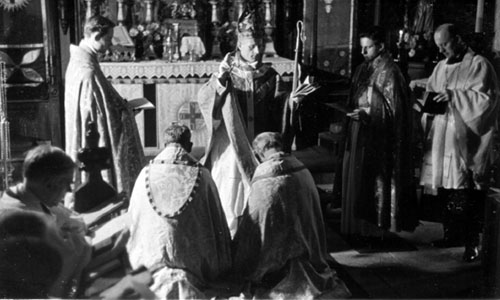
John Ward was what church officials called an episcopi vagantes, meaning ‘wandering bishop’ or ‘bishop at large’. His first affiliation outside the Anglicans was with the Autonomous African Universal Church when he was consecrated as a bishop by its London-based Primate, Mar Kwamin. Soon after that, when doubt was cast over Mar Kwamin’s authority to hold office in England, Father Ward sought advice from the elderly Archbishop John Sibley of the Orthodox Catholic Church. The two men clicked and agreed that the Abbey of Christ the King should be incorporated into the Orthodox Catholic Church, contributing much needed numbers to Sibley’s congregation, while at the same time granting Ward’s Abbey Church the institutional affiliation it craved. His second ordination is recorded by Geoffrey Ginn thus:
Ward was baptised and re-confirmed, ordained deacon and, finally, solemnly admitted to the Sacred Office of the Priesthood by the authority of Archbishop Sibley’s hand and seal. In further ceremonies the following day, Ward was solemnly consecrated as a Bishop in the Church of God and commissioned as its Chancellor of the Province (England).6
During World War II John and Jessie Ward struggled financially and were dragged through a court case brought by the parents of a teenage girl in their community, the charge being enticement of a minor. This resulted in damages of five hundred pounds being awarded against them, taking a toll on their funds as well as their health, reputation and confidence. Wartime saw membership numbers and income of many other itinerant English bishops flounder too, leading to an initiative to unify the various strands of the episcopi vagantes – and to the third ordination of Father Ward.
A group of six autonomous Christian churches merged under the leadership of Hugh George de Willmot Newman, who had recently been disavowed by the Syrian Orthodox (Jacobite) Patriarch on whose authority he depended. Forming a council, they declared the Syrian Church to be in schism and re-constituted themselves as a Western Orthodox Church. This was in contrast to Eastern Orthodoxy, which sprang from the first century Christian missionaries in the Eastern, Greek-speaking part of the Roman Empire. Newman took for himself the title Mar Georgius, Archbishop of Glastonbury, which he called the Occidental Jerusalem. Thus Father Ward received from this new church his third consecration as its ‘Archbishop of Olivet’, thereby bringing his Orthodox Catholic Church into its fold.
“Orthodox Catholicism offered itself to Ward as a religious vehicle that was necessarily flexible in matters of formal doctrine, but charged with a sense of history and a living heritage of faith,” writes Geoffrey Ginn in his departmental journal, Crossroads, adding, “In the first instance, then, Orthodox Catholicism appealed to his sense of historical drama. Ward took seriously the claims of Orthodox Catholicism to be an historic rapprochement between Christianity’s two great warring factions: ‘the Orthodox Catholic Church in itself’, he wrote, ‘marks the reunion of the Eastern and Western Churches, which mutually excommunicated each other in the 11th century, since when Christendom has been divided into camps’.”7
This refers to the mutual excommunication of the Eastern and Western Orthodox Churches in 1054. The identity of today’s Orthodox Catholic Church at the Abbey in Caboolture can be further linked to a later separation in 1870, when a number of Roman Catholics renounced their allegiance to Pope Pius IX following his declaration of infallibility. Having no bishops of their own, the breakaways could not be confirmed or ordained, so they contacted the Old Catholic Church of Holland, which had already become disassociated from the Vatican but retained valid Orders. Another historical figure, the priest Francis Xavier Alvarez and his followers in India, severed ties with the Papacy and obtained consecration by turning to the Syrian Christians, whose bishops on the Malabar Coast were under the jurisdiction of the Patriarch of Antioch, thereby adding to the bewildering melting pot of ‘bishops at large’.
Thus these ‘Old Catholics’ (the breakaways) could claim two possible lines of ordination: the first from St Peter and the Western Church in Rome via St Augustine, the fourth century Bishop of Hippo; the other from the Eastern Church, this lineage tracing itself back directly to the church founded in Antioch in 34 AD by St Peter himself.
Stations on the Journey
By 1945 the effects of the war and the legal proceedings against them left the Wards disillusioned with Britain, and it occurred to them that their Kingdom of the Wise might be destined to emerge in a foreign land. Fortuitously, John Ward’s old friend Gerald Gardner, who had designed the witch’s cottage for him, expressed an interest in taking over the cottage and its artefacts in exchange for a piece of land with a farmhouse he owned in Cyprus and wanted to offload. Cyprus held great appeal for the Confraternity – it was an English territory in the Eastern Mediterranean with a pleasant climate and, most importantly, it already embraced the tradition of Orthodox Christianity. The following year, after selling off the more valuable of their antiquities and library books, the small community packed up whatever they had left and made the two-week voyage from Southampton to Cyprus.
Disappointingly, Gardner’s farmhouse turned out to be derelict and sat on barren land but, undeterred, they simply walked away from it and immediately purchased a more suitable property on the coast close to Limassol. This land was more than a hectare and boasted an orange orchard with a furnished two-storey house plus gardener’s cottage, outdoor brick oven and a chicken house with poultry. At a cost of two and a half thousand pounds, it was a drain on their funds, so they were relieved a few months later when they received over four thousand pounds from the sale of Hadley Hall back in London. Here they would stay for more than eight years, earning their living from farming and handicrafts they produced.
For the Reverend Father John Ward, Cyprus was to be the last station on his life journey. Before his passing due to a stroke in mid-1949, he fathered a child with one of the ladies among his flock, Ursula Cuffe, and their son John was raised by Jessie Ward as her own. Growing up with Father Ward’s tradition and principles, the mature son would go on to be known as Bishop John Cuffe, presiding over an off-shoot of the present-day Orthodox Catholic Church in Queensland. A number of the older members of the original Confraternity were to pass away soon after Ward and the remaining followers had become restless by the mid-fifties, scouting around for a new home base. After looking first at Ceylon (Sri Lanka) and India, they decided to head for Australia where they settled briefly in Sydney and then in the Blue Mountains. When Jessie suffered a bout of pneumonia, she decided to head to the warmer climate of Queensland to recover, accompanied by a few others, including the nine year-old John Cuffe.
The influence of John Sebastian Marlow Ward lives on and the depth and diversity of his legacy can be gleaned from the titles of some of his books: Gone West: Three Narratives of After-Death Experience; Freemasonry and the Ancient Gods; The Hung Society; The Kingdom of the Wise: Life’s Problems; The Psychic Powers of Christ; and articles: ‘The Hindoo Symbol of the Point Within the Circle’, ‘The Knights Templar’, ‘The Aims and Ideals of Freemasonry’, ‘Chinese Secret Societies’.8 Author Geoffrey Ginn neatly sums up his character in the final paragraph of his book:
In J.S.M. Ward we find, indisputably, a man of many parts. A historian with a strong sense of the romantic, a visionary with heightened spiritual sensibilities, he was a questing soul, curious until his last days about the human past, how we might comprehend its mysteries, and the life beckoning beyond that of everyday sense experience.9
The Ongoing Legacy in Queensland
The community began settling at its present site of the Abbey at Caboolture, Queensland, half a century ago, and Jessie Ward survived until three years later, providing a clear link back to the organisation she co-founded with her husband in the late 1920s. What makes today’s Orthodox Catholic Church stand out from other Christian sects are their teachings on the afterlife, their representation of the Holy Spirit as the feminine aspect of the Godhead, and how at the very core is their belief in the imminent return of Christ. Concerning reincarnation they say, “that the journey of each Soul encompasses many lives to complete its journey back to God”; and concerning Catholic traditions, they affirm their church “holds to the tenets of the Christian Faith as enunciated in the Nicene Creed.”10
Its followers seek spiritual development, both on a personal level and also collectively as a Confraternity. According to their publicity material:
Community members strive to live a balanced life that revolves around attending Church Services, devotion and personal prayer and the practicalities of everyday life. The four main areas of the work of the Confraternity include the Church, the Farm, the College and the Museum. Holding public services, visiting the sick, undertaking works of charity and giving public lectures form part of the ongoing work of the Confraternity members.11
In keeping with the values established at the original Abbey Folk Park in England over eighty-five years ago, the tranquil setting at Caboolture is also home to the Abbey Museum, as well as the independent co-ed school, St Michael’s College. Describing itself as a welcoming community, their church and museum at The Abbey Place are open to the public.
Further reading: Archangels & Archaeology: J.S.M. Ward’s Kingdom of the Wise by Geoffrey Ginn
Footnotes
1. Geoffrey Ginn, Archangels & Archaeology: J.S.M. Ward’s Kingdom of the Wise, Sussex Acad. Press 2012, 261
2. ‘Orthodox Catholic Church of the New Age, Life of J. S. M. Ward’, http://orthodoxcatholicnew.tripod.com/id7.html
3. Geoffrey Ginn, Op. cit. 29
4. Ibid 106
5. Ibid 109, quoting from Secret Societies by Noel Gist, 1940
6. Ibid 197
7. Crossroads, Special Issue 2006, AEN Conference (page 11) www.uq.edu.au/crossroads/Archives/Vol%205/Issue%201%202010/Vol5Iss110%20-%207.Ginn%20%28p.45-57%29.pdf
8. For full catalogue of publications, see Archangels & Archaeology, Op. cit., 297–310
9. Geoffrey Ginn, Op. cit. 265
10. http://abbeychurch.com.au/history-of-the-church/
11. http://abbeychurch.com.au/history-of-the-confraternity/
© New Dawn Magazine and the respective author.
For our reproduction notice, click here.