
From New Dawn 204 (May-June 2024)
Time appears to march on at what seems a constant rate. In this way, time has two opposite directions, the somewhat known past and the largely unknown future. However, events in the sky repeat and so they can be predicted as seasons within a year or lunar phases within a month. Even before modern calendars, Stone Age humans counted the days in a month to understand the recurrence of the menstrual period and know when moonlight would be strong again at night.
Stone Age Origins of Time
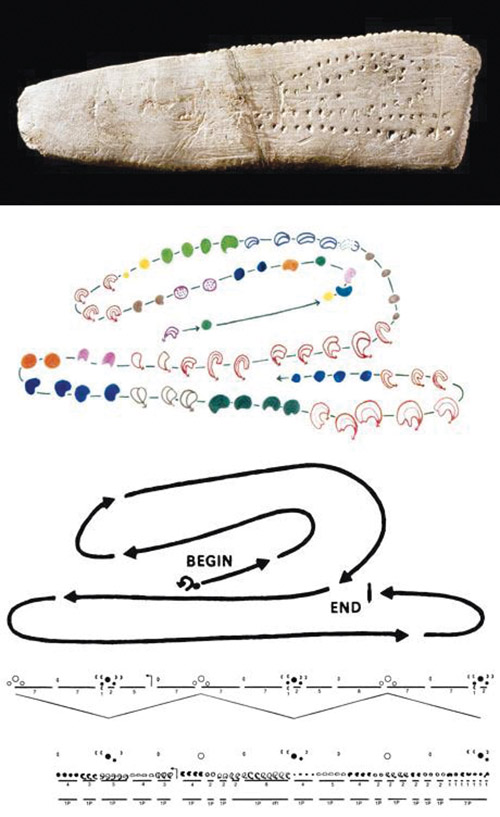
Two months happen to equal 59 whole days: a lunar month is 29.53 days long, just over twenty-nine and a half, which is half of 59. In the artefact shown at the top of Figure 2, each day was carved upon a flat bone, each mark appearing varied in shape and depth to show the Moon’s changed phase on a given day. The flat bone enabled a cyclic shape to be used, of 59 marks, which “ate its own tail,” showing there was always the same number of days in two “moons.” This sameness emerges from dividing the recurring time of the solar day into the time of the month’s phases over two months to give the recurring whole number of 59, then forever useful as a knowledge object.
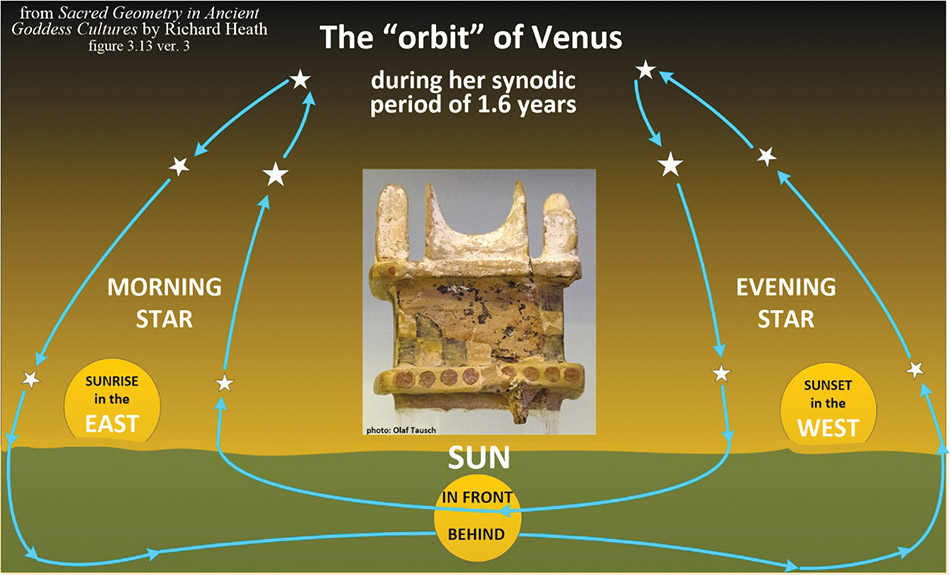
The solar day clearly has the same duration every day, and two lunar months clearly repeat twice after 59 days. But our modern life is the extended straight line of day numbers belonging to unequal months of the Sun so that the loops that recur are lost in the framework of man-made time. The Stone Age “lesson from nature” was that events in the sky largely run according to a definite schedule along cyclic paths, most of these being along the path of the Sun, along which the Sun, Moon, and planets follow their own cyclicities, seen from the Earth.
This reliable cyclicity shaped our notion of an unchanging realm of Eternity, different to Life upon the Earth as our ever-developing present moments within Existence. In this way, knowledge from the sky came to be considered sacred and interconnected through numbers when counted as days and months, especially through counting the often identically sized discs of the Sun and Moon and their respective years.
While astronomy started as a Stone Age hobby, it later became a tribal science quite unlike our own astrophysics. Only later would farmers support city specialists who assimilated this prehistoric science by forming religious sciences and cosmologies in the East, such as Egypt, Babylonia, India, China, and so on.
Millennia later, the 16th century altogether discarded this geocentric view-from-the-Earth and adopted a new heliocentric view of the solar system, which enabled the planetary orbits of the Sun to be clearly seen as mathematical ellipses by Kepler. This system was soon seen to be held together by Newton’s newly intuited force, gravity, of the central Sun’s large mass.
If counting the Moon had synchronised both female fertility and male hunting, then this shaped the format we call the hunter-gatherer who foraged for food before there was farming. Their women formed a naturally less-mobile core for the tribe and its children, the men hunting over extensive ranges. All adults worked together for the greater good, and since they were in-common descended from the women, a matrilineal society was an effective format for problems requiring larger groups.
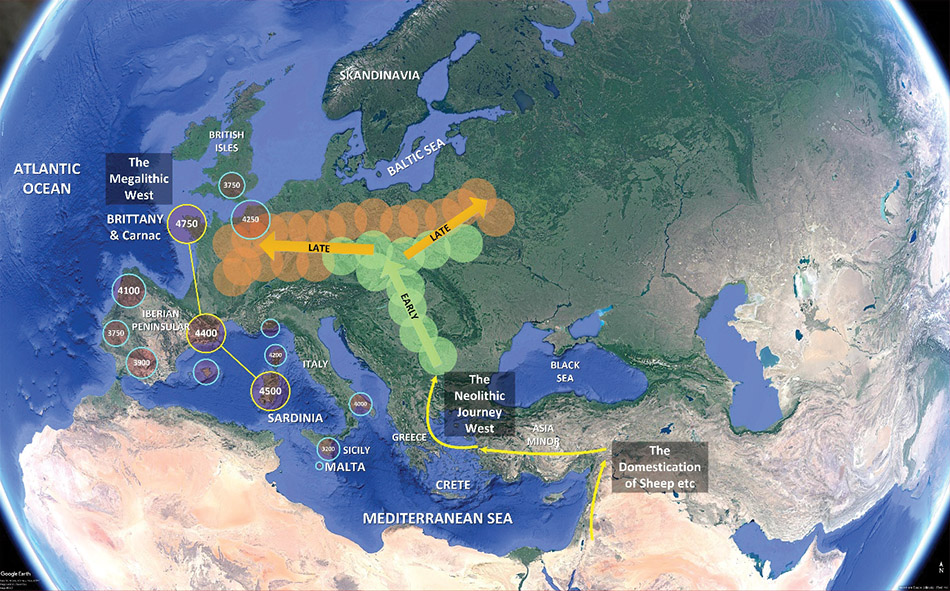
Stone Age art of the goddess seems to have been varied and geometrical (see Language of the Goddess by Marija Gimbutas). In Sacred Geometry in Ancient Goddess Cultures, myexperience in analysing megalithic sites caused me to question whether the megalithic monuments were the work of Neolithic or a New Stone Age farming revolution moving west from the Middle East where it started. Because the farming revolution only advanced slowly through central Europe and towards the Atlantic coast (see Figure 3), it pretty much avoided the Mediterranean.
The megalithic revolution largely took place within the islands and hinterlands of the Mediterranean and Atlantic Coast of Europe between 5000 BCE and 2500 BCE. It was, therefore, much more likely to have been carried out by the late middle Stone Age (Mesolithic) people before the farming way of life arrived. The indigenous culture of old Europe was Mesolithic – well-established and centred around women, foraging, and matrilineage (using your mother’s name) rather than the neolithic norm, led by men – farming and patrilineage (using your father’s name).
Clash of the Titans
Being indigenous, matrilineal tribes were far more likely and able to innovate megalithic astronomy, which was effectively inherited from the long tradition of day counting seen on Stone Age tallies like the Blanchard plaque.
This continuity of interest in the sky conflicts with today’s model of history and our foundation myth for modern science – as the grandchild of ancient Near Eastern civilisations and exact sciences, fuelled by farming on fertile soils using irrigation.
By comparing day counts, sky time could be given geometrical forms such as circles, squares, and rectangles/triangles, and these were rightfully considered sacred by the coherent megalithic culture on Europe’s shores. The civilisation was numerate and intelligent, but not Stone Age in the vernacular sense, of having no ability to reason.
Having an extended family of adults and no urgent need to seasonally grow crops, conserve seeds or tend their animals, nature already provided food through foraging. There was a natural collaborative workforce, perhaps explaining the dearth of neolithic settlements alongside the earliest megalithic monuments.
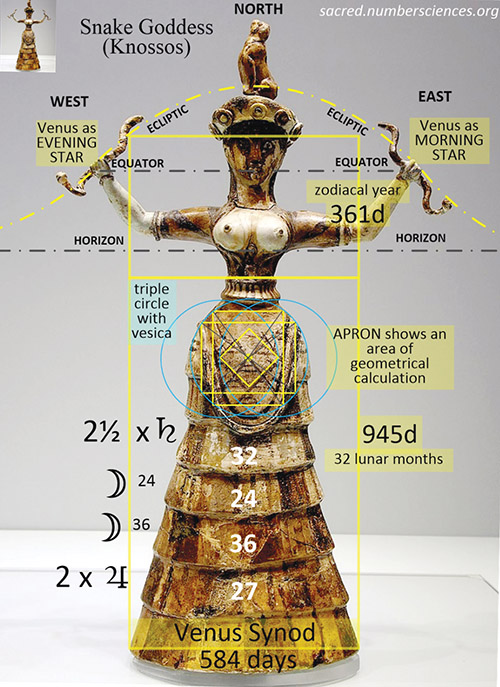
Having overcome this misnomer that megaliths were automatically neolithic, further work is required to see why modern science cannot understand sky phenomena like the Stone Age did. Today, we do not study the synodic periods of the planets because they are seen as merely an incidental composite of the planetary orbits and our solar year.
Quite unexpectedly, the view from the Earth is supremely important since the structure of time on Earth is a phenomenon reflecting the form and structure of the numerical world. This suggests that the Earth was, in some way, influenced by the abstract world of numbers to form this type of time environment. It might also suggest that the evolution of Life was an intended outcome for the third planet.
Having discarded the Earth-centred model of the universe and ridding ourselves of the religions and gods proposed to explain this phenomenon, modern humans are free to live in an accidental universe where one is simply alive on an existential line-of-time with no end except for death, and without any appreciation of the deeper structural recurrences implicate within the sky. Instead, there is a hotch-potch Roman calendar whose roots were largely man-made.
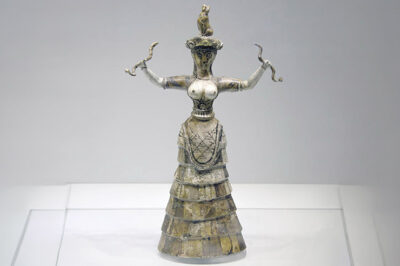
The Greek myths referred to women but in ways designed to put matrilineage norms in a bad light. The patriarchal farmers of Jupiter-Zeus had defeated the religion of the Goddess whose representatives had snakes (perhaps the dreadlocks of the Medusa or knowledge of the snake-shaped ecliptic) or had kept men sexually enslaved on an island (as in the Odyssey) or sacrificed a sacred king after “a year…” (of 364 days) “…and a day” (making 365 in all). Our 7-day week derives from this Saturnian year of 364 days (52 weeks), named because the synod of Saturn is exactly 378 days (54 weeks) while the synod of Jupiter is 57 weeks.
In this, one is seeing through a series of invisible filters – the ancient Greeks were against the tribal age that preceded farming and cities, when women rather than men were most important to that way-of-life.
The Enlightenment adopted the heliocentric planets as a binary, removing the foundations of a vast past cultural corpus of religious and pre-scientific thought that had quite reasonably shown something special about the world that modern science never chooses to see.
If we fathom megalithic astronomy, its uniquely powerful discoveries reveal what the religious texts were about: Earth’s favourable environment is no accident; it is a planet for the evolution of Life.
Megalithic discoveries were transmitted subconsciously into the cultural subconscious of later civilisations. This impulse still informs and infects our arts and the classical form of numeracy called mathematics.
This diffusion benefited from the clash of the Titans, namely between the matriarchal and patriarchal ways of life in the Eastern Mediterranean and Levant. It was recorded in the intellectual life of the Greeks and Hebrews, thus informing the Islamic and Christian world views as a code of numbers and stories often agreeing with those of the East.

Continuity in Sacred Building
If you know how to look, one finds the units of measure and geometries of the megalithic repeated in later sacred buildings, built under disparate religions, as if the design of sacred buildings had some sort of megalithic origin.
The Chinese, Indian, Buddhist, Minoan, Classical Greek, Romanesque, Islamic, South Asian, Amerindian, Gothic, Sufi, and Renaissance buildings draw upon common geometric and metrological blueprints relating, for example, to the relative size of the Earth and Moon, and the sophisticated celestial time cycles such as eclipse phenomena, as if to celebrate the cosmic environment even though many religions conceptualised the heavens as if not found in the sky.
For this reason, my books explore buildings of the historical period in the same way as megalithic buildings to demonstrate this continuity of an invisible language, as if there are people with megalithic knowledge behind the construction of buildings without the outer religion officially acknowledging this fact.
In some strange way, others and I are recapitulating ancient works in terms of their meaning by employing skills belonging to the past. For example,
In Cappadocia, Turkey, stone-cut churches inexplicably contain high levels of meaning in their dimensions and definition of circular apse and rectangular naos occupied by hermit monks.
Angkor Wat is shown to be a massive statement of astronomical cyclicities alongside an outer meaning of Vedic mythological carving and Indian temple design.
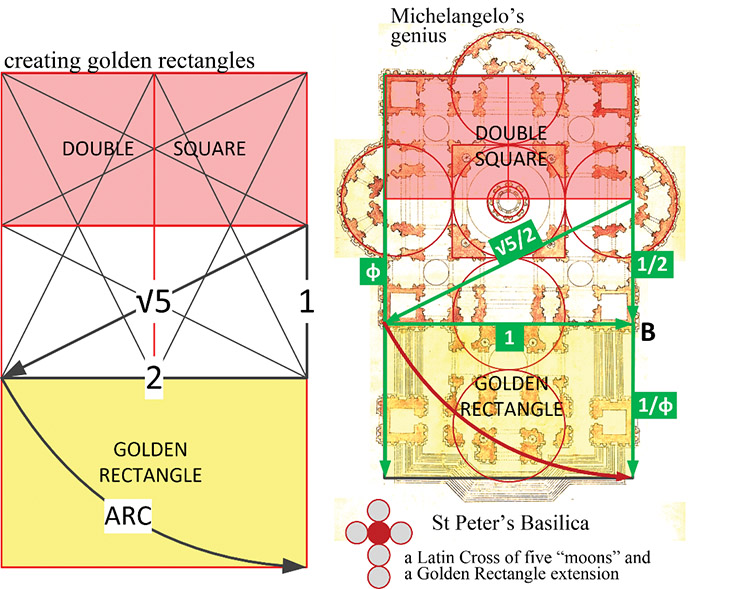
St Peter’s Basilica was a Renaissance rebuilding involving many great architects, including Michaelangelo, who displayed sacred geometrical skill in translating a Greek square-cross basilica design into a Latin cross cathedral design through the golden mean relationship of a square to such a rectangle (see Figure 5). St Peter’s tomb is in the centre of a model of the Earth and Moon.
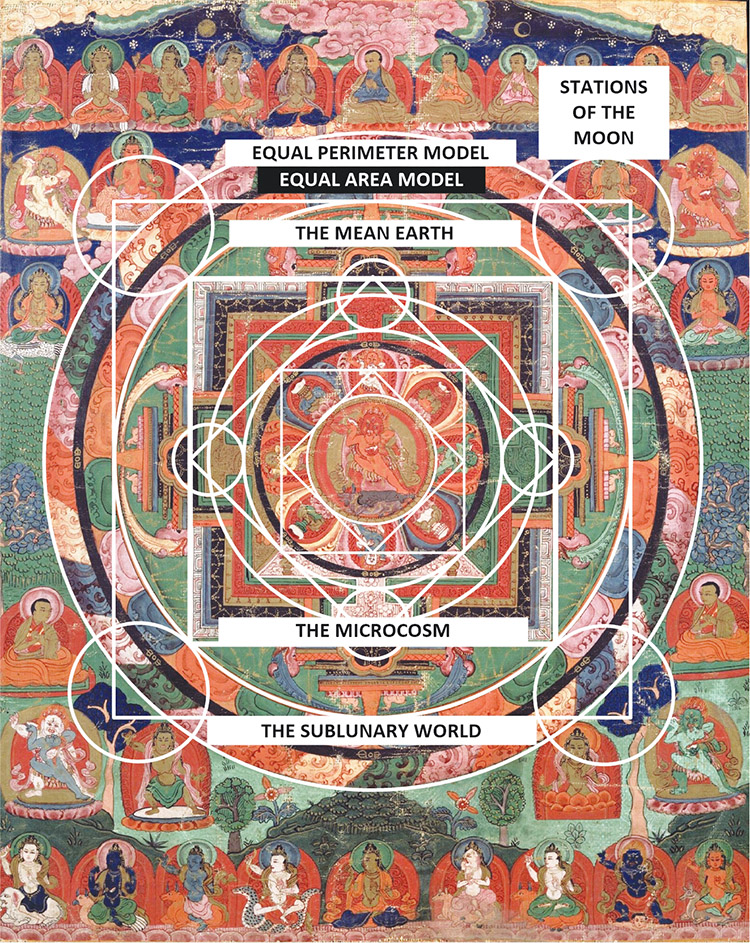
Chapter 11 of my 2024 book Sacred Geometry in Ancient Goddess Cultures: The Divine Science of the Female Priesthood demonstrates that the equal perimeter model of the Earth and Moon had been related to the now-abandoned geocentric model.
The Earth is at the centre, and a system of growing square areas for each planet’s synod grows to embrace the whole figure, revealing that it was the archetypal form taken as the norm for Buddhist Mandalas. Jungian therapists and others use Mandalas to enable interaction with the subconscious mind. This suggests that our very being, as microcosmos, is part of the Earth and its planetary Sky environment of time.
Celestial time appears to be a carrier wave for reality, not just a straight line.
The author’s book Sacred Geometry in Ancient Goddess Cultures: The Divine Science of the Female Priesthood is available to purchase.
Images courtesy of Richard Heath and the publisher Inner Traditions International.
References
Barry Cunliffe, Europe Between the Oceans: 9000 BC to AD 1000, Yale 2008.
Marija Gimbutas, The Language of the Goddess, Thames & Hudson 1989.
Richard Heath, Sacred Geometry in Ancient Goddess Cultures, Inner Traditions 2024.
Richard Heath, Sacred Geometry: Language of the Angels, Inner Traditions 2021.
Richard Heath, Tragic Loss of the Geocentric Arts and Sciences: When Poetry was the Language of Cosmology, New Dawn #185 (Mar-Apr 2021), sacred.numbersciences.org/2023/06/03/tragic-loss-of-the-geocentric-arts-and-sciences.
Alexander Marshack, The Roots of Civilization: The Cognitive Beginnings of Man’s first Art, Symbol and Notation, Weidenfeld and Nicolson 1972.
Bettina Schulz Paulsson, Time and Stone. The Emergence and Development of Megaliths and Megalithic Societies in Europe, Archaeopress 2017.
© New Dawn Magazine and the respective author.
For our reproduction notice, click here.