
From New Dawn 216 (May-June 2026)
On 27 February 2026, Oman’s Foreign Minister Badr Al-Busaidi told the world that peace was “within reach.” Iran had agreed to full IAEA verification, permanent limits on uranium stockpiling, and irreversible downgrading of its enriched uranium to the lowest possible level. Talks were set to resume on 2 March.
The bombs started falling on 28 February.
The United States and Israel launched a joint assault that killed the Iranian leader Ali Khamenei, flattened military facilities, and also tore through schools, hospitals, and cultural sites across the country. Iran struck back with missiles and drones aimed at Israel and US bases in Bahrain, Jordan, Kuwait, Qatar, and Saudi Arabia. The Strait of Hormuz was shut. Oil prices spiked to levels not seen since the 1970s. By early April, with thousands dead, the conflict was dangerously widening.
The stated reasons from Washington shifted by the day. Regime change. Self-defence. Nuclear prevention. Securing oil. No single story held for more than a news cycle.
That drift is the tell. When the reasons for a war change by the day, the real reason must stay hidden. And the real reason reaches far beyond any nuclear programme.
The Western ruling elite knows its era of unchallenged global dominance is closing. The economic centre of gravity is migrating eastward. The dollar’s monopoly over world trade is eroding. BRICS is expanding. China’s Belt and Road Initiative is weaving the Eurasian landmass into a single integrated economic zone.
In a desperate, last-ditch bid to preserve their grip on global power, Western elites are racing to build a Techno-World Order, a system of control founded on artificial intelligence, digital currencies, biometric tracking, and rule by algorithm.
That system requires the physical world to stay in their hands. And the physical world runs through Eurasia.Anglo-American strategists have understood this for over a century.
The Blueprint
To see this clearly, you need to look at two texts that most people have never heard of. One was a lecture delivered in 1904, later published as an article. The other was a book published in 1997. Taken together, they read like a blueprint for modern empire, so candid in their strategic vision that they feel like an architect’s own drawings for a structure you have been living inside your whole life.
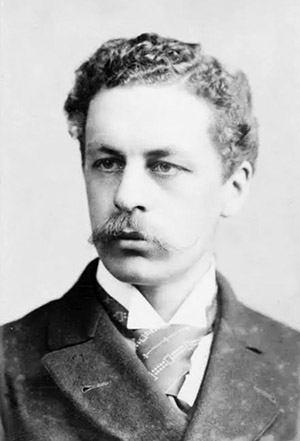
Sir Halford John Mackinder was a man who acted on his ideas. A British geographer who directed the London School of Economics from 1903, he built his career on a single argument: the age of sea power was fading and the real prize was land.
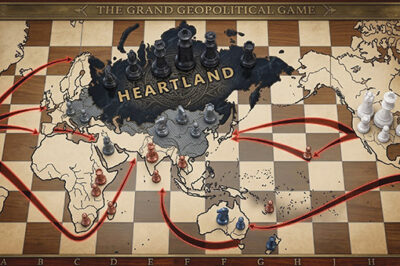
In 1904, before the Royal Geographical Society, he proposed that the vast interior of Eurasia, stretching from the Volga to the Yangtze, held the resources and the position to command the globe. He called it the “Heartland” (see map on page 11) Around it lay coastal states he termed the “Inner Crescent,” and beyond them the maritime fringe of Britain, Japan, the Americas, and Australia.
His dictum, refined in 1919, still runs Western strategic thought. “Who rules East Europe commands the Heartland; who rules the Heartland commands the World-Island; who rules the World-Island commands the world.”
Then he tested it. In late 1919, the British government sent Mackinder to southern Russia as High Commissioner during the civil war. His mission was to unite the White Russian forces of General Denikin against the Bolsheviks and prevent a hostile power from consolidating the Eurasian interior. He returned to London and proposed to the Cabinet a “cordon sanitaire” of buffer states running from Georgia, Armenia, and Azerbaijan through Ukraine, Poland, and the Baltic provinces. The Cabinet ignored him. Britain withdrew its troops. South Russia fell to the Bolsheviks.
Mackinder’s proposed buffer states were swallowed by the Soviet Union for the next seventy years. The same states he named in 1920 remain flashpoints in 2026. Georgia. Armenia. Azerbaijan. Ukraine.
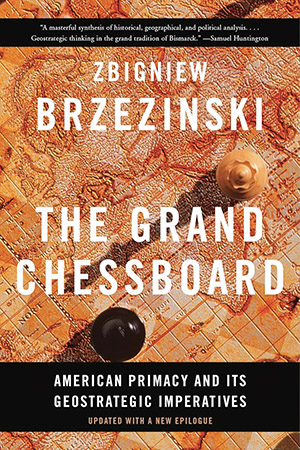
Ninety-three years after Mackinder’s London lecture, Zbigniew Brzezinski picked up his thesis and fitted it for American use. The Grand Chessboard, published in 1997, is a startling book. Brzezinski, a former US National Security Advisor and co-founder of the Trilateral Commission, laid out American imperial strategy with a bluntness unthinkable in any official document. (He misspelled Mackinder’s first name as “Harold” throughout. The American heir to British imperial geostrategy got his own master’s name wrong.)
The core argument was simple. Eurasia holds seventy-five percent of the world’s people, sixty percent of its economic output, and three-quarters of its known energy. Control Eurasia and you control everything. America’s task was to prevent any rival from locking that landmass together.
Brzezinski identified five states whose fate would decide the balance. Ukraine. Azerbaijan. South Korea. Turkey. Iran. He warned that one scenario above all would threaten American power. A grand coalition of Russia, China, and Iran, joined not by ideology but by shared hostility to Western hegemony.
He was blunt about what lay beneath the surface. The Caspian Basin and Central Asia hold reserves of oil and gas that dwarf those of Kuwait, the Gulf of Mexico, or the North Sea. Iran, with its own massive reserves and its position astride every proposed energy corridor, was the lock on the door.
Selling the project to voters would be hard. “Democracy is inimical to imperial mobilisation,” Brzezinski wrote. The public would back foreign wars only if given a “sudden threat or challenge to the public’s sense of domestic well-being.”
In Iran’s case, the nuclear bogeyman served that function for two decades. When diplomacy threatened to remove it, the bombs fell anyway.
Everything Brzezinski described in theory, Iran embodies in geography. The country is the gateway to Eurasia. No other nation bridges the Indian Ocean to the Caspian and Central Asia in a single overland corridor. The Iranian coastline commands the Strait of Hormuz, through which close to a quarter of the world’s seaborne oil flows. The country shares land and sea borders with fifteen nations. Iranian oil and gas reserves rank among the largest on Earth.
Western strategists see a strategic position on a map. Iran is something else.
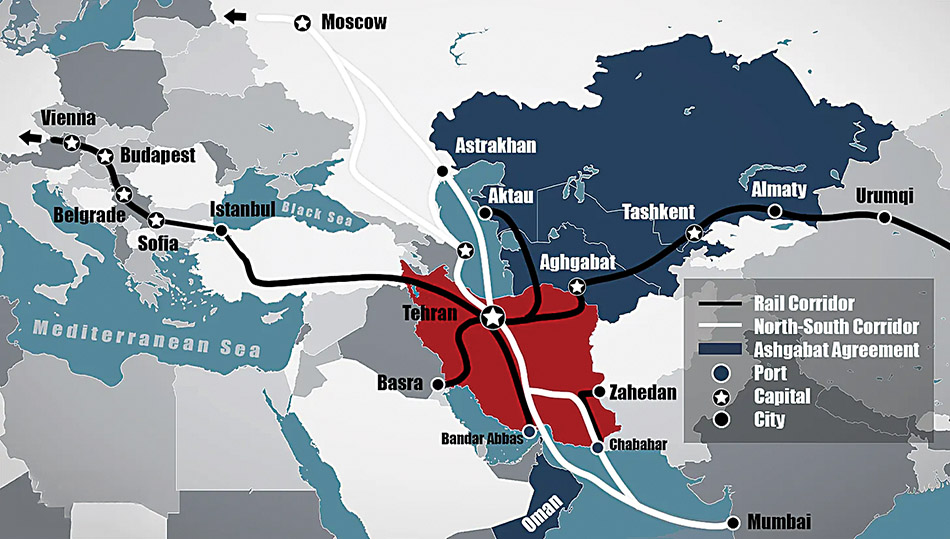
Persia, as it was known for most of recorded history, is one of the oldest continuous civilisations on the planet. Five thousand years. When the first stones of the Persian Royal Road were laid, connecting the Mediterranean to Central Asia, Rome did not exist. When the Silk Road began threading through Iranian territory, Christianity had yet to be born. Zoroastrianism, one of the earliest monotheistic faiths, emerged from this soil. The mystical traditions of Sufism flowered across the Persian cultural world, producing a spiritual literature, including the Persian-language poetry of Rumi, Hafez, and Omar Khayyam, that still crosses every border of language and belief.
This is a land where the seen and the unseen have coexisted for millennia, where philosophy and statecraft and spiritual practice grew from the same root. The men in Washington see pipelines and chokepoints. What they fail to see is a civilisation with roots strong enough to outlast any empire that tries to uproot it.
The West has been trying for a long time. In 1953, when Iran’s elected Prime Minister Mohammad Mosaddegh moved to nationalise the Anglo-Iranian Oil Company, the CIA and MI6 engineered a coup that toppled him and installed Shah Mohammad Reza Pahlavi. The stated reason was Cold War containment. The operating logic was older. Keep the resources and corridors of the Inner Crescent under Western-aligned control.
Iran’s 1979 revolution ejected the Shah and with him the Western strategic presence. The Islamic Republic has been targeted by Anglo-American policy ever since, through decades of sanctions, proxy conflicts, covert operations, and now direct military assault. The nuclear question has always been the public face of a strategic interest that predates Iran’s nuclear programme by half a century.
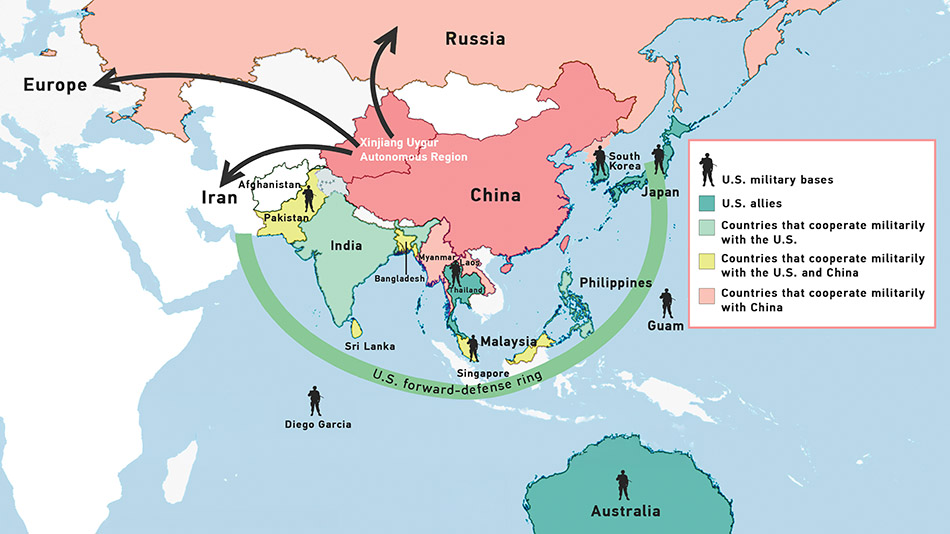
In the years before the 2026 war, Iran was doing what Mackinder and Brzezinski had both warned about. Tehran was fast becoming a key player in Eurasian integration. Iran joined the Belt and Road Initiative. In May 2025, the first direct freight train from Xi’an, China, pulled into the Aparin dry port, cutting transit from a month by sea to fifteen days by rail. The North-South Transport Corridor, linking Russia through Iran to India, was turning Iranian ports into the spine of a new Eurasian trade network. India had poured investment into the Chabahar port on Iran’s southeastern coast, giving Delhi a route into Afghanistan and Central Asia that bypassed Pakistan and sidestepped the Strait of Hormuz. Iran was connecting east to west and north to south at once. The keystone was locking into place.
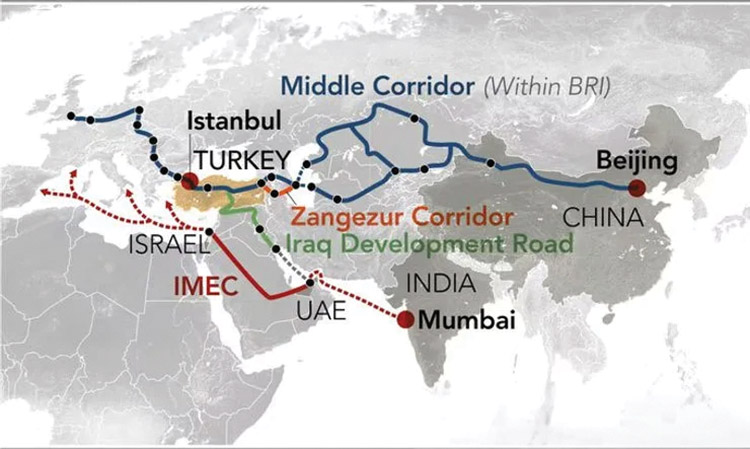
Look at the map in 2026. The coalition Brzezinski described has arrived. The alliance runs through BRICS, the Shanghai Cooperation Organisation, and the Belt and Road Initiative. What Brzezinski feared on paper now moves in steel, rail, and pipeline. And the gateway holding it all together is Iran.
The Techno-World Order
This is where the century-old Mackinder doctrine meets the twenty-first-century endgame.
The Western elite policymakers can read the trends. American debt is spiralling. The move away from the dollar is picking up speed. China’s economy has overtaken the United States in purchasing power terms. The BRICS bloc now represents a larger share of global GDP than the G7. Military bases, dollar hegemony, arm-twisting through the IMF and World Bank, the old tools of Western control are losing their grip. The world that Mackinder and Brzezinski sought to manage is slipping away.
The ruling class has chosen a different path. Instead of accepting a multipolar future, it has set about building a new architecture of control, one founded on something beyond aircraft carriers and trade agreements.
At the World Economic Forum in Davos, January 2026, the shape of that architecture was plain to see. AI-driven governance. Digital currencies. Biometric identity frameworks. Machine-run control of whole populations. These were working agendas backed by people who hold state power.
Technocracy researcher Patrick Wood (see New Dawn Special Issue Vol 20 No 1), who has tracked these developments for decades, calls key figures in the Trump administration “arch-technocrats” building a system of global digital dominion. He names Elon Musk, Peter Thiel, and Howard Lutnick among the architects. The stated US policy goal, laid out in an AI strategy co-authored by senior officials, is to export America’s “full AI technology stack” to every country willing to join its digital alliance.
By early 2026, the Trump family’s World Liberty Financial had launched a dollar-pegged stablecoin backed by US Treasury securities, and the GENIUS Act had created the federal regulatory framework to legitimise it. The merger of state power and private digital finance was no longer theoretical.
This Techno-World Order has material demands. AI runs on rare earth minerals and vast energy. Digital currencies need compliant banking systems. Surveillance needs cooperative states. All of this depends on controlling the trade corridors and energy routes of the physical world, the same corridors that Mackinder mapped in 1904 and that converge at Iran.
If Russia, China, and Iran build their own digital and financial systems outside Western reach, the technocratic project fractures beyond repair. And that is what has been unfolding.
BRICS states have moved toward de-dollarised trade. China’s rail links to Iran skip every Western-controlled sea lane. After the Strait of Hormuz was initially closed, Iran offered safe passage to BRICS members and blocked American-allied ships. A multipolar world with independent tech freedom is the one outcome the architects of the Techno-World Order are determined to prevent.
A stable, integrated Iran at the heart of Eurasian trade poses a greater danger to this project than any uranium centrifuge. The centrifuges made for a good story. The real target was the gateway.
The war itself had been building for years. In 2024, Iran and Israel exchanged direct attacks for the first time. In June 2025, Israel struck Iran and the United States later joined the 12-day war with attacks on Iranian nuclear sites. In January 2026, Iran was shaken by its worst domestic unrest since 1979. By late February, Washington had assembled one of its biggest regional military deployments since the 2003 invasion of Iraq. Oman-mediated indirect nuclear talks, which had resumed in early February, showed progress. The 28 February assault ended that diplomatic opening. What followed stripped away whatever remained of diplomatic language.
A Whole Civilisation
On 21 March, Trump posted on his internet platform ‘Truth Social’ that if Iran did not “FULLY OPEN, WITHOUT THREAT, the Strait of Hormuz, within 48 HOURS,” the United States would “hit and obliterate their various POWER PLANTS.” Twelve hours before that deadline expired, he postponed it. On 26 March, he extended the deadline again, writing that negotiations were “going very well.” On 30 March, he expanded his threatened targets to include oil wells, Kharg Island, and “possibly all desalination plants.” Each deadline arrived and was pushed back. Each postponement came with louder threats.
On Easter Sunday, 5 April, Trump posted what may be the most unhinged statement ever issued by a sitting US president. “Tuesday will be Power Plant Day, and Bridge Day, all wrapped up in one, in Iran. There will be nothing like it!!! Open the F****** Strait, you crazy bastards, or you’ll be living in Hell. JUST WATCH! Praise be to Allah.” His Defence Secretary Pete Hegseth had already threatened to send Iran “back to the Stone Age.”
On 7 April, Trump told reporters the US had a plan “where every bridge in Iran will be decimated by 12 o’clock tomorrow night, where every power plant in Iran will be out of business, burning, exploding and never to be used again.” Hours later, on Truth Social, he wrote the words that Amnesty International’s Secretary General called “apocalyptic” and members of Congress called “genocidal.”
“A whole civilization will die tonight, never to be brought back again. I don’t want that to happen, but it probably will.”
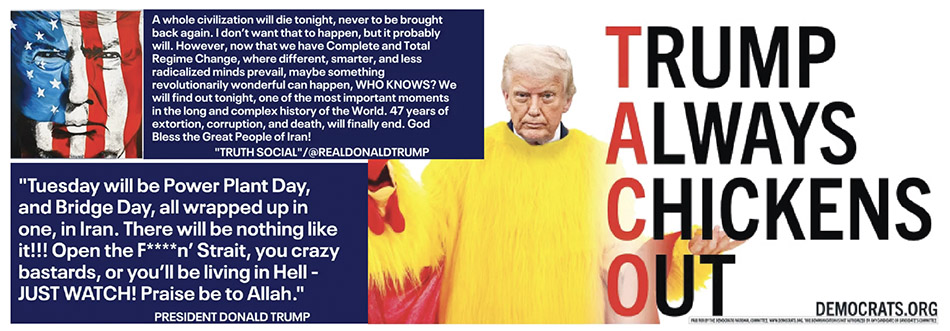
A whole civilisation. The president of the United States was threatening to extinguish one of the oldest continuous civilisations in human history. Five thousand years of philosophy and poetry and spiritual seeking, reduced to a target in a social media post sandwiched between threats about power plants and boasts about a rescued airman.
Iran’s response told a different story. Across the country, young Iranians formed human chains around power plants to shield them with their bodies. President Masoud Pezeshkian wrote that more than 14 million Iranians had registered to sacrifice their lives defending their homeland. “I too have been, am, and will remain devoted to giving my life for Iran,” he said. Iran’s foreign ministry called Trump’s threats “a sign of ignorance.”
Ninety minutes before his own 8 p.m. deadline on 7 April, Trump backed down. A two-week ceasefire was announced after mediation by Pakistan, where Washington’s traditional allies had failed to act. Iran agreed to allow passage through the Strait of Hormuz for the ceasefire period. Oil prices dropped eight percent within minutes. But Iran’s Supreme National Security Council, accepting the ceasefire on 8 April, issued a pointed clarification. “This does not signify the termination of the war. Our hands remain upon the trigger.”
The power that threatened to wipe out a civilisation failed to make its own deadline stick. Three ultimatums were set and withdrawn before the fourth produced a pause. The off-ramp was negotiated by a country that Brzezinski would have classified as a secondary player on the chessboard.
A confident hegemon behaves differently. The pattern of escalation, bluster, retreat, and re-escalation reveals an establishment that knows its position is eroding and is lurching between force and negotiation with no coherent strategy beyond buying time.
The war on Iran makes full sense when we consider Mackinder’s 1904 lecture and Brzezinski’s 1997 book The Grand Chessboard. Hold the Eurasian gateway or lose the world. In 2026, add the final layer. Lock the planet into a Western-built digital grid before any rival bloc can raise its own.
The desperation with which that project is being pursued, the expletives, the shifting deadlines, the threats of civilisational annihilation, tell you everything about how the architects of that project assess their own chances.
Iran, the ancient mystical land of Persia, has held this ground for five millennia. Every empire that tried to seize it, from the Macedonians to the Mongols to the British, paid a price too heavy to sustain. The land outlasted them all. Persia endures as a living civilisation, rooted in traditions older than any Western institution now claiming the right to reshape the world.
The question hanging over 2026 is whether an empire armed with cruise missiles, blockchain ledgers, artificial intelligence, and a social media account can break that record.
The accompanying article “The View From the Other Side of the Chessboard” can be read here.
© New Dawn Magazine and the respective author.
For our reproduction notice, click here.