
From New Dawn 216 (May-June 2026)
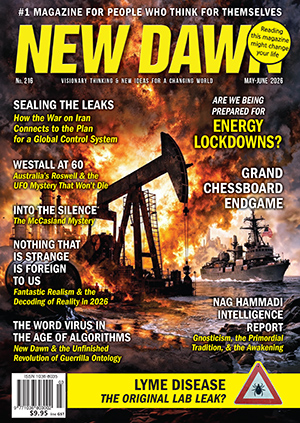
The ongoing conflict between the US and Iran makes “The Grand Chessboard Endgame” essential reading for anyone willing to understand the strategic design behind the shifting headlines. Exclusive to New Dawn #216, this investigation traces the struggle back to Mackinder and Brzezinski, revealing why Iran’s position at the heart of Eurasian trade, energy and emerging multipolar alliances matters far beyond the official explanations.
For a gripping preview, read “From the Other Side of the Chessboard” (full text below), where Russian philosopher Alexander Dugin argues that the assault on Iran marks the final, dangerous struggle of a fading unipolar order. Readers who already have #216 have seen through the Establishment narrative and understand the larger agenda. The latest developments come as no surprise to them.
Share the following or pass your copy of New Dawn #216 to anyone who dares to question the official approved version. If you haven’t already done so, you can still order New Dawn #216 here and discover what the nightly news leaves out.
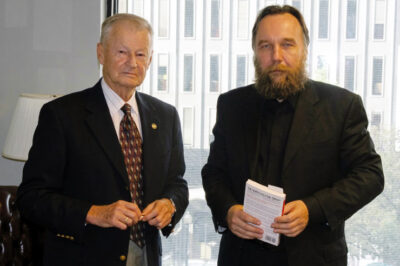
In 2005, Alexander Dugin sat across a chessboard from Zbigniew Brzezinski in Washington. The Russian philosopher asked the American strategist whether chess was a game for two players. Brzezinski’s answer was immediate. “No, it’s a game for one.”
The author of The Grand Chessboard saw a single player at the table of world geopolitics. Two decades later, as American bombs fall on Iran, the man on the other side of the board has a different reading of the game.
Dugin, the most prominent theorist of Russian neo-Eurasianism, has been sanctioned by the European Union and the United States. His daughter Darya was killed by a car bomb in Moscow in 2022, an act widely attributed to Ukrainian intelligence. None of this has slowed him down.
On the 6 April 2026 Russian Sputnik programme ‘Escalation’, Prof. Dugin delivered what amounts to his most comprehensive analysis of the war on Iran and its place in the global contest between unipolarity and multipolarity.
In Dugin’s analysis, the American-led global order established after the Cold War is expiring. The assault on Iran, Trump’s expletive-laden threats, the shifting deadlines, the bombing of cultural sites, all of it registers as the desperate flailing of a system that can feel the ground giving way beneath it.
His central concept is the “agony of the unipolar world.” He means the word in its classical sense, the final struggle before death. Trump, in Dugin’s analysis, has been chosen by the Western ruling elite as the instrument of that agony. There is no longer time for liberal illusions, for humanitarian rhetoric, for talk of human rights.
Dugin reads Trump as the unwitting agent of this collapse. Where previous American presidents wrapped imperial policy in the language of human rights and international law, Trump has stripped that language away. The liberal mask is off. What remains is raw force, openly declared.
Dugin identifies a four-stage strategy behind what looks like chaos. First, reassert control over Latin America through pressure on Venezuela, Cuba, Mexico and Colombia, a renewed Monroe Doctrine. Second, destroy the main pole of sovereignty in the Islamic world through Israel, with Iran as the primary target and Turkey next in line. Third, pressure Russia into vassalage, using European NATO as leverage, interpreting Moscow’s willingness to negotiate as weakness. Fourth, full-scale strategic war with China before the end of Trump’s term.
Each target, Dugin argues, is told the next stage “does not concern you.” Iran is stage two. The war is already underway. Each stage is designed to clear the path for the final confrontation with Beijing.
“Trump does not need negotiations,” Dugin says. “His ultimatum to Iran is a clear warning to China and to us: ‘this is what will happen to you if you dare to resist’.”
Dugin frames Iranian resistance as civilisational, drawing on the Shia tradition of accepting earthly defeat for spiritual victory. When Trump attacks Iranian society with open cruelty, Dugin argues, he receives in return the opposite of what he expects.
“The heroic Iranian people today stand united against pure, unalloyed evil coming from the West.” The human chains around power plants in April 2026 and the millions of Iranians who registered to sacrifice their lives are, in Dugin’s reading, expressions of a civilisational depth that brute force cannot reach.
The American president is attempting to complete this programme before the 2026 midterm elections, ignoring all obstacles, burning through allies and generals alike. Dugin points to Trump’s dismissal of loyal figures, combat generals removed mid-campaign, his own attorney general thrown out, as evidence of a leader operating under extreme time pressure in a system that knows its window is closing.
Two years before the war, Tucker Carlson warned Dugin during a private conversation that “Trump will not accept multipolarity.” Carlson, who helped bring Trump to power, is now in open opposition. “He believed in him, shared his ideas,” Dugin says, “but Trump betrayed the MAGA movement and his supporters.”
Dugin closes with a formulation that leaves no room for ambiguity. “Many of us believed that Western dominance was already in the past and that multipolarity was an accomplished fact. But it seems we were just as premature as Francis Fukuyama was with his ‘end of history’. The multipolar world has not yet arrived. The struggle for it is happening now.”
Brzezinski told Dugin in 2005 that chess was a game for one player. The board in 2026 tells a different story. Iran has refused to be swept from the squares. Russia and China stand behind their own pieces. The “single player” Brzezinski imagined is running out of moves.
© New Dawn Magazine and the respective author.
For our reproduction notice, click here.