
From New Dawn 206 (Sept-Oct 2024)
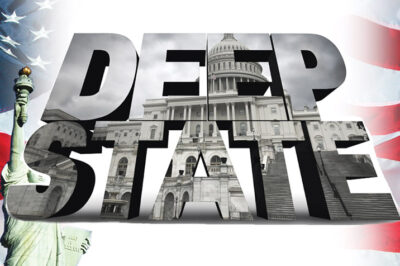
Most talk you hear these days about the deep state – the interlocking network of multinational corporations, government bureaucracies, and nongovernmental institutions that holds the reins of political and economic power in today’s industrial societies – treats it as a monolithic presence with the discipline of a Nazi division goosestepping past the review stand at a Nuremberg rally. Most of that talk also treats the deep state as omniscient and omnipotent, possessed of knowledge and power so all-encompassing that all its opponents can do is grumble on online forums.
There are plenty of reasons why the deep state wants to project these images of itself into the collective conversation of our time. I trust nobody is naïve enough to think, however, that an interest in factual accuracy has any place among those reasons. No ruling class in all human history has ever been that unified, that well-informed, or that powerful – though every ruling class in all human history has tried to make its opponents think that all these things are true.
Let’s begin with the obvious. The people who make up the interwoven hierarchies of the deep state aren’t robots or mindless minions. Nor are they nice people. They have clawed their way to their current positions of power in the savagely Darwinian environment of a modern bureaucratic state, in which backstabbing and betrayal are a way of life and a moment’s weakness or kindness is usually fatal. They have climbed a ladder in which each rung is reached by trampling on the faces of less successful rivals.
Those at the summit of the deep state are constantly intriguing against each other while fending off attempts by those immediately below them to unseat them and take their place. Those below them face the same struggle with peers and subordinates while simultaneously trying to climb the ladder to the next level. Will they set aside their rivalries to defend the system against its enemies? Yes, but only when this works out to their personal advantage. Give them a chance to better their position at the expense of their superiors or the system as a whole, and they’ll take it. This is one of the reasons that systems like theirs always eventually fall.
They face another lethal vulnerability, one that counterculture philosopher Robert Anton Wilson traced out mordantly in his writings: communication is only possible between equals. It’s worth taking a moment to see how this works. Imagine a hierarchy, like any of those that make up the deep state. At every level, you have a superior who lords it over a number of subordinates and whose job tenure and prospects for promotion depend on pleasing his own superiors and keeping his subordinates in line.
Now suppose that a piece of information has to make its way up the hierarchy from the people at the bottom, who have direct experience of what is happening, to the people at the top, who have the power to make decisions. At every level, the subordinates have a strong incentive to tell the superior what the superior wants to hear, whether or not it happens to be true. If one subordinate suffers from a sudden lapse of self-interest and tries to pass on an unpalatable truth, the others can be counted on to treat this mistake as a vulnerability to exploit, tell the superior what he wants to hear, and undercut the erring subordinate. Repeat this same process ten or twenty times as the piece of information makes its way from the bottom to the top, and the chance of any of it coming through intact is minimal at best.
Now imagine what happens when a piece of information has to go in the other direction, from the top to the bottom. At every level, a similar dynamic applies because the superior has a strong incentive to tell the subordinates what the superior wants the subordinates to believe, whether or not it happens to be true. Apply both these processes at the same time – and they’re both constantly in operation in every hierarchy – and you end up with a situation in which the upper levels of the hierarchy are serenely detached from the actual state of affairs and the orders that come down from above display a more than schizophrenic detachment from reality.
If this reminds you of life in today’s Western industrial societies, that’s no accident. The weird disconnect between the pronouncements of politicians and business leaders and the realities that the rest of us encounter is not just a matter of dishonesty on the part of the ruling class. (Of course, they’re lying through their teeth, but it’s more than that.) The people at the summit of the deep state have no clue what’s happening in the world. All they know is what they’re told in their elaborate daily or weekly briefings, which are massaged by whole armies of subordinates who have every incentive to tell them nothing except what they want to hear.
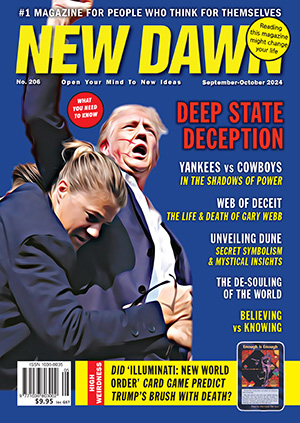
These two factors – the constant struggles for power within the ruling classes and the toxic effect of power relationships on communication – form the realities of life in any hierarchical society. They are among the core reasons why empires fall and civilisations crumble, and they explain the explosive political realities surrounding the rise of Donald Trump in today’s America.
The Yankee-Cowboy War
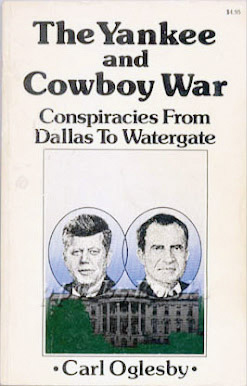
The crucial role of conflict within the deep state was the central thesis of one of the forgotten classics of alternative politics, The Yankee and Cowboy War: Conspiracies from Dallas to Watergate (1976) by Carl Oglesby. The first president of Students for a Democratic Society (SDS), the most influential American radical group in the mid-1960s, Oglesby was forced out of the group because he rejected Marxism and argued instead for an alliance between radical youth and democratic populists. After his expulsion, he devoted time to researching the assassination of John F. Kennedy (JFK) and the deep structure of political and economic power in the United States.
In The Yankee and Cowboy War, Oglesby mapped out the hidden terrain of American power from the Second World War to the election of Jimmy Carter. He showed that beneath the apparent unity of the deep state in those years, a bitter conflict raged between two factions of the ruling class – the old east coast establishment (“Yankees”), oriented toward Europe and drawing their power and wealth from control over international finance, and the new rich of the Florida-Texas-California corridor (“Cowboys”), more interested in Asia than in Europe, and drawing their power and wealth from fossil fuels and the military-industrial complex.

Oglesby argued that the war in Vietnam was a Cowboy project. When Yankee scion JFK edged out Californian Richard Nixon in the 1960 election and began to move against Cowboy interests, reorienting US foreign policy away from the Pacific Basin, the Cowboy faction treated this as an existential threat. JFK’s assassination, which put the Texan Lyndon Johnson in power, was their response: a coup d’etat against the Yankee faction that handed the levers of power to the Cowboys and signalled full speed ahead for the Vietnam adventure. Yet the Cowboys had no realistic grasp of conditions on the ground in Vietnam. Meanwhile, the Yankee faction responded by fostering antiwar activism on college campuses and using the mainstream media to trip up the Cowboys at every turn. The turmoil of the Sixties was one inevitable result. Another was the coup against Richard Nixon.
That was the story as far as Oglesby traced it in his book. The rest of the tale is easy enough to outline. Ronald Reagan’s two terms as president marked the triumph of the Cowboys. From that point until the rise of Donald Trump, every US president had a close connection to the Cowboy faction. Notice, however, that the Bush family was an old Yankee family which had relocated to Texas and made connections with the Cowboy elite. This same pattern was underway across the Yankee faction as the old aristocracy cut deals with the new. Meanwhile, the fossil fuel and defence industries became fully integrated with international finance as Cowboy families made their own journeys in the other direction.
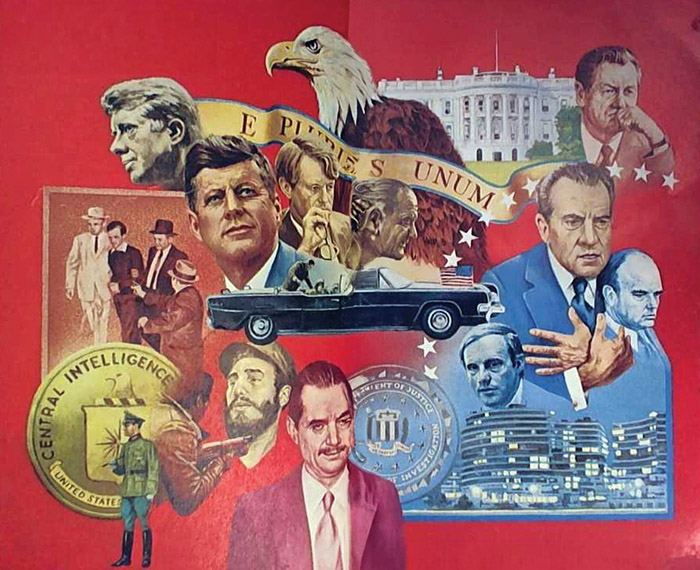
Hillary Clinton was one more interchangeable part from the same bin, raised in an east coast political family but married to a rising Sun Belt politician. Her two terms in the White House were expected to continue policies that had been welded in place for forty years. What neither she nor anyone else in the ruling class had noticed, however, was that the United States was lurching toward an explosion.
A Time For Caesars
Writing more than a century ago, German historian Oswald Spengler anatomised the way that this crisis is playing out. In the history of every high culture, there comes a point at which the ruling class sinks into a kleptocratic stupor in which the last traces of effective leadership give way to a blind pursuit of personal enrichment while the hierarchies through which the ruling class enforces its will become so baroquely complex that no meaningful information can make its way to the top at all. Even if the society is swarming with secret police, that does little since the information gathered by the ordinary working Joes who staff the secret police has less than a tossed coin’s chance of getting to decision-makers.
A society in this condition can no longer cope with the challenges that it faces. This is what drives the process that Spengler called Caesarism. Julius Caesar was a high-ranking member of the Roman Republic’s deep state, as insanely rich, financially corrupt, and morally depraved as any of his peers – it was a running joke in Rome during his time that he was every woman’s husband and every man’s wife. Unlike the other members of the senatorial class, however, he realised four things. The first was that the entire Roman system faced disaster if its ruling class continued its kleptocratic feeding frenzy; the second was that ordinary Romans would rally around anyone who took the levers of power away from the ruling class; the third was that some elements of the ruling class would do the same; and the last was that if he took advantage of these things, he could seize unparalleled power.
As history shows, he was right. This is why after a cabal of senators assassinated Caesar, the Roman people rose up and drove the assassins and their allies out of Rome. It is why Caesar’s nephew Octavian and his close ally Mark Antony crushed the senatorial party in the war that followed. It is also why, once Octavian and Mark Antony turned on each other and Octavian won, he had himself installed as Augustus, first emperor of Rome, to the wild cheering of Roman crowds.
Donald Trump is not Julius Caesar. Nevertheless, the same pattern that put Caesar in power gave Trump his first term in the White House and seems likely to give him a second. The American ruling class, Yankee and Cowboy factions alike, long ago forfeited the trust and respect of the American people. More recently, they have become hated, and in the last few years, they have come to be despised. That opens the way for the same overturning of the political establishment that Caesar began and Augustus completed.
A very large number of Americans – quite possibly a majority at this point – are sufficiently disgusted by the antics of their self-anointed leaders that anyone who takes the levers of power away from them can count on robust public support. Significant figures among the rich and influential can be expected to rally around any such project. If Trump did not exist, in other words, someone else would have done the same thing he did – and if he is removed, there’s no shortage of others ready to take his place.
The End of Empire
The revolution from within that Julius Caesar and Augustus carried out in ancient Rome is even more likely in today’s America because the American empire that emerged out of the Second World War is running on fumes. Dependent on distant countries for essential resources, burdened with a vast bureaucratic sector and an economy so riddled with graft and incompetence that it can no longer accomplish such basic tasks as providing munitions for its proxy wars, the United States is stumbling toward terminal crisis.
The ongoing war in Ukraine is a glaring example. When that began in February 2022, the United States and its allies placed their trust in punitive economic sanctions, which were expected to cripple the Russian economy and force Russia to its knees. Apparently, nobody in Washington DC considered the possibility that other nations interested in undercutting the US empire might have something to say about that. Of course, that was what happened. China, which has the largest economy on Earth in terms of purchasing power, extended a middle finger in the direction of Washington DC and upped its imports of Russian oil, gas, grain, and other products. So did India, currently the third largest economy on Earth, as well as more than a hundred other countries.
For many decades, the threat of being cut out of international trade by US sanctions was the big stick Washington DC used to threaten unruly nations that weren’t small enough for a US invasion or fragile enough for a CIA-backed regime change operation. Two years ago, that big stick turned out to be made of balsa wood and snapped off in Joe Biden’s hand. The result is the first shockwave of a massive rebalancing of global wealth that is already transforming the world.
Until the era of the European global empire, the economic heart of the world was in East and South Asia. India and China were the richest countries on the planet, and half a dozen other nations, from Japan to Iran, were also major economic powers. The great age of European conquest temporarily diverted much of that wealth to Europe, impoverishing Asia in the process. That began to break down with the collapse of European colonial empires after the Second World War, but some of the same arrangements were propped up by the United States thereafter. Now, those are coming apart, and Asia is rising in response. By next year, in terms of purchasing power, four of the five largest economies on the planet will be Asian. The fifth is the United States, and it may not be on that list for much longer.
The consequences will reshape the lives of everyone on the planet, but their impact will be especially harsh here in the United States. Roughly five per cent of the human race currently live in the United States of America. That very small fraction of humanity, until quite recently, got to enjoy about a third of the world’s energy resources and manufactured products and about a quarter of its raw materials. That didn’t happen because nobody else wanted these things. It happened because America’s global empire funnelled a disproportionate share of the planet’s wealth to one nation.
As those arrangements break down, the five per cent of us in the United States will have to go back to living on about five per cent of the planet’s wealth, as we did before 1945. If we still had the factories, the trained workforce, the abundant natural resources, and the thrifty habits we had back then, that would have been a wrenching transition but not a debacle. The difficulty, of course, is that we no longer have those things. The factories were shut down in the offshoring craze of the 1970s and 1980s, when the imperial economy slammed into overdrive, and the trained workforce was handed over to malign neglect after that.
We still have some natural resources, but nothing like what we once had. The thrifty habits? Those went whistling down the wind a long time ago. In the late stages of an empire, exploiting flows of wealth from abroad is much more profitable than trying to produce wealth at home, and most people direct their efforts accordingly. The result is the typical late imperial economy, with a governing class that flaunts absurd levels of paper wealth, a parasite class of hangers-on that thrive by catering to the very rich or staffing the bureaucracies of the deep state, and the vast majority of the population impoverished, sullen, and unwilling to lift a finger to save their so-called leaders from the consequences of their own actions.
It is still possible for the United States to pull out of its current power dive. “Possible,” however, is not the same thing as “easy.” Our government, most of our corporations, and a great many of our wealthier citizens have run up debts so gargantuan that they can never be paid off. A federal debt default is a certainty sooner or later. So is the bankruptcy of most large American corporations, especially in the FIRE (finance, insurance, and real estate) sector. US troops will have to come home from the hundreds of overseas bases where they currently prop up proxy regimes of various kinds. US allies in Europe and the island fringes of East Asia will have to make their own arrangements for defence. Very little in global affairs will remain unchanged.
There is no evidence that Donald Trump, the circle of upper-class dissidents that surrounds him, or the cheering crowds that attend his rallies understand all this. Trump seems to realise, however, that the United States can no longer afford its global military footprint, its gargantuan government bureaucracies, or the attitudes that justify these and cater to the vast lumbering dinosaur of the deep state. Such policies are inevitable sooner or later – and the sooner they take place, the more it will be possible to salvage from the smoking rubble of the American experiment.
© New Dawn Magazine and the respective author.
For our reproduction notice, click here.