
From New Dawn 210 (May-June 2025)
Some conflicts can only be resolved by divine intervention, and so after arguing with your most stubborn intellectual jousting partner about “simulation theory” – the notion that earthly reality is some sort of cosmic computer program – you find yourself in a deserted part of town on a rainy night, the lone customer in a metaphysical shop smelling of incense and old books.
An old book is precisely what you need, you tell the bearded proprietor, and not just any book. One that contains the “secret doctrine” of the ancients, a book with all the answers.
“Is there such a breviary,” you ask, “revealing all to those who wish to see?”
“There is,” the old man responds, withdrawing a vellum volume from behind the counter. “I keep one aside for anyone who asks.”
“I’m afraid I wouldn’t be able to afford something as magnificent as this,” you say as the book vibrates in your hands.
“Oh, but this book is free to anyone who requests it!” the proprietor says. “There are limitless copies, and yet it is worth more than all the riches in the world.”
At home, you retire to your study, light a candle, and pour a glass of wine. The first thing you notice is the weighty tome is only half-written; half the book is blank. And then, across a manic midnight and into the wee small hours, you read its pages and begin to see. Not the physical reality seen by your eyes but the invisible reality behind it.
The mysterious book begins by asking what the great star we call the Sun has in common with the blood flowing through our veins, the special significance of the orbital path of Venus, and what video games have in common with the supreme deity men call by the name God.
Without the Sun, the book explains, Earth would not exist. It is the starting point, the bringer of light and life, the envoy of the simulation-creation. As we orbit the Sun, which causes the four seasons, its fiery rays come down and lift the water from the sea, which returns to Earth in the form of rain, which causes the foliage to grow, creating oxygen for our atmosphere.
An unseen fifth element makes it all possible, a quintessence that simulation-theory eggheads call the “god particle,” forever eluding their understanding. In the human body, the blood acts similarly to the fifth element operating outside it. We breathe in air, charging the bloodstream with oxygen which our central “sun,” or heart, pumps to all the parts of the body, taking from the blood what it needs to fulfil its function.
Now let us look at the path of Venus as seen from Earth (see image on the left). The so-called fairest sight in nature, the third brightest object in the sky after the Sun and Moon, appears like a glimmering five-pointed diamond, six months of the year at dawn and six at dusk. The ancient wise men used geometry to trace its trajectory from season to season, year to year, and discovered that over the course of eight years, the path of Venus around Earth forms a mandala shape, or what we call sacred geometry, despite the fact that both planets are in constant motion.
No atheist vs. believer modern-human argument will ever settle matters of this sort. If you don’t look at the path of Venus and immediately and intuitively understand that the reality in which you exist has been crafted down to the tiniest detail, then you probably wouldn’t be reading this. But you are, so let us explore “simulation theory,” a recent buzzword of Silicon Valley types who are highly adept at staring through the proverbial positivist microscope to perceive the workings of things but who’ve completely lost sight of the big picture and great master-key of occult philosophy: analogy.
When video game technology became sufficiently sophisticated, what did humans do? They invented open environments for a character controlled by the player’s will because there’s no game without free will. The game world is then filled with trials against antagonistic forces and the possibility of failure because nothing would happen without obstacles and opposing forces. Each victory brings upgraded powers, leading to a final destination written by the game’s author.
According to ancient doctrines, everything in the universe follows the same laws and patterns, like an immense multidimensional paisley in which each part is a microcosm of the larger to which it is attached.
So yes, you’re in a simulation. Of course you are. This is the great secret known to all the world’s spiritual traditions. Only when man became intoxicated by his machines did he lose sight of the fundamental fact that in his own sphere of action here on Earth – aided by will, reason and intelligence – man is a mirror of his simulation author – a creator, transformer, and builder of worlds.
A gust of wind blows the window open, letting in the silvery moonlight. You decide to leave it open, and the cool night breeze sharpens your mind as the mysterious book reveals the laws governing the reality-construct in which you find yourself, drawing on an excellent summary from the 1908 book The Kybalion. The seven Hermetic laws governing creation are:
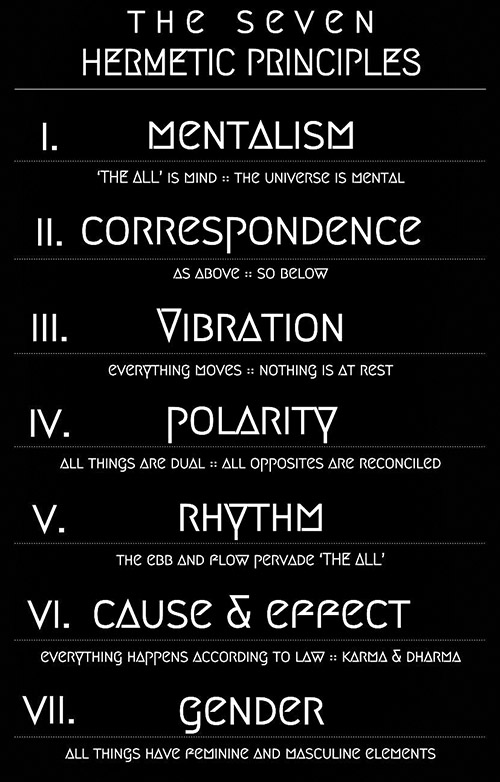
Mentalism – This is the most relevant to exponents of simulation theory, as it means the universe is based not on matter but consciousness. At the atomic level, what appears to you as solid matter is mostly empty space, and all of Earth will be vaporised when the Sun becomes a red giant billions of years from now.
Where will the solid matter go? It will be transformed into a different form of energy that can ultimately be traced back to that mysterious fifth element.
Correspondence – Everything in the cosmos exhibits the same pattern, from seasons to civilisations, galaxies to snail shells.
Vibration – Everything is forever in motion.
Polarity – Everything presupposes its opposite: life/death, spirit/matter, good/evil.
Rhythm – The pendulum is always swinging; day is racing to night, the tide goes in and the tide goes out, you inhale and then you exhale.
Cause & Effect – Perceived effects come from higher causes.
Gender – Everything is based on two opposing principles, one active, the other receptive, which come together in the act of creation.
These are just the laws that run the simulation world.
Before revealing what happens in this world, the book with all the answers explains the primordial energy running the whole thing. Consider the proverb about blind men inspecting an elephant. Each can touch a single part – trunk, tusks, ears, enormous scaly body – but cannot see the whole and so thinks an “elephant” is the one part he can grasp. Likewise, the primordial energy of the cosmos has various overlapping ways of being known, and traditional doctrines employ the following terms:
The quintessence or prima materia is the building block of everything in the universe, which modern science calls Dark Energy.
The primordial generative androgyne “dragon” is felt in the solar plexus and genital region as a dual serpentine energy. Some metaphysical schools refer to this as chaos or undifferentiated energy.
The pneuma is a thin vibration detectable in pranayama or sacred breathing; the word means breath and offers direct experience of something like living Spirit.
The Great Magical Agent or Universal Plastic Medium, to use two terms employed by Eliphas Levi, is the combination of intelligent spirit acting on the dragon, which consciousness experiences as a kind of viscous material. It’s something like active imagination or magic, and what we use to create possibilities assessed by reason and put into action on the material plane by the will.
The Astral Light is something like what psychology calls the collective unconscious. Levi seems to use it interchangeably with the dragon, quintessence and prima materia, but given his references to it as “saturated with images” and “nature’s imagination,” it appears Astral Light best describes not primordial energy but the archetypal realm of consciousness.
In astrology, this is associated with the planet Neptune, whose gravitational energy comes to us at a very high vibration and is likely the place from which artists receive inspiration. Although the ancients could not see this planet, they could feel its frequency above the seven planetary “metals” that power human life. It is the divine realm where ancestral archetypes roam in a kind of living fantasia. It’s no coincidence that the same planet and deity are associated with the unseen world beneath the sea, which is why Gustav Holst wrote an eerie chord progression for Neptune in his 1914 suite “The Planets.”
The numen is the Roman concept of divine presence beyond any god or archetype, something like the watchful eyes of the Supreme Author of the simulation. The term means “to nod” and is likely where we get the term “a wink and a nod,” expressing another level of reality to that which is perceived.
To spiritual initiates who find their way to the metaphysical dimension, all the unexplainable synchronicities and serendipities in earthly life are experienced as fleeting nods of the higher powers. The Latin term gives us the English word “numinous,” meaning supernatural.
Modern humans – say, those whose frame of reference is based on the scientific rationalism and social institutions of the past three centuries – who ponder simulation theory are too smart for their own good or what esotericists would call “intelligently stupid.” They will never crack the code of the reality they inhabit because their human ego – necessary for the trial of earthly incarnation but an impediment to spiritual knowledge – is too wedded to their material intelligence or sense of reason. They will always be a scientist-subject looking at metaphysical reality as an object, unable to transcend the dichotomy and enter the idea-world they behold in their minds.
To paraphrase The Upanishads, the simulation is not anything you can see but rather that by which you can see. It’s like asking a fish to explain water from a scientific point of view when water is the very thing in which it lives and which gives it life. A fish’s reality-construct is taken for a given. They do not think about their cosmos – water – only what happens in it, such as eating, spawning, and avoiding predators.
The mysterious book has now prepared you for the next revelation, for beyond the laws, principles and primordial energies that drive the simulation reality-construct. What actually happens in it?
We are not in a static universe of rigid rule; the seven Hermetic laws taught us that. Everything is in motion, everything has its season. There are various races, gods and archetypes; myths and legends; literature and fairy tales; civilisations that achieve greatness and then fall to barbarian hordes. There are also innocuous humans whose lives are as cogs in the great turning wheel, and there are geniuses, kings, mages and sages who are completely differentiated and distinct, and who possess powers of intelligence, wisdom and creativity that seem to come from another dimension.
The three shots comprising the last 30 seconds of the 1937 fairy tale film Snow White give us a hint, for they are a visual distillation of ancient doctrines revealing the analogy of how human life and the overworld overlap – the Hermetic dictum from the Emerald Tablet is “As above, so below” – and how archetypal symbols are ever at work in man’s imagination, the medium – or Astral Light – through which human consciousness interacts with divine consciousness.
As dawn begins to break, you close the magical book of secret wisdom, unable to absorb anymore.
We’ll reopen it in the next issue of New Dawn, in part two, when the sacred science – the ultimate field of study for man, the highest challenge, the absolute endeavour – begins to come to life.
Christian Chensvold is the author of the new book Gothic Olympus, available from https://arktos.com/product/gothic-olympus/. When a mysterious inheritance leads Julien Stanwyck from the hazy clubs of New York to the absinthe-glowing cabarets of fin-de-siècle Europe and the ruins of a family château, a drama of infernal torments and divine fury rattles the cage of the modern world.
Gothic Olympus launches the reader into the phantasmagoric odyssey of one man’s mission to reawaken the old gods and defy the onslaught of demonic collectivism and matriarchal tyranny. It follows Julien Stanwyck’s alchemical transformation from a pale, scrawny, angry young man into an Olympian sovereign who conquers death with the sword of Achilles, wins a goddess for a bride through initiation into the Mysteries of Sex, and travels through earthly and celestial realms to fulfill his destiny.
A mythopoetic allegory for the twilight of Western Civilization between the Belle Époque and the present dystopia, Gothic Olympus detonates the postmodern abyss through a pulse-pounding concoction of dark humor, occult wisdom, and virile spirituality, weaving Julius Evola’s revolt against the modern world with elements of steampunk, dark fantasy, and Decadence. Through the magic mirror of Stanwyck’s trials and adventures, Gothic Olympus is a riveting tale of heroism, a summons to metaphysical awakening, and a daring vision of the greatest force the world has ever known: European man’s imagination. Order here: https://arktos.com/product/gothic-olympus/.
© New Dawn Magazine and the respective author.
For our reproduction notice, click here.