
From New Dawn Special Issue Vol 16 No 2 (April 2022)
Most people think of Glastonbury as a quiet little town in Somerset, England, that occasionally hosts the “Glasto,” otherwise known as the Glastonbury Festival. This five-day event has in the past featured, since its inception in 1970, some of the biggest names in the performing arts, music artists like U2, David Bowie, Coldplay, T-rex, Oasis, Billie Eilish, Bruce Springsteen, Jay-Z, Lady Gaga and Tom Jones, as well as theatre, dance, comedy, cabaret and circus acts on smaller stages.
The Festival typically brings in about 200,000 people and raises money for various charities. It has all the trappings of the American 60s counterculture Woodstock festival, but with modern touches added over the decades.
Many people attending the Festival may not realise they are walking upon sacred ground. Ground that Joseph of Arimathea once walked upon. Ground that King Arthur once walked upon. Ground that some believe Jesus Christ himself once walked upon.
The Town By the Tor
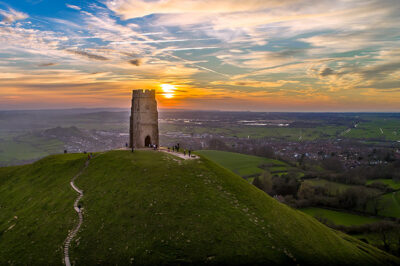
The town of Glastonbury, at last census, boasted a population under ten thousand people. The civil parish of Somerset, Glastonbury is about 23 miles south of Bristol and a mile across the River Brue from Street. Once a centre of commerce with its Glastonbury Canal and the Street railway station, it nowadays looks like a sleepy town at the foot of the enigmatic Glastonbury Tor, a dramatic hill in the distance, about ten minutes from the centre of town. At the top of the hill stands St. Michael’s Tower.
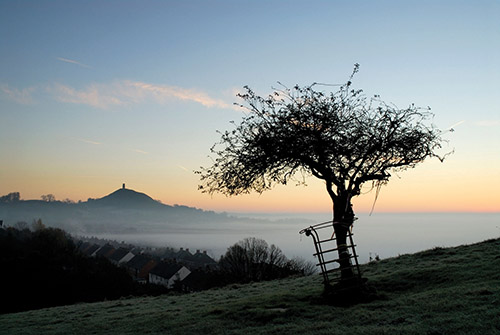
It is rumoured that beneath the Tor is a hidden hollow cave that can take you to the fairy world of Annwn, where the lord of the Celtic Underworld, Gwyn ab Nudd, lives with the Cauldron of Rebirth. Annwyn has been associated with Avalon of Arthurian legend, the land of the dead, with the Tor as the gateway to this otherworld. This may have led to a more recent rumour of the Tor being the place where Jesus’s alleged great uncle, Joseph of Arimathea, brought the Holy Grail to keep in hiding. As part of the legend of King Arthur, the Grail was the main object of his knightly quests and Glastonbury Tor has long been thought to be the famed Isle of Avalon where the body of King Arthur was sent to rest in eternal slumber.
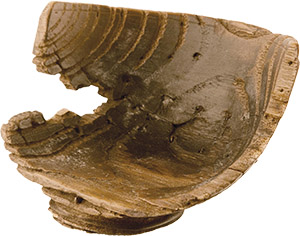
The Nanteos Cup, from the 14th–15th century, is located in the National Library of Wales.
The Tor is often referred to as “Ynys yr Afalon” which means “the Isle of Avalon” by the Britons, also known as the Isle of Glass because of how the Tor was reflected in the waters that once surrounded it. The Tor is close to the Glastonbury Abbey where legend places the burial coffins of King Arthur and Lady Guinevere, and the Welsh monastery that housed the Nanteos Cup. The Nanteos Cup is a medieval wood mazer bowl held for many years at Nanteos Mansion, Rhydyfelin, near Aberystwyth in Wales. Up to the late 19th century, it was said to have the supernatural ability to heal those who drank from it and traditionally believed to be fashioned from a piece of the True Cross of the crucifixion.
Near the Tor stand two ancient oak trees known as Gog and Magog, named after the prophesied invader of Israel and the land he came from, marking the entrance to the land of Avalon.
Shrouded in its mysterious past, the low-lying damp ground around the Tor produces a visual effect known as a Fata Morgana, during which the Tor seems to be literally rising out of the silvery mist. The Italian term Fata Morgana comes from the name of the powerful sorceress of the King Arthur legend, Morgan le Fay. This strange optical illusion is referred to in the title of the hugely popular book series The Mists of Avalon by Marion Zimmer Bradley.
A Visit From a Boy King
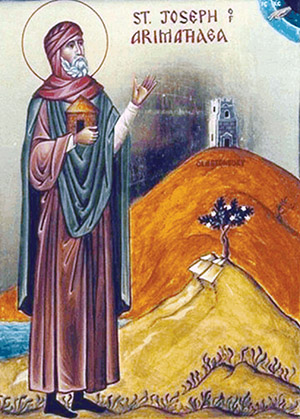
Rich with Arthurian legend and lore, the Glastonbury town and Tor also hold secrets to an even greater kingly visitation, that of Jesus Christ himself. Legend has it that Jesus came to Glastonbury as a boy with his great uncle Joseph of Arimathea, and his mother Mary, on a boat over the then flooded Somerset Levels. When Joseph arrived, he stuck his staff into the ground where it miraculously bloomed into the famed Glastonbury Thorn, also known as the Holy Thorn, a giant hawthorn tree that grew just a few miles from the town and flowered twice each year, once in the spring, the time of “resurrection,” and once around Christmas to mark the birth of Christ.
There was a tradition where a sprig was cut each year from the tree by the oldest child attending the St. John’s School and sent to the Queen. The Holy Thorn became a centre of pilgrimages during the Middle Ages but was cut down during the English Civil War. Replacement trees in the immediate spot didn’t fare too well, and now there are numerous hawthorn trees all over Glastonbury, including on the grounds of the Glastonbury Abbey, the St. John’s Church, and the Chalice Well.
Poet William Blake wrote of the legend of the boy Jesus visiting Glastonbury in his poem, ‘Jerusalem’:
And did those feet in ancient time
Walk upon England’s mountains green?
And was the Holy Lamb of God
On England’s pleasant pastures seen?
Glastonbury’s rich legends label it the western cradle of Christianity, at least in the British Isles. The Roman Empire, the centre of Christianity, had established trade links in the region, and Glastonbury bustled with a thriving arts community because of it. It was already an established centre for Celtic traditions and beliefs with a high level of culture, and Christian missionaries eager to convert pagans no doubt saw Glastonbury as a prized jewel, possibly even bringing relics back with them on their travels there.
The grounds of Glastonbury Abbey were located near the base of the Tor and consisted of a wattle and daub building, possibly the first church ever built in the British Isles, dedicated to the Virgin Mary. It has been posited that disciples of Christ built the church in the 1st century AD.
We have read of the missing or lost years of Jesus between the ages of 12 and 30, and that he travelled to India and the Far East to pursue spiritual studies. But he may have visited the British Isles much earlier after the death of his father, Joseph.
This was not uncommon during the time of Jesus. People often travelled from the Middle East to Britain, seeking trade or sending Roman-raised children to receive an education elsewhere. Despite the hardships of travel and the perception of isolation of the British Isles, this kind of journey happened all the time.
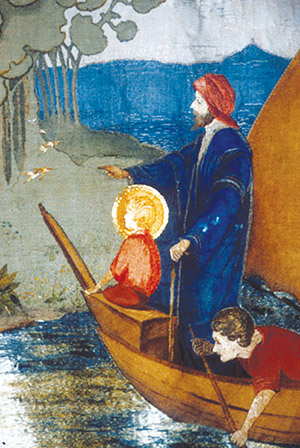
Who Was Joseph of Arimathea?
Joseph of Arimathea was the man responsible for the burial of Jesus Christ. His account can be found in the four Gospels: Matthew 27:57–60; Mark 15:42–46; Luke 23:50–53; and John 19:38–42. He came from the Judean town of Arimathea and was a part of the Sanhedrin – the council of Jewish religious leaders who called for Jesus’ crucifixion. Joseph was opposed to the council’s decision and was a follower of Jesus, but because of his position on the Sanhedrin, he kept it secret.
He was also very wealthy, although the source of his wealth is unknown (he is noted according to numerous sources to have done much travelling for trade in tin, wool, and other commodities). Joseph of Arimathea may have been a merchant in metals who often bartered in tin and took young Jesus with him on his journeys to England, India, and even to South America. Britain led the world at this time in tin mining, and Joseph was referred to as ‘Nobilis Decurio’ or Minister of Mines to the Roman Government by Gildas the Wise, a British monk who lived from 500-750 AD.
After Jesus’ crucifixion, Joseph went to Roman governor Pontius Pilate to request his body. Nicodemus, a Pharisee, accompanied Joseph, and they were granted custody of Jesus’s body, immediately preparing it for burial. Following Jewish custom, they wrapped the body in linen strips mixed in myrrh and aloe. On the Day of Preparation before the Jewish Sabbath, they quickly placed Jesus in Joseph’s own tomb. The day after, the chief priests and Pharisees went to Pilate to request that the stone Joseph had placed in front of the tomb be sealed, and a guard posted for three days to prevent Christ’s disciples from stealing the sacred body to fabricate a resurrection and match the prophecy. Despite the precautions, Jesus rose from the dead on the third day.
As for Joseph being a blood relative of Jesus, there is no such connection directly stated in the Bible itself, but the argument can be made that the members of the Sanhedrin would have never given the body of Jesus to someone who was not a blood relative. According to Jewish and Roman law, only the next of kin could accept the body of an executed criminal, so unless the wealthy Joseph of Arimathea found a way to buy the body and the Sanhedrin’s silence, he very well may have been Jesus’s great uncle.
It is said Joseph made many trips to Britain for trade and eventually brought the gospel to that country. Glastonbury legend holds that he returned to the same area some thirty years after the crucifixion and resurrection of Jesus, leading the twelve disciples there in 63 AD. The local king allowed them to settle on the Isle of Glass (Avalon), then an island in the marsh waters, where they fasted, prayed, and built the Old Church to honour the Virgin Mother. After they died, Pope Eleutherius restored the Old Church and founded a community of twelve hermits that eventually became the medieval monastic community.
Crossroads of Legend and History
We forget that legend is often a fictionalised truth and reflects actual events and people, embellished over time in the same manner as the famous game Chinese Whispers (aka Telephone) in which people whisper a phrase in the ear of the next person down the line. By the time the last person receives the phrase, it most likely has been added onto, if not outright changed from its original form. But it contains most aspects of its original form.
Numerous writings refer to Joseph visiting Glastonbury with the boy king, lending credence to the legends.
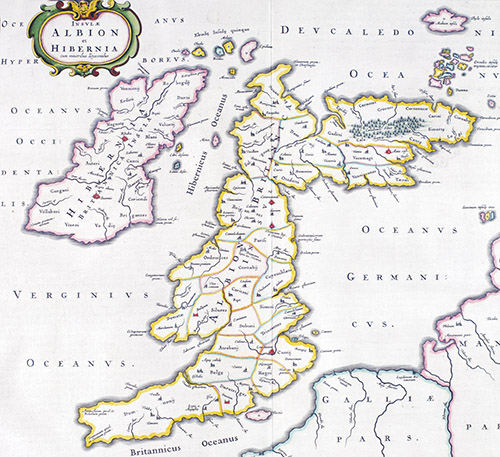
In his book, The Missing Years In the Life of Christ, Bertrand L. Comparet says: “Another Cornish tradition is to the effect that Joseph of Arimathea came in a boat to Cornwall and brought the boy Jesus with him, and the latter taught him how to extract tin and purge it of the wolfram. When the tin is flashed, then the tinner shouts ‘Joseph was in the trade’.”
Traditional tales told in Somerset include stories of Jesus and Joseph coming in a “ship of Tarshish to the Summerland, and sojourned in a place called ‘Paradise’.” “Summerland” is Somerset and at the mouth of the River Brue lies Burnham. An old Ordnance Survey Map gives the name of the area around Burnham as “Paradise.” Glastonbury appears in ancient writings by the name “Paradise.”
The greatest kings, bishops, saints, and heroes of the British race were buried at Glastonbury Abbey for a thousand years. There are historical references that suggest Jesus’s visit was real, including that of Taliesin, the Druid and Welsh prince and bard of the 6th century, who wrote: “Christ, the Word from the beginning, was from the beginning our teacher, and we never lost His teaching.”
Church Historian Hugh Paulinus de Cressy wrote in 1668 AD: “This our land of Brittany, though called by the Romans another word, as being divided from the whole then discovered habitable earth, yet by the riches of Divine mercy received the beams of the Sun of Righteousness before many other countries nearer approaching to the place where He first rose.”
There are numerous references to the presence of early Christianity in Britain from the likes of Tertullian, who wrote of the parts of Gaul and regions of Britain to receive the teachings of Christ and which were never penetrated by the reach of the Romans. The Roman Christian theologian Sabellius wrote in 250 AD that although Christianity was privately practised in other regions, Britain was the first nation to publicly proclaim its following of Christ’s teachings.
Gildas the Wise proclaimed in the 6th century that, “These islands, stiff with cold and frost, and in distant region of the world, remote from the visible sun received the beams of light, that is the holy precepts of Christ, at the latter part, as we know, of the reign of Tiberius Caeser.” There are numerous references of the “light” coming to Britain alongside those of the introduction of Christianity.
Cardinal Baronius, Church Historian, Librarian to the Vatican, quotes a Vatican manuscript, dated 35 AD, that in the same year the Jews arrested Joseph of Arimathea, they put Lazarus, Mary, Martha, and two other Christians on a boat and cast it adrift in the Mediterranean. When they reached land, they trekked by foot or four-legged beast to Britain. St Gregory of Tours, an early historian, writes in his History of the Franks about Joseph of Arimathea preaching the gospel of Christianity in Britain.
De Cressy says: “Now the most eminent of the primitive disciples, and who contributed most to this heavenly building, was St. Joseph of Arimathea, and eleven of his companions along with him, among whom is reckoned his son of the same name.” Could that son of the same name really have been Jesus?
Historians of the time noted that British King Arviragus granted to Joseph of Arimathea a considerable area at Glastonbury as a site for a church and its accessory buildings and fields. This was proven as fact in 1066 AD when William the Conqueror surveyed the kingdom’s lands for tax purposes and published it in the “Domesday Book.” Completed in 1088 AD, it contains the following: “The Domus Dei, in the great Monastery of Glastonbury, called The Secret of the Lord. This Glastonbury church possesses in its own Villa XII hides of land which have never paid tax.” The name of the early church, “Domus Dei,” means “The Home of God” and “The Secret of the Lord.”
When the Glastonbury Abbey was destroyed by fire in 1134 AD, King Henry II of England issued a royal charter to rebuild it, calling the Abbey “the mother and burying-place of the saints, founded by the very Disciples of our Lord.”
At the burial place of Joseph of Arimathea at Glastonbury is a sarcophagus. Upon it, there is a Latin epitaph said to have been recorded by the 14th-century monk Roget of Boston when it was exhumed in 1345 AD: “To the Britons I came after I buried Christ. I taught. I have entered my rest.”
If Jesus did walk the grounds of Glastonbury, and we have only the witnesses of ancient times to tell us he did, then one wonders how many other places he walked with his great uncle in search of trade routes? One wonders if Jesus as a child and later as a young man visited numerous places over the course of those missing 18 years which now remain a mysterious enigma… much like that of King Arthur, who many writers and scholars to this day believe is the Celtic equivalent of the story of the Christ.
Two Legends, One King?
There are obvious similarities between the stories of Jesus Christ and King Arthur. References abound that link Joseph of Arimathea to Arthurian legend, as with the stories of the Grail and his travels with Mary and Jesus and eventual burial at Glastonbury Abbey. In 540 AD, the historian Maelgwyn of Avalon, in Historia de Rubus Britannicis, writes: “In this church they worshipped and taught the people the true Christian faith. After about fifteen years Mary died and was buried at Glastonbury. The disciples died in succession and were buried in the cemetery.” Another book, St Joseph of Arimathea at Glastonbury by historian Lionel Smithett Lewis, quotes another historian, John of Glastonbury, who claimed to have traced the lineage of King Arthur through his mother, Igraine, through her paternal line, to Joseph, and it was his belief all twelve round table knights descended from Joseph.
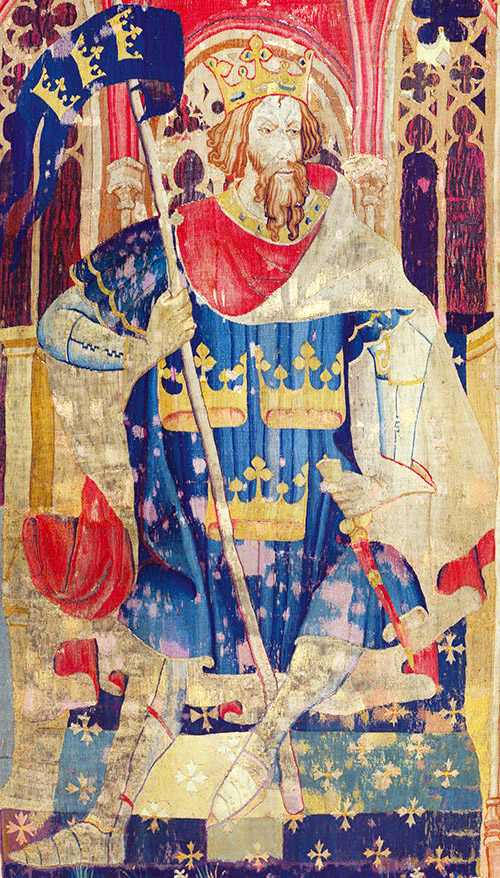
Were Jesus and Arthur different interpretations of the same story?
Both were conceived in a mystical way. Jesus was the result of the “virgin birth” when the Holy Spirit impregnated Mary. Arthur was born of a man looking like his father who impregnates his mother under enchantment.
Both were considered saviours, messianic figures with twelve devoted followers who carried out their missions.
Both were considered kings in their own right and gained their followings due to supernatural or “miraculous” acts. Both men fulfilled a prophecy. Both were betrayed.
Arthur was married to Guinevere, an adulteress. Jesus was said to have been married to Mary Magdalene, an alleged prostitute. Both women were powerful influences upon these men.
Both are associated with the symbols of swords and stones. Jesus proclaimed he was not here to bring peace but a sword and referred to his disciples as stones. Arthur is associated with the famed sword in the stone, Excalibur.
Both men were believed to walk between the earthly and spiritual worlds.
Both were said upon their deaths to one day return to help restore humanity.
There are challenges proving either man really existed in the same fashion that we currently believe because we are interpreting legends that passed down through the ages. Yet the circumstantial evidence, especially with the links between Joseph of Arimathea and the Christian and Arthurian worlds, and the ongoing research by those who seek proof in the physical historical records, is there for those willing to extend their faith beyond pure fact.
No matter if they were one and the same king, their stories are interwoven into the fabric of Glastonbury’s rich history and lore.
© New Dawn Magazine and the respective author.
For our reproduction notice, click here.