
From New Dawn 157 (Jul-Aug 2016)
Even the greatest thinkers are uneven. They have areas of brilliance and other areas where they cannot avoid showing their weaknesses. Immanuel Kant, for example, one of the most admired philosophers in Western civilisation, is known for The Critique of Pure Reason rather than for Dreams of a Spirit Seer, his intemperate and embarrassing rant against the visionary Emanuel Swedenborg.
René Guénon is no exception. An esoteric philosopher of uncommon brilliance, he has become increasingly influential since his death in 1951. But he, too, has areas where his views seem poorly reasoned and out of accord with known facts.
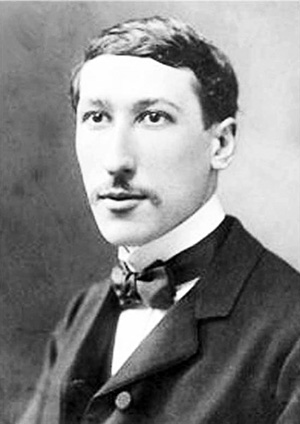
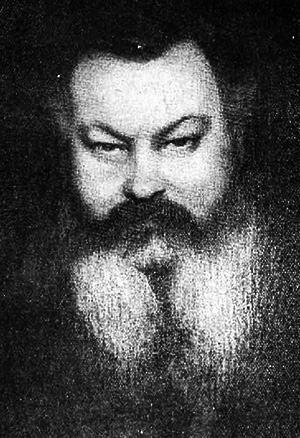
Born in Blois, France, in 1886, Guénon was educated as a mathematician. As a young man, he was drawn into the occult revival that was sweeping France at the turn of the twentieth century. He was befriended by Gérard Encausse, better known by his pseudonym Papus, the celebrated occultist who, among other accomplishments, founded the Martinist Order. But Guénon soon became dissatisfied with both Papus and occultism and drifted into other esoteric circles.
The years between 1906 (when Guénon began to explore occultism) and 1912 were the critical points in his development. After breaking with Papus, he received initiations in lineages connected with Taoism, Freemasonry, and Sufism. He also began exploring what he came to call “Tradition” – meaning not merely what has been handed down from antiquity, but a body of universal esoteric doctrine that, he contended, underlies all the great world religions.
Guénon’s explication of this Tradition, set out in many books and articles he published up until his death in 1951, has a number of curious features. In the first place, it is strongly oriented toward Hinduism, although the sources of Guénon’s contacts with Hinduism, both in the Paris of the Belle Époque and later, are mysterious in the extreme. Indeed his first book, Introduction to the Study of the Hindu Doctrines, was submitted as a dissertation to the Sorbonne but was rejected partly because, violating academic norms, it contained almost no references.
In the second place, although Guénon converted to Islam in Paris in 1910, and was initiated as a Sufi, before moving to Cairo in 1930, neither Sufism nor Islam plays any great role in his ideas. At the time of death, he had been living in Egypt for over twenty years, but his 3,000-volume library still contained four times as many books on Hinduism as it did on Islam, according to Mark Sedgwick in Against the Modern World: Traditionalism and the Secret Intellectual History of the Twentieth Century, an important study of Guénon and his followers.
Rather, for Guénon, the Traditional doctrine is most fully expressed in Hinduism. It is also focused on metaphysics. Today metaphysics – usually described as the philosophical study of being – is among the least sexy of intellectual pursuits. In Anglo-American academic philosophy, it is moribund. For Guénon it is central. Not surprisingly, his discussion of it is among the most masterful aspects of his work. But comparatively few of Guénon’s admirers give much attention to metaphysics.
Despite its failure to impress the Sorbonne, Introduction to the Study of the Hindu Doctrines was published in 1921. It is one of Guénon’s most important works and provides the best introduction to his thought.
Metaphysics – “Knowledge of the Universal…”
In it Guénon says that metaphysics, or metaphysic, in the singular, “is essentially the knowledge of the Universal, or, if preferred, the knowledge of principles belonging to the universal order… but in making this statement we are not really trying to propose a definition of metaphysic, for such a thing is a sheer impossibility by reason of that very universality which we look upon as the foremost among its characteristics.” Metaphysic stands above “that which changes or which is subject to the influences of time and place; the contingent, the accidental and the universal belong essentially to the individual domain.” Metaphysic deals not with this individual domain, but with the universal.
Although metaphysic “cannot contradict reason” of the conventional kind, “it stands above it.” Nor is metaphysic grasped with reason, but by the “intellect… that faculty which possesse[s] a direct knowledge of principles.” Intellect, in this sense, is not what present-day thought understands by that term. As Guénon describes it, intellect is a type of higher cognition – a direct experience of principles. And it is “infallible” because “its operation is immediate and, because, not being really distinct from its object, it is identified with the truth itself.” This, he adds, is exactly how Aristotle and his heirs, the Scholastic philosophers of the Middle Ages, understood the concept of intellect – in Greek, called nous, intellectus in Latin.
Intellect may be infallible, but the ways of expressing it are not. “Since all expression is bound to be imperfect and limited, error is inevitable in its form, if not its content: however exact one tries to make its expression, what is left out is greater than what is included.”
Symbolism of the Cross
One of the central themes of this metaphysics is what Guénon calls “the multiple states of being” (the title of one of his books). The best way to understand this concept is to picture it as Guénon does in what is probably his masterwork, The Symbolism of the Cross, published in 1931.
For Guénon, the significance of the cross goes far past its meaning in Christian symbolism. As he says, it is a virtually universal symbol. His explication of it magnificently illustrates not only his metaphysical system, but many otherwise obscure points in the symbolism of the world’s religions.
To begin with, the cross (pictured in its Greek, or equal-armed form) symbolises the juncture of the supernal with the mundane. The latter is represented by the horizontal line, which, Guénon says, represents the possibilities of manifestation at any given level of existence (such as human incarnation). The vertical line represents the ascent possible from one of these levels to another, and thus to “the indefinite series of states of the total being.”
Guénon expands this cross into a three-dimensional form. There are now two crosses, one perpendicular to the other, both with the same centre. The horizontal cross defines a plane – the plane of manifestation at any given level of being. This plane is not the only one there is. In fact at every point on the vertical line, another horizontal cross can be drawn, defining another plane and signifying another, different realm of being. The number of these realms is infinite, or, as Guénon puts it, “indefinite.”
Thus our human existence, complete with all the possibilities (both physical and spiritual) latent in it, comprises just one plane of this three-dimensional cross.
It’s not possible to go further into this schema here, which is sort of a Cartesian coordinate system of the levels of being (a comparison Guénon would have loathed; if he ever wrote a kind word about Descartes, I have not read it). But it masterfully ties together symbols and ideas from a wide and disparate range of traditions. One symbolic version of this cross is the World Tree, which is found almost universally.
In any event, these three books define the core of what he calls the Traditional doctrine:
Introduction to the Study of the Hindu Doctrines
Man and His Becoming according to the Vedanta
The Symbolism of the Cross
I would read them in the order given to get a comprehensive view of Guénon’s doctrine. They are not necessarily easy reading, but Guénon takes pains to write clearly and precisely. At any rate his style is free from the jargon-infested prose and pretentious neologisms favoured by many twentieth-century philosophers, particularly those on the European continent.
Spiritualism & Multiple States of Being
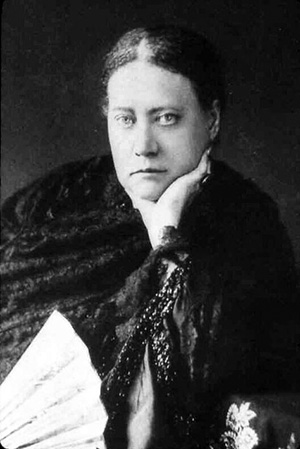
After Introduction to the Study of the Hindu Doctrines, Guénon published two books on more narrowly defined topics: Theosophy: History of a Pseudo-Religion and The Spiritist Error. These are the works in which his thought is the weakest. They aim to demolish the Theosophy of H.P. Blavatsky and her successors on the one hand, and, on the other, to combat the spiritualist, or spiritist,* movement that had reached its heyday in the nineteenth century. At the time Guénon was writing, in the early 1920s, many were drawn to spiritualism in the wake of the First World War. Bereaved survivors of dead soldiers often turned to it to be reassured of their loved ones’ continued life beyond the grave.
* The term applied to those who try to communicate with the dead is, in the English-speaking world, “spiritualism.” In French, it is spiritisme, “spiritism.” Guénon naturally uses the latter more often. There is some difference between these movements as they manifested in France and in the English-speaking world, but for convenience in this article, I will for the most part use the word spiritualism to apply to both.
Guénon did not believe that spiritualists genuinely contacted the dead, even in the cases where there was no fraud involved (and there were many in which it was). One of his main points has to do with the manifestations of spirits in séances. He did not think these “phenomena,” as he called them, were illusory. But he denied that they were actually appearances of the dead people in question. In his view, the essential core of the dead individual – the spirit – went on to another of the multiple states of being, and did so necessarily and without exception.
So who or what were the ghosts who appeared in séances? These, he claimed, were “simply those inferior elements that the being has in a way left behind in the earthly realm after the dissolution of the human complex that we call death. These are… what the ancient Latins called the manes. This is also what the ancient Hebrews called the ob, which is invariably the word used in biblical texts in regard to evocations” (cf. Deuteronomy 18:11; 1 Samuel 28:7). The root meaning of the Hebrew word ob (more correctly, ’ov) is “wineskin,” which suggests how the ancients conceived of these subtle remains. He explains:
It is, if you will, like a subtle form that can only take on an illusory corporeal appearance when manifesting under certain circumstances. This is the origin of the name the ‘double’ [ka] given to it by the Egyptians. For the rest, in all respects it is only an appearance. Separated from the spirit, this element cannot be conscious in the true sense of the word. Nevertheless, it possesses a semblance of consciousness, a virtual image, so to speak, of the living being. And the magician, reviving this apparition by lending it what it lacks, temporarily gives it enough of a reflexive consistency to obtain responses when he asks questions of it.
These astral remains thus are a kind of shell that the dead person has left behind, and which can be activated under certain conditions. They can even appear to answer questions.
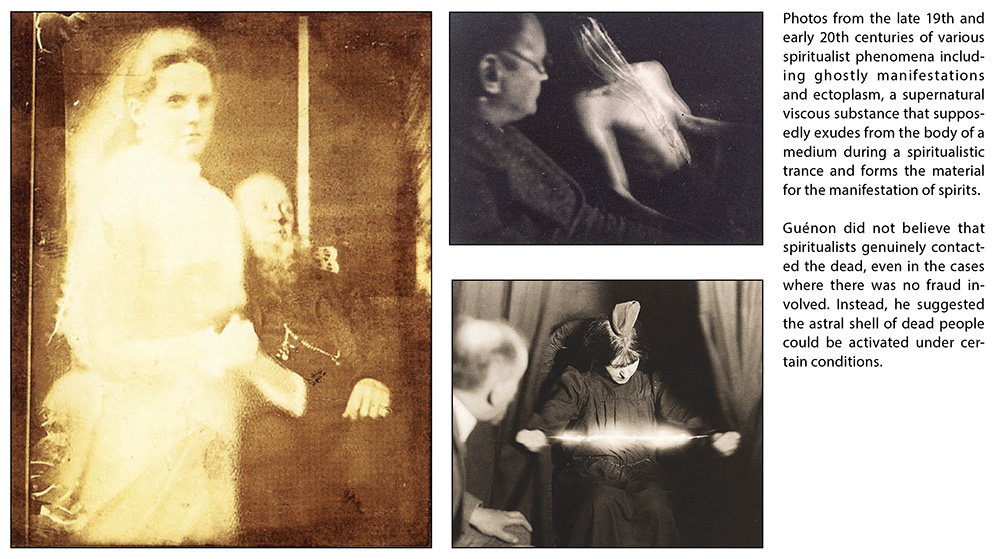
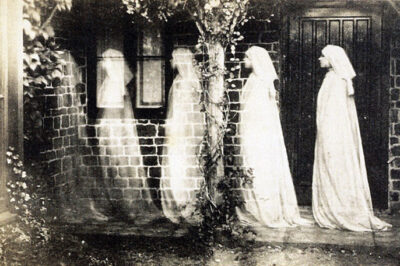
This explanation does not cover all of the phenomena that take place in séances. Guénon also talks about materialisation, “perhaps the rarest of all phenomena.” In these cases a spirit actually appears to manifest palpably to participants. “A kind of substance, at first unformed and nebulous, seems to separate itself from the [medium’s] body, then gradually condenses. These entities often can be seen, touched, and even photographed (thereby excluding the possibility of hallucination).” In these cases, Guénon claims, the form arises from the mind of either the medium or of one or more of the participants. This is why there have been apparitions of people who turned out never to have existed. “Cases have been noted in which the ‘materialised’ forms quite simply copied portraits of fantastic figures borrowed from pictures or designs seen by the medium,” he writes. The energy is supplied by the medium or the participants or both.
Why does Guénon take such great pains to refute the ideas of the spiritualists? To return to his metaphysical system, in which each plane in the three-dimensional cross represents one level of manifestation – even, one could say, of reality – Guénon holds that an individual goes through each level exactly once and then passes on to another. He does not remain in connection with the previous level. It is to refute these fallacies that he makes his elaborate case in The Spiritist Error. One could even say that, in essence, this is the spiritist error.
His arguments are successful up to a point: they seem to fit in well with descriptions of the spiritualistic phenomena of his time and earlier. Furthermore, they help explain why most encounters with the dead take place in the few days after death, when presumably these residual elements have not had the time to break down fully. But Guénon’s claims stop short of explaining all such phenomena. There are instances in which the dead person appears much later than the time of death. Moreover, it seems to be in full consciousness and aware of things that were not known by the person to whom it appears. Such are the cases with warnings sometimes given by the dead to avoid certain voyages or plane flights.
One difficulty here, as with many of Guénon’s arguments, is that he holds rather rigidly to an extremely precise schema that is logical and consistent in its own terms but does not completely square with manifest reality. Indeed, even by his own theory, there must necessarily be some dissociation between the world of pure principle and the imperfect world of manifestation. But sometimes he does not seem to grasp the implications of this fact.
Guénon on Reincarnation
Guénon also takes great pains to refute the teaching of reincarnation. “The idea of reincarnation… like that of evolution, is a very modern idea; it appears to have materialised around 1830 or 1848 in certain French socialist circles” (Guénon, Theosophy, 104). Regarding the transmigration of human souls into animals, he says:
In reality, the ancients never conceived of such transmigration, any more than they did of a human into other humans, which is how one might define reincarnation. There are expressions, more or less symbolic, that could give rise to such misunderstandings, but only when one does not know what they are really saying, which is this: There are psychic elements in the human being which separate themselves after death, and which can pass into other living beings, human or animal, although this has no more importance than the fact that, after the dissolution of the same individual, the elements that made him up can be used to make up other bodies.
Unfortunately, the ancient accounts of reincarnation say nothing of the kind. At the end of the Republic, Plato tells the myth of Er, a soldier who has a near-death experience in which he learns the fates of individuals after death (Plato, Republic, 614b-621d). In one famous passage, Er sees the dead choosing their lots for new incarnations. Odysseus, the shrewdest of men, refuses lives of riches and honour and instead chooses the existence of an ordinary citizen. However “symbolic” this story might be, it is hard to see how it might accommodate itself to a theory like Guénon’s. One could make the same point about the teachings of the Pythagorean mysteries, to the extent that we know anything specific about them.
Guénon’s own views about the fate of the spirit after death are complex. Defining transmigration in what he considers the true sense, he contends, “It is not a matter of a return to the same state of existence… but on the contrary, the passage of the being to other states of existence, which are defined… by completely different conditions from those to which the human being is subject… Whoever speaks of transmigration is essentially speaking about a change of state. This is what all the traditional doctrines of the East teach, and we have many reasons to believe that this was also the teaching of the ‘mysteries’ of antiquity; it is the same thing even in heterodox doctrines such as Buddhism.” The last remark indicates that when he was writing The Spiritist Error, in the early 1920s, Guénon believed that Buddhism was not a pure reflection of the “orthodox” Traditional doctrine. Later in life, he granted it a certain grudging acceptance.
As we have seen, Guénon conceives of existence as a kind of three-dimensional grid, with a vertical axis transecting an infinite number of horizontal planes. The vertical axis represents the Self, the true essence of a given being; each of the innumerable horizontal planes constitutes a separate plane of manifestation. Human life on earth is only one of these planes. A given being can manifest itself only once on any particular plane. Therefore you cannot be born more than once as a human.
Like much of Guénon’s thought, this is rigorously precise and would seem to be irrefutable except for one thing. Guénon assumes that any given plane – such as earthly human life – is static. But in fact there is nothing to prove that this is so. On the contrary, the earth and earthly life are changing form ceaselessly, whether we look at them from the perspective of geological ages or even of human history. The possibilities for human life on earth today are not the same as they were in the year 1000 or will be in 3000. You can never be born onto the same earth twice, any more than you can be born as the same person twice.
At that time Guénon could get away with saying that Hinduism and Buddhism did not teach reincarnation. The number of Hindus and Buddhists in the West was insignificant, and many of those were Western converts. It is much harder to make such claims now, when the West has access to teachers from high levels in these traditions. The Dalai Lama, for example, the supreme authority in Tibetan Buddhism, has written: “There have been and are found at the present time, many incidents illustrating rebirth, from many countries in the world. From time to time small children talk about their work in a previous life and can name the family in which they lived. Sometimes it is possible to check such cases and so prove that the facts remembered by the child are not at all nonsense but are indeed true.”
And of course the Dalai Lama’s credentials as an authority of “Traditional” teaching are far more solid than Guénon’s own.
For a Hindu perspective, we might turn to Paramhansa Yogananda’s classic Autobiography of a Yogi. Yogananda quotes his guru, Sri Yukteswar, as saying, “Beings with unredeemed earthly karma are not permitted after astral death to go to the high causal sphere of cosmic ideas, but must shuttle to and fro from the physical and astral worlds only.” The process of shuttling to and fro from the physical world would suggest that physical incarnation is not a once-only option. And again, the credentials of both Yogananda and Sri Yukteswar as transmitters of traditional teaching are far higher than Guénon’s.
A follower of Guénon’s might try to argue that all of these Eastern teachers have been somehow corrupted by Western views – but that comes very close to begging the question. If you are trying to determine whether “Traditional” Hinduism and Buddhism teach reincarnation, you cannot categorically say that any Hindu or Buddhist teacher who holds to such a doctrine is therefore “untraditional.” You are assuming the very thing you are trying to prove.
Why should Guénon work so hard to deny the ideas of both the spiritualists and the Theosophists (the leading proponents of reincarnation in the West in his time)? Because, in his view, they are corruptions of Traditional ideas that date, at the earliest, from the eighteenth century. And if you read both Theosophy: History of a Pseudo-Religion and The Spiritist Error, you will see that he has an almost convulsive aversion to such concepts as “progress,” “evolution,” and reincarnation.
Guénon believed that the early nineteenth-century utopian French socialists Charles Fourier and Pierre Leroux invented the concept of reincarnation in order to explain inequalities among the human race. For Guénon, such inequalities are inevitable and even, one suspects, uninteresting. Every individual is different from every other; if it were otherwise, they would not be individuals at all. Thus of necessity all humans have different capacities and fates. Guénon accepts this eventuality with more equanimity than, I suspect, most readers would.
In an article on Guénon’s views of reincarnation, scholar Joscelyn Godwin points out the likely basis of Guénon’s reasoning. “In an infinite series, such as that of integers, each term appears but once. Likewise, in the infinite variety of the Universe, experienced in its totality by every being, no single state need or can be repeated.” By such reasoning reincarnation would be impossible.
Of course that would be true if the states of being were exactly analogous to mathematical integers, but there is no reason to accept such a thing a priori. In fact much of Guénon’s arguments against the failings of modernity have to do with its obsessive interest with number above all things – what he calls the “reign of quantity.” He quotes Thomas Aquinas, who wrote, Numerus stat ex parte materiae: “Number is on the side of matter.” This means that number, or quantity, has to do with matter, not with the world of the spirit. Number, as Guénon so intricately argues, does not apply to the higher, spiritual realms. There is, then, no reason to suppose that the laws of mathematics, however apparently inexorable, would apply either.
Every thinker has his own dynamic – meaning the tensions between two ideas or types of ideas that he struggles, more or less successfully, to reconcile. For Guénon it is the tension between the world of multiplicity, of number, of quantity, of matter on the one hand and the realm of the intellect, of the spirit, of what he calls “quality” on the other. This dynamic, as he understands, is a powerful, perhaps an all-powerful one. And he intuits – correctly, I believe – that the modern world is balanced far too much in the direction of matter and quantity. But I am not sure that he himself manages to step past this imbalance completely. He himself may be prone to the fault that he so readily sees in others: applying quantitative principles to realms where quantity does not apply. He is no doubt right in saying that the states of being are infinite, or virtually so. But then its possible combinations would be infinite as well, and it would not be wise to jump to conclusions about what is and is not possible within them.
Sources
The Dalai Lama XIV, The Opening of the Wisdom-Eye, 2nd ed., Quest Books, 1991
Joscelyn Godwin, “The Case against Reincarnation,” Gnosis 42 (Winter 1997), 28–32
René Guénon, L’erreur spirite, 2d ed., Éditions Traditionelles, 1952
René Guénon, Theosophy: History of a Pseudo-Religion, Translated by Alvin Moore Jr. et al., Sophia Perennis et Universalis, 2003
Richard Smoley, “Against Blavatsky: René Guénon’s Critique of Theosophy,” Quest 98:1 (Winter 2010), 28–34; www.theosophical.org/publications/quest-magazine/42-publications/quest-magazine/1696-against-blavatsky-rene-guenons-critique-of-theosophy; accessed March 28, 2016.
© New Dawn Magazine and the respective author.
For our reproduction notice, click here.