

From New Dawn Special Issue Vol 18 No 6 (Dec 2024)
I believe that some of us dedicated to experimental spirituality and mind metaphysics must attempt to theorise the mechanics and delivery systems behind what we experience and observe. There exist, of course, manifold risks of personal bias toward a favoured thesis. But to limit the wish to “know thyself” to clinical study is to eviscerate the principle itself. This is my effort to describe “what happens” in the process of thought causation or what is popularly, though inadequately, called positive thinking or manifestation.
Everyone hates The Secret. Mainline cultural commentators and “serious” spiritual seekers routinely resurrect the nearly 20-year-old work for excoriation, presumably allowing H.L. Mencken (1880–1956) to sleep undisturbed after writing the first “take down” piece on mind metaphysics more than a century ago. In 1910, the Bard of Baltimore wrote in “Mental Vibrations”:
The New Thought, that fantastic magic, goes marching on… There is, in brief, little if any truth in the belief that good wishes may be transformed into objective phenomena, that mind influences matter – and little, even, in the belief that mind influences mind.
To today’s cutting-edge rationalists who would lift our spiritual blinkers: we’ve been there.
Mapping a Theory of Thought Causation
My task in this article is neither to defend alternative spirituality nor enumerate its flaws – of which I write often – but rather to consider why, from a spiritual or extra-physical perspective, positive thinking, “manifestation,” or the “Law of Attraction” just might work. Before you cry confirmation bias! (materialism’s equivalent of lock her up!), take a beat.
I venture to map a seeker’s theory of mind causation – but one that also stands defensible within parameters of accepted (if not always understood) knowledge. My theory may be wrong. It may be grossly incomplete. But I believe that those of us engaged in the search for practical spirituality must at least attempt to theorise from the intersection of testimony, science, and experience. Each generation owes the labour of verification to the search of the next, which will have its own ideas and critiques.
Indeed, today’s seekers must move beyond inherited decisions and templates. We need our own experiments and results, including failures. Those of us who care about New Thought, or mind causation, owe the spiritual culture – and ourselves – a supportable hypothesis of how it works. We must be equally willing to discard cherished hypotheses. In that vein, I conclude this essay with articles of personal experimentation.
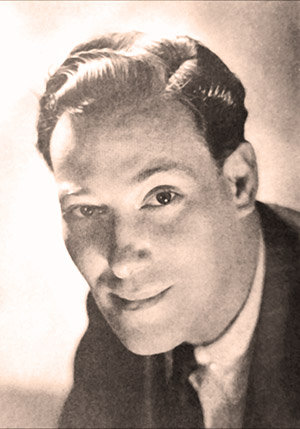
I start by quoting mystic Neville Goddard (1905–1972) from a 1948 series of lectures in Los Angeles:
Scientists will one day explain why there is a serial universe. But in practice, how you use this serial universe to change the future is more important.
It was a striking observation. The mononymous Neville is, I believe, the most penetrating voice to emerge from New Thought tradition – because it was not until years later that quantum physicists began discussing the many-worlds theory, devised by physicist Hugh Everett III (1930–1982) in 1957.
A Short Overview of Quantum Physics
Everett was attempting to make sense of some of the extraordinary findings that had been occurring for about three decades in quantum mechanics. For example, scientists are able to demonstrate, through various interference patterns, that a subatomic particle occupies a wave state or state of superposition – that is, an infinite number of places – until a sentient observer or automatised device takes a measurement: it is only when measurement is taken that the particle collapses, so to speak, from a wave state into a localised state. At that point, it occupies a definite, identifiable, measurable place. Before measurement is taken, however, the localised particle exists only in potential.
Now, I have just about squeezed all of quantum physics into a couple of sentences. I think it is an accurate description, but obviously I am reducing huge complexities into the dimensions of a marble. I believe I am faithfully stating what has been observed in the last ninety-plus years of particle experiments (as well as emerging experiments on larger objects, such as hydrogen molecules). We are seeing that on the subatomic scale matter does not behave as we are conditioned to expect.
Measurement & Observation: The Role of Mind
Starting about twenty years ago, it became fashionable for New Agers and laypeople, like me, to put quantum theory at the back of cherished spiritual principles. It became equally fashionable for professional sceptics and mainstream journalists to pushback, crying B.S. and sophistry. That position, while still heard, has quieted. Not because sceptics have grown more pensive or attenuated to media-speak, but because the proposition of mind-over-matter, strange as it may seem, now resounds in debates on theoretical physics in mainline journals and magazines.
In 2009, I attended a presentation on the “quantum measurement problem” delivered by parapsychologist Dean Radin before an audience of scientists, social thinkers, and scholars of religion. I asked Radin to address the 800-pound gorilla in the room: If observation and perspective alter material on a micro level, in the world of waves and particles, might that say something about the legitimacy of the New Thought or mind-power thesis? “It’s not complete bullshit,” Radin replied. “There may be an inkling of something to it.” Another physicist and longtime military researcher was also present. “As the resident sceptic,” he said, “I concur.”
Our understanding of matter in our macro world generally comes from measuring things through our five senses and experiencing them as singularities. There is one table. It is solid and definable. It is not occupying an infinite number of spaces. But contemporary quantum physicists have theorised that we may not normally see or experience superposition phenomena because of what is sometimes called information leakage.
This means that we gain or lose data based on fineness of measurement. When you measure things with exquisitely well-tuned instruments, like a microscope, you see more and more of what is going on, i.e., actual reality. But when you pan the camera back, so to speak, your measurements coarsen and you see less and less of what is actually happening. To cite the most basic example, to all ordinary appearances, a table is solid. The floor beneath your feet is solid. Where you are sitting is solid. But measuring through atomic-scale microscopes, we realise that if you go deeper and deeper, space appears within these objects. Particles make up the atom and still greater space appears. We do not experience that; we experience solidity. But no one questions that space prevails among particles composing an atom.
Furthermore, we possess decades of data demonstrating that when subatomic particles are directed at a target system, such as a double slit, they appear in infinite places at once until a measurement is made; only then does locality exist. But we fail to see this unless we are measuring things with comparative exactitude. Hence, what I am describing seems unreal based on lived experience – but it is actual.
In any event, my supposition is this: if particles appear in an infinite number of places at once until a measurement is taken; and if, as we know from studying the behaviour and mechanics of subatomic particles, there exists an infinitude of possibilities; and if we know, as we have since the inception of Einstein’s theories, that time is relative, then it is possible to reason – and it is almost necessary to reason – that linearity itself, by which we organise our lives, is illusory.
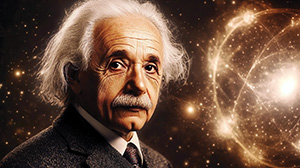
Linearity is a useful and necessary device for five-sensory beings to get through life; but it does not stand up objectively. Linearity is conceptual – a subjective interpretation of what is really going on. It is not reflected in Einstein’s theory of relativity, which demonstrates that time slows for an object approaching the speed of light. (The individual travelling in a metaphorical spaceship at or near light speed experiences time slowing, not from their perspective but in comparison to those not at near light speed. And this is no mere thought exercise: space travellers in our era, although they are obviously approaching nowhere near that velocity, experience minute effects of time reduction.) Nor is linearity reflected in quantum mechanics, where particles appear in an infinitude of places and obey no orderly modality. Linearity is not replicated when measurement of a particle serves to localise the appearance or existence of the object.
This begins to clarify why Einstein famously wrote in a letter of March 1955:
People like us, who believe in physics, know that the distinction between past, present, and future is only a stubbornly persistent illusion.
If we pursue this line of thought further – and this is where Everett’s many-worlds theory comes into play – the very decision to take a measurement (or not take one) not only localises a particle but creates a past, present, and future for that particle. Hence, an observer’s decision to log a measurement creates a multidimensional reality for the particle.
There exists debate over whether a device represents a method of measurement distinct from an observer, as well as whether the “collapse” from wave to particle results from an observer’s individual psyche or “transpersonal mind behaving according to natural laws,” as observed by Bernardo Kastrup, Henry P. Stapp, and Menas C. Kafatos in a May 29, 2018, Scientific American article “Coming to Grips with the Implications of Quantum Mechanics.” This transpersonal mind, the writers continue, “comprises but far transcends any individual psyche,” a description similar to the Hermetic concept of Nous or an over-mind. The authors compellingly argue that even if a device is used for measurement – and thus localisation – perception and intent, either of the individual, the meta-mind, or both, remains the determining force.

Schrödinger’s Cat
Multidimensional reality is implied in the famous thought experiment called Schrödinger’s Cat. 20th-century physicist Erwin Schrödinger (1887–1961) was frustrated with the evident absurdity of quantum theory, which showed objects simultaneously appearing in more than one place at a time. Such an outlook, he felt, violated all commonly observed physical laws. In 1935, Schrödinger sought to highlight this predicament through a purposely absurdist thought experiment, which he intended to force quantum physicists to follow their data to its ultimate degree.
Schrödinger reasoned that quantum data dictates that a sentient being, such as a cat, can be simultaneously alive and dead. Here is a variant of the Schrödinger’s Cat experiment: a cat is placed into one of a pair of boxes. Along with the cat is a collar fitted with a device which, if exposed to an atom, releases a deadly poison. An observer then fires an atom at the boxes. The observer subsequently uses some form of measurement to check which box the atom is in: the empty one or the one with the cat and the poisoning device. When the observer goes to check, the wave function of the atom (the state in which it exists in both boxes) collapses into a particle function (the state in which it is localised to one box). Once the observer takes his measurement, convention says that the cat will be discovered to be dead or alive. But Schrödinger reasoned that quantum physics describes an outcome in which the cat is both dead and alive. This is because the atom, in its wave function, was, at one time, in either box, and either outcome is real.
Of course, all lived experience tells us that if the atom went into the empty box, the cat is alive; and if it went into the box with the cat and the poisoning device, the cat is dead. But Schrödinger, aiming to highlight the frustrations of quantum theory, argued that if the observations of quantum-mechanics experiments are right, you would have to allow for each outcome.
To take it even further, many-worlds theorists in the 1950s posited that if an observer waited some significant length of time – say, eight hours – before checking on the dead-alive cat, he would discover one cat that was dead for eight hours and another that was alive for eight hours (and now hungry). In this line of reasoning, conscious observation effectively manifested the localised atom, the dead cat, and the living cat – and also manifested the past, or in other words, created a history for both a dead cat and a living one. Both outcomes are true.
So, whatever a particle is doing, the very fact that a sentient observer has chosen to take a measurement at that time, place, moment, and juncture creates a whole past, present, and future – an infinitude of outcomes. A divergent set of outcomes would exist if that measurement were never taken. A divergent set of outcomes would also exist if that measurement were taken one second later, or five minutes later, or tomorrow. And what is tomorrow? When particles exist in superposition until somebody takes a measurement, there is no such thing as tomorrow, other than subjectively.
Consider too: the cat, from its perspective, is local; the observer, from its perspective, is local – but both, in fact, are in a wave state or superposition. We can speak of them as concrete, singular beings only from their personal perspective. From the quantum perspective, they are infinite. Expanding on this idea, research physician Robert Lanza, adjunct professor at Wake Forest University School of Medicine, argues that death itself is ultimately a mental phenomenon: we “die” only insofar as an observer perceives demise; the consciousness of the “deceased” branches off into one of Everett’s many worlds. (This begs the question of who experiences these effects if there’s no such thing as “one” person/life. I consider this in my book Daydream Believer.)
And what, finally, are our five senses but a technology by which we measure things? Are our five senses anything other than a biological technology, not necessarily different in intake from a camera, photometer, digital recorder, or microscope? So, it is possible that within reality – within this extra-linear, super-positioned infinitude of possibilities in which we are taking measurements – we experience things based upon our perspective. This is why in considering mind causation I use the term select rather than manifest.
Neville Goddard: Thoughts Have Wings

Here, we return to mystic Neville Goddard. His instinct was, I believe, correct in the schema just considered. Neville taught that you can take a measurement by employing the visualising forces of your imagination. You are taking a measurement within the infinitude of possible outcomes. The measurement localises or actualises the thing itself.
In the 1948 lectures quoted earlier, Neville further noted:
Man can prove the existence of a dimensionally larger world by simply focusing his attention on an invisible state and imagining that he sees and feels it. If he remains concentrated in this state, his present environment will pass away, and he will awaken in a dimensionally larger world where the object of his contemplation will be seen as a concrete objective reality.
I feel intuitively that, were he to abstract his thoughts from this dimensionally larger world and retreat still farther within his mind, he would again bring about an externalisation of time. He would discover that, every time he retreats into his inner mind and brings about an externalisation of time, space becomes dimensionally larger. And he would therefore conclude that both time and space are serial, and that the drama of life is but the climbing of a multitudinous dimensional time block.
Again, note how foresightful Neville’s ideas and language proved of the many-worlds theory.
Aleister Crowley, the confounding and brilliant British occultist and artist, made a statement related to Neville’s. Writing in the introduction to his 1904 channelled text The Book of the Law – later published in a general edition in 1938 – Crowley observed:
Each of us has thus an universe of his own, but it is the same universe for each one as soon as it includes all possible experience. This implies the extension of consciousness to include all other consciousnesses. In our present stage, the object that you see is never the same as the one that I see; we infer that it is the same because your experience tallies with mine on so many points that the actual differences of our observation are negligible… Yet all the time neither of us can know anything… at all beyond the total impression made on our respective minds.
Neville’s formula is simplicity itself: an assumption, if persisted in, hardens into fact. But the assumption must be persuasive; it must be convincing. That is why emotions and feeling states must come into play. And Neville observed that you can use hypnagogia – the state of cognizant pre-sleep or drowsy relaxation – to help facilitate that process.
Hypnagogia naturally occurs twice daily: just prior to and following sleep. It is a period of hallucinatory sentience during which we are nonetheless capable of controlling attention; what’s more, your rational defences are lowered. This can be considered “prime time” to visualise a desired end. (Hypnagogia is also a period of heightened ESP-related activity, as recorded in academic psychical research.)
Another way of using Neville’s approach to mental creativity is to enter an inner state of theatrical or childlike make-believe. Not childish but childlike: a state of internal wonder and pretending. Children excel at this. We grow embarrassed about this quality as we age, but Neville spoke ingenuously about walking the streets of Manhattan imagining that he was in the treelined lanes of his native Barbados, boarding a ship to some desired destination, or in a location where he wanted to be.
He would say: “Unfoldment will come. You will see.” Again, he argued that an assumption, although false, if persisted in, eventually hardens into fact. He further advised, “Assume the state of the wish fulfilled. Live from the end.” Remember, the teacher reminded listeners, you are not in a state of wanting; you are in a state of having received. Your aim is simply to occupy the emotional and mental condition that you would experience following fulfilment.
Of course, you must also continue to go about your adult life in this world of Caesar, currency, and commerce – fulfilling your obligations and remaining accountable. You must cooperate with the world. You must do the normative things that life requires. The crisis of the New Age is the inability of an outsized number of its adherents to abide this. In my observation, until a person demonstrates accountability, competency, and agency in outer life, the spiritual path is a diversion, possibly a disastrous one.
Should you accept this challenge, how long will it take to witness your desired changes in outer life? How long is required for outer life to conform to your internal focus, your act of living “from the end” of your ideal? The question of time intervals is deeply fraught because with all the stresses that life throws at us, it is very difficult to adopt a feeling state and stick with it for weeks. At times, psychological barriers and stresses make it impossible.
Neville noted that there could fall a substantial time interval between your visioning and experience of the wished-for state or thing. He would point out that the gestation period of a human life is nine months. The gestation period of a horse is eleven months. The gestation period of a lamb is five months. The gestation period of a chick is twenty-one days. There is almost always going to be some time interval. You will find that naturalness of persistence comports with depth of passion for your aim. It can appear more a matter of the aim holding you than you it. This is one reason why clarity of aim and self-honesty are essential: we follow emotions, acknowledged or not.
Careful What You Wish For
Johann Wolfgang von Goethe (1749–1832) made an interesting observation in this vein. We have all heard the expression, “Be careful what you wish for; you just might get it.” It is rooted in Goethe. Taking a leaf from the philosopher and dramatist’s play Faust (c.1772–1775),Ralph Waldo Emerson noted this dynamic in his 1860 essay “Fate,” which led to the popular adage. Emerson wrote:
And the moral is that what we seek we shall find; what we flee from flees from us; as Goethe said, “what we wish for in youth, comes in heaps on us in old age,” too often cursed with the granting of our prayer: and hence the high caution, that, since we are sure of having what we wish, we must beware to ask only for high things.
We are being warned to act with perspective: what we wish for when we are young will visit us in waves when we are old.
Goethe’s observation relates to Neville’s remarks about the perceived passage of time and the gestation between thought and actualisation. Many people would reasonably object that they have all kinds of unfulfilled wishes. But unlocking the truth of this observation requires peeling back the layers of your mind and probing formative images and fantasies from when you were very young.
What is the earliest dream you recall from when you first gained conscious memories, maybe at age three or four? What fantasies occupied your earliest recollective years? Children lead very intense fantasy lives, even at ages four or five. If you take Goethe’s counsel, you might be surprised – barring extreme countervailing events (to which I return) – to discover remarkable symmetry between things you are living out today and concepts you harboured when very young. These can be positive, negative, or numerous stations between.

Neville recommended against thinking in terms of, “It will happen this way” or, “I’ll do something to make it happen.” His attitude was that the event will unfold in its own natural manner. In his system, your job is not to draw the map – it is to live from the destination.
I must, finally, add a word about suffering on both an intimate and global scale. New Thought has proven woefully inadequate in addressing matters of implacable tragedy and catastrophe, a topic on which I’ve written widely.
My contention is that even if awareness or consciousness is the ultimate arbiter of existence, we still experience many different laws and forces within the physical framework we know. I used to say that we live under many different laws and forces; I’m not sure if that’s entirely right. But we certainly experience diffuse laws and forces, and these experiences are hard-baked into us.
So, it stands to reason that even if emotive thought, perspective, and awareness are determinative of what reality gets concretised into our individual experiences, there exist different laws and possibilities that are also playing out at the same time. There are physical facts which also form part of the nature of our experience within the framework that we find ourselves. And it could be that there are other frameworks in which our psyches are much freer. There may be frameworks in which we experience fewer laws and forces that seem to interrupt a sense of continuity between you, the individual – you, the seeker – and that which you experience.
That said, suffering and catastrophe must, for every ethical being, be understood as fundamental, urgent, and, where possible and according to personal conviction, requiring of amelioration and solidarity.
I believe that Neville is going to be remembered – and is already seen today – as having created the most elegant mystical analogue to quantum physics.
When I started writing about Neville in 2005 – the first journalistic coverage of his life since the 1940s – he was a figure of obscurity even among most New Thoughters. But today Neville’s voice and work net millions of results in search engines. At a 2022 tech conference, I was floored by the number of programmers and engineers (not the usual suspects) who approached me to talk about him.
As seen, Neville espoused a variant of the many-worlds theory long before the popularisation of quantum physics. Indeed, he had a series of remarkable instincts in the 1940s that have since been tantalisingly, if indirectly, reiterated by quantum theorists – most of whom have not (yet) heard his name.
Indeed, it would not surprise me if, within a generation, some physics students begin to read Neville as a philosophical adjunct to their work. That may seem a stretch, but remember that many of today’s senior cohort of physicists, people in positions of academic and grant-making authority, were inspired by Star Trek, Arthur C. Clarke,and Zen and the Art of Motorcycle Maintenance. There is visibly greater openness in the field today to matters of perspective and thought causation.
Living by the Inner Light of Conviction
As I’ve suggested, you can use several different techniques in connection with Neville’s ideas, including those of your own devising: I challenge you to try them and see what happens. You are entitled to results. I believe that every therapeutic, ethical, or spiritual philosophy should produce some concrete and desired change in your life and conduct; if it does not, then such an idea warrants no hold on you.
I feel similarly that the ability to observe and note an outcome in your life is vitally important. Testimony forms a critical source of ideas, a meaningful record, and a warranted inducement to others.
We all live by philosophies, spoken or not. Even if we say we do not have an ideology, we obviously harbour assumptions by which we navigate life. When I look back on figures like Neville or pioneering parapsychologist J.B. Rhine (1895–1980), I realise that their greatness is that they lived by the inner light of their ideas. That is rare. We are a world of talkers. People are sarcastic or cruel over Twitter and think they are taking a principled stand. Is it courageous or honourable for a keyboard warrior (often under a pseudonym) to call out people online? That is no victory. It is make-believe morality.
When we look back on iconic figures in the social, cultural, artistic, or spiritual milieu, we remember those few who lived by the inner light of conviction; who struggled to comport their ideals with conduct. Such private philosophies are the only ones that last. Indeed, if you cannot keep your word, apologise, demonstrate solidarity or loyalty, then write nothing of an ethical or spiritual bent. You’ll be writing on sand.
I must state the following and I mean it in my heart: if you sincerely attempt what I am theorising in this article, I believe that you will find greatness; because, if nothing else, you will be attempting to live by the inner light of an idea. Try.
© New Dawn Magazine and the respective author.
For our reproduction notice, click here.