
From New Dawn Special Issue Vol 18 No 6 (Dec 2024)
I am the founder and premier investigator of the Mars research group known as The Cydonia Institute and a member of the Society for Planetary SETI Research (SPSR). My research encompasses over 30 years of study and analysis of NASA and ESA images of the planet Mars.
I have coauthored two books and six peer-reviewed science papers that discuss anomalous formations on the surface of Mars. Over the past two decades, I have attended various science conferences and seminars as an invited speaker and appeared on numerous radio, podcasts and television programs, such as Beyond Belief and Coast to Coast with George Noory. I also appeared on the History Channel’s Ancient Aliens, The Proof is Out There and The UnXplained with William Shatner.
From Artist to Investigator: A Journey into Mars’ Anomalies
Before I continue, I would like to make a very clear point. I am not a scientist. I am an artist. My early schooling was in the visual arts. I am a sculptor, painter, art instructor, writer, curator, and the former director of the Sculptors’ Association of New Jersey. I have exhibited extensively throughout the New Jersey and New York area and was represented by the Grace Harkin Gallery in New York’s East Village. By the close of the 1980s, my work was recognised by one of the most influential art dealers of the twentieth century, Ivan Karp, and I had a one-man show at his gallery, the OK Harris Gallery of Art in SoHo. I was on top of the world.
Outside my short art career, I had a great interest in archaeology and studied the artwork of the Olmec, Maya, Aztec and Native American cultures. I attended glyph workshops at the University of Pennsylvania and learned to read Maya hieroglyphs. I also joined the Pre-Columbian Society, holding membership with the University of Pennsylvania and its affiliate in Washington D.C.
After finding a book by Randolfo Pozos titled The Face on Mars, Evidence for a Lost Civilization? my studies quickly turned to Mars. The structural formations presented in his book were truly remarkable. Around this time, a friend informed me about a new video by Richard C. Hoagland featuring his UN Briefings titled The Moon/Mars Connection. Hoagland was one of the first researchers to promote the discovery of the famous Face on Mars and expose evidence of artefacts on the moon.
Moving forward with the eyes of an artist, over the next thirty years, I acquired a vast collection of images from the ever-growing NASA archives. I found numerous formations with a high degree of geometric form and symmetry and others with pictographic design. Shuffling through my best-of-list, I decided to present some of these discoveries as a traveller’s guide to these anomalous structures on Mars.
My investigation opens with a short history of aerial photography, from the innovative use of hot air balloons and aeroplanes to the current use of high-tech satellites and LiDAR. I scrutinise its ‘bird’s eye view” advantage for military reconnaissance and explore the creation of Google Earth, which has enabled armchair archaeologists to travel the world. They have discovered everything from giant bird and deer geoglyphs to the ruins of long-lost ancient cities submerged by the sands of time.
Exploring Elysium Planitia: The Pyramids of Mars
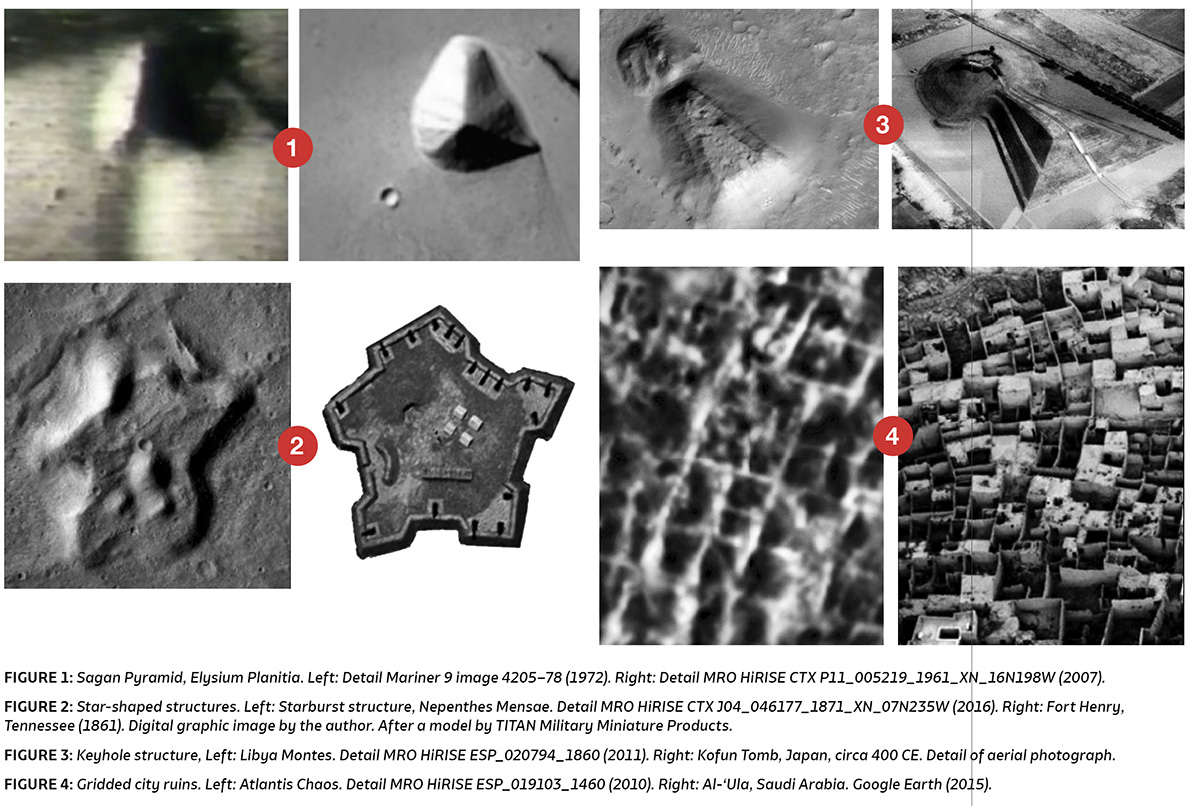
My tour of Martian structures begins in the northeastern quadrant of the red planet in an area known as Elysium Planitia. There, I provide the reader with the opportunity to take another look at a set of enormous pyramidal formations that were once made famous by the world-renowned astronomer Carl Sagan (Figure 1). He was so intrigued by one of these pyramidal formations that he included it in his early lectures and his 1980 book and television series Cosmos. Unfortunately, Sagan never had the opportunity to examine better images. Five years after his death, the European Space Agency released a high-resolution image of the area that showed the pyramids to be real and captured an entire complex of additional pyramidal structures.
Mysteries of Nepenthes Mensae: The City of Symbols
From there, the reader travels to west and is confronted with a pair of city complexes occupying the planet’s Nepenthes Mensae region. The pair of settlements includes over 20 pictographic and geometrically shaped structures nestled within a small and condensed area. The first settlement consists of a small group of highly symmetrical and geometrically shaped structures that include a Hexagonal Pyramid, a U-shaped Delta, and a Five-sided Star formation (Figure 2). The complex also features pictographic formations representing a full-bodied Dove, Killer Whale and the head of a Bulldog Bat. The second Nepenthes Mensae settlement consists of a connective train of four aligning platforms, each containing an assortment of highly symmetrical and geometric structures such as ovals, squares, triangles and rectangles.
Another mysterious feature is below this pair of city settlements within the same area of the Nepenthes Mensae region of Mars. Both NASA and The European Space Association (ESA) released a set of images showing an elongated hexagonal structure that is highly symmetrical. The six-sided structure has a thick, relatively flat platform with a central mound formation. After doing a quick Google search of ancient ruins around the world, much to my amazement, I found the remains of an identical elongated hexagonal mound in the southern region of central Turkey. Known as Araban Hoyuk, the six-sided mound has a similar flat platform design with a central mound formation, just like the structure on Mars. I sat staring at the screen in disbelief; I was looking at its terrestrial companion, a true doppelganger.
Libya Montes and the Keyhole Enigma
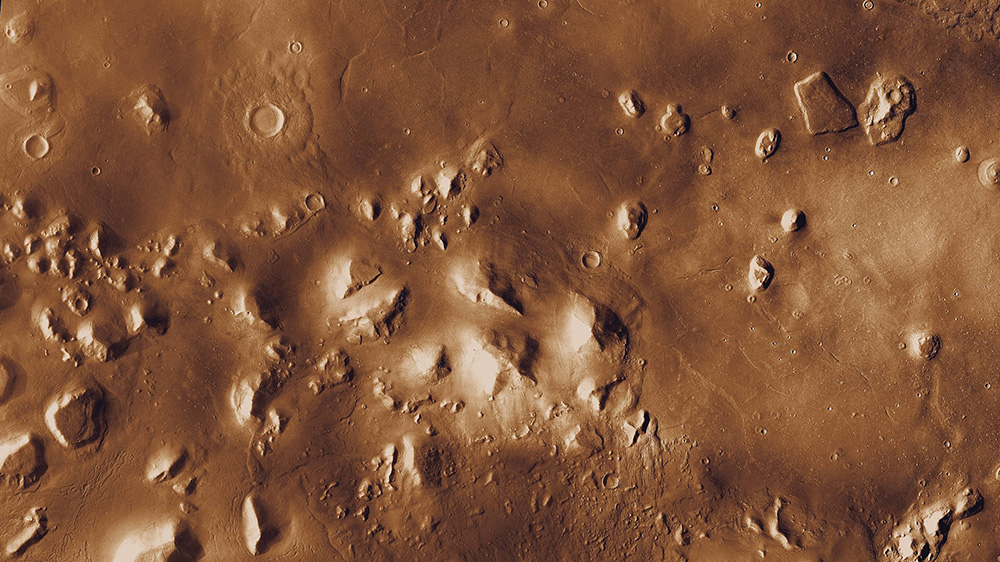
Continuing my tour on a westward trek, I take the reader to a well-known area of the planet just above Isidis Planitia known as Libya Montes. It is here that NASA proudly proclaimed to have photographed an odd formation that resembles an “exclamation mark” on the surface of Mars. The isolated formation appears to sit alone in the middle of nowhere. Although the highly symmetrical structure can also be seen as a keyhole and screams of artificiality, NASA scientists quickly dismissed it as a natural phenomenon.
Taking on the challenge, my colleagues and I delved into a comprehensive analysis of the keyhole-shaped structure and produced a science paper which shows this geometrically precise structure to not only be highly symmetrical but also match the design of the keyhole-shaped tombs found in Japan (Figure 3).
As a result of our studies, the Martian Keyhole structure can now be found all over the World Wide Web in news reports, blog articles and YouTube videos. It was also featured on the History Channel’s Ancient Aliens and the UnXplained program with William Shatner.
Pushing further west, across this once thriving planet, the reader travels down below Valles Marineris and into the Atlantis Chaos region of Mars. Once there, the reader is exposed to an extensive investigation of the remains of an ancient city nestled along the vast edge of a dead lake. The city consists of a gridded network of broken walls and shattered foundations that bring to mind the compartmentalised city of Al-‘Ula in Saudi Arabia (Figure 4) or the shell-shocked remains of Dresden after World War II.
Directly below the remains of this gridded city in Atlantis Chaos are two neighbouring settlements. Both settlements contain a set of five large geometrically shaped formations that include squares, triangles, and other polygonal forms. They are all very similar in size and have almost identical dimensions.
Parrotopia: A City Under the Wings
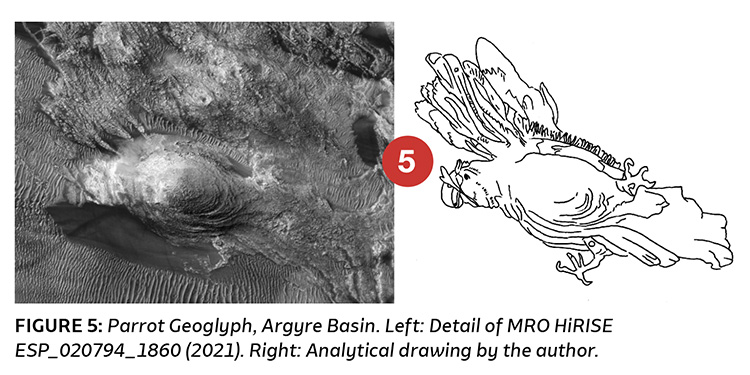
The tour concludes in a large-impact crater located within the southwestern quadrant of the planet known as Argyre Basin. Setting on the western side of this massive basin, the reader will experience a real “bird’s eye view” of a parrot-shaped formation over a mile long (Figure 5). The sculpted parrot formation has clear and recognisable features in the appropriate size and shape of a real parrot. It has a head, eye, beak, body, and wing. Additional anatomical components include two legs with feet and toes. When two geologists and four veterinarians examined the formation, they all confirmed that this parrot geoglyph on Mars has over twenty-two points of anatomical correctness. Yes, that’s right, over twenty-two points of anatomical correctness!
Beyond the mind-blowing accuracy of the parrot formation, the wing area above the main body contains the remains of an entire city. Dubbed Parrotopia, the city includes a port jetty, a towering lighthouse and other shoreline-related structures. Hidden within the wings streets and gridded infrastructure, we find the pictographic imprints of the Maya Rain God in his various mythological incarnations.
Before the Parrot geoglyph’s inclusion in my new book, it was the subject of two papers published in peer-reviewed science journals. It featured on the History Channel’s Ancient Aliens and The Proof is Out There programs. It was also mentioned on the front page of the Wall Street Journal and, most importantly, as a “tip of the hat” to its discover Wil Faust, an anthropologist and city planner from Pennsylvania, NASA officially titled the area Parrotopia.
Ancient Wars Between Mars & Earth?
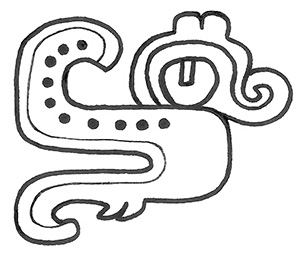
The reader is left with a little-known Mayan story that records what archaeologists read as a Star-War. The conflict was between the ancient cities of Naranjo and Tikal with the occupants of the planet Mars. Maya records show that Naranjo was founded around 896,000 years ago by a group of unknown people related to Mars and worshipped a primordial creature known as the Zip Monster, the patron god of Mars (Figure 6). It appears that just as the 13 colonies of America fought a revolutionary war with their homeland, England, to acquire independence 22,000 years ago, the colonies of Naranjo and Tikal fought a similar battle for independence with the occupants of Mars.
This New World story sounds quite similar to the Sumerian stories of the Anunnaki wars between Earth and Mars with Enlil and Marduk, as interpreted by Zecharia Sitchin. In both versions, all life on Mars is extinguished by some kind of nuclear war. This dim scenario is supported by NASA’s detection of high levels of Xenon 129 within the Martian atmosphere, which was recently revealed by theoretical plasma physicist and astrophysicist Dr. John Brandenburg.
The current evidence of structures and ruined cities presented in official NASA and ESA images of Mars suggests that they were built after their original occupants were destroyed. Therefore, it is speculated that what we see today are the abandoned remains of that second occupation, which was only partially destroyed.
When this collection of structures is examined, you will find that they exhibit a direct correlation between the architecture and iconography of many of the cultures found on Earth, most notably within North and South America. These findings are supported by image specialist James S. Miller, geomorphologist William R. Sanders and geologist Michael Dale. They offer pro and con arguments for the artificial and natural origins of these unusual formations. Side-by-side comparisons of Martian structures are presented with their terrestrial counterparts, offering evidence of a shared aesthetic achieved in two opposing worlds.
In the foreword to The Great Architects of Mars, Dr John Brandenburg says that the evidence presented would appeal to anyone interested in the mysteries of Mars and our ancient past or if we entertain the idea that Mars and the Earth share a common point of origin. He states: “This is a unique and extremely important book, which provides the clearest and most precise evidence, ever compiled, to support the existence of artificial structures on the surface of Mars.”
As an artist, I have an eye for art and architecture, and my book, The Great Architects of Mars, results from those observations. I invite you to take another look at Mars with clear eyes and remember that through NASA’s own pictures, the truth will be revealed.
George J. Haas’s book The Great Architects of Mars: Evidence for the Lost Civilizations on the Red Planet (with a foreword by John E. Brandenburg, PhD) is available from Inner Traditions.
© New Dawn Magazine and the respective author.
For our reproduction notice, click here.