
From New Dawn 210 (May-June 2025)
In an attempt to give themselves godlike abilities, the technocratic elitist class is pushing society towards a transhumanist future powered by their own ‘intelligent design’.
Through gene editing, synthetic biology, and the fusion of humans and technology, governments and corporations aim to fundamentally change what it means to be human.
At its core, this anti-human agenda aims to completely reshape the image of our species into a new one, ready to be exploited and controlled.
Deus Ex Machina
Artificial intelligence has reached new frontiers in recent years. Today, collectively, we are staring down perhaps the most pivotal period of our entire existence. Each day, this transformation is at the forefront of many societies across the world.
In early 2025, US President Donald Trump announced an unprecedented $500 billion investment in infrastructure tied to artificial intelligence in partnership with leading companies in the field, such as OpenAI, Oracle, and SoftBank.1
According to the White House, the new entity “Stargate” will start building data centres and the electricity generation needed to develop fast-evolving AI.
“It’s big money and high-quality people,” said Trump, adding that the investment is “a resounding declaration of confidence in America’s potential” under his new administration.
This declaration of a half-a-trillion-dollar investment shows just how serious artificial intelligence is becoming and how the Fourth Industrial Revolution has truly begun.
“This will be the most important project of this era,” said Sam Altman, CEO of OpenAI.
Indeed, artificial intelligence is a game-changer.

The technology is already upstaging humans. One example occurred in March 2023 when the Sony World Photography Awards announced the winner in their creative photo category: a black-and-white image of an older woman embracing a younger one, entitled “PSEUDOMNESIA: The Electrician.”
The press release announcing the win describes the photograph as “haunting” and “reminiscent of the visual language of 1940s family portraits.”2
The artist, Boris Eldagsen, who is based in Berlin, turned down the award. He announced that his photograph was not a photograph at all. Instead, he had crafted it through the creative prompting of DALL-E 2, an artificial intelligence image generator.
“I applied as a cheeky monkey to find out if the competitions are prepared for AI images to enter. They are not,” explained Eldagsen on his website.3
His stunt sparked controversy and conversation about whether AI-generated or assisted images should be considered ‘art’. But the bigger picture is being missed: Would anyone have even been able to tell if he had not turned down the award?
This is the power of the software alone, generating fakes disguised as real and outpacing humans at their own games. However, beyond that, the products powered by this software, including the rise of humanoid robots, are where things start to get crazier.
Tesla’s CEO, Elon Musk, announced that the carmaker will start selling its Optimus humanoid robot in the near future. Optimus has already begun performing tasks autonomously, such as handling batteries at one of Tesla’s facilities.4
“Tesla will have genuinely useful humanoid robots in low production for Tesla internal use next year and, hopefully, high production in 2026,” Musk posted on X.
Musk predicted that Optimus would be capable of performing a wide range of tasks inside and outside the home, estimating that the robot would be available for purchase at approximately AU$48,000.
Tesla is not the first company to begin working on such humanoids – nor, according to available evidence, is it the furthest along.
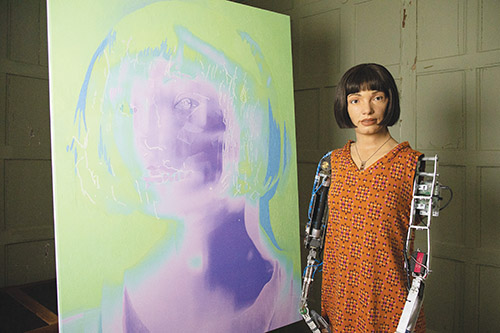
Take, for example, Ai-Da the Robot – named after Ada Lovelace, the English mathematician and world’s first computer programmer – who recently became the first humanoid “robotic artist” to have “their” artwork sold by a major auction house.5
On 7 November 2024, the AI-powered robot’s painting of the mathematician Alan Turing (an early pioneer of the technology) sold for AU$1,344,272.
The humanoid regularly creates self-portraits by “observing” itself in the mirror, using sophisticated sensors and cameras to guide the attached robotic arm and brush.
Sotheby’s auction house announced that Ai-Da was “the first humanoid robot artist to have an artwork sold at auction.”
Yes, from photography to painting, artificial intelligence is becoming increasingly proficient not only at repetitive labour tasks but also at intellectual endeavours.
And we’re only at the very beginning of the humanoid robot story.
With the world’s information readily available at its electronic fingertips and powered by advanced software and human-like robotic hardware, humanoid agents will soon emerge as ‘advisors’ for everyone. This story is already unfolding across the globe, including here in Australia.
The ‘Agent’ Revolution
Robotic personal assistants have been promoted through science fiction for decades, painting a blissful future where humans are surrounded by friendly machines that improve every aspect of our lives. Today, fiction becomes reality – but is it as nice?
In 2025, many individuals and businesses routinely use AI assistants, such as ChatGPT, to carry out various tasks. With each new year, AI ‘learns’ more and more, and the next step in this evolution will come in the form of “AI agents.”
From AI-run classrooms and hospitals to machine learning technologies in workplaces, almost all industries are predicted to incorporate sophisticated ‘agents’ in the future.
Some experts describe this push as an “obsolescence regime,” believing the transformation is inevitable since the ‘cat is out of the bag’.

Don’t believe me? In an Australian-first, the Real Estate Institute of NSW (REINSW) has appointed “Alice Ing” – an AI bot – as an official Advisor to the Board. With a reported (software) IQ of 155, Alice is “the world’s smartest Board Advisor.”6
Yes, you read correctly. AI is already being appointed at companies right now at home.
According to REINSW: “Alice’s encyclopaedic knowledge of real estate provides an instantaneous and valuable contribution to the Board, bolstering REINSW’s capacity to advocate for the industry and influence policy changes that benefit consumers, real estate professionals and REINSW members.”
Sitting in on executive meetings, ‘Alice’ is available to answer any questions and is equipped with built-in AI software like ChatGPT. It doesn’t stop there, either.
Chinese researchers have developed an “AI hospital town,” similar to Stanford’s AI town, which went viral in 2024. The AI hospital, named “Agent Hospital,” was developed by researchers from Tsinghua University.7
The AI hospital town features virtual patients treated by AI doctors designed to evolve autonomously and “improve their medical expertise.” All doctors, nurses, and patients in the virtual environment are driven by large language model (LLM) powered intelligent ‘agents’ capable of autonomous interaction.
According to the team, these AI doctors can treat 10,000 patients in just a few days, a task that would take human doctors at least two years.
We have already seen the introduction of robotic AI-powered arms for surgeries in remote Australian regions in the far north of Queensland, and we can expect this trend to continue to grow as Trump’s $500 billion investment powers this field.
One last example – the UK’s first “teacherless” GCSE class, using artificial intelligence instead of human teachers, is about to start lessons.8 David Game College, a private school in London, opens its new teacherless course for 20 GCSE students in September 2025.
Hospitals, schools, and important decision-making roles: This is no longer fiction, folks. The rise of humanoid robots has arrived, and they are taking over very quickly.
Of course, Bill Gates has been discussing this ‘revolution’ in great detail over the past few years, stating in one blog post that AI agents represent “the biggest advancement of computing in recent memory.”
Finding a more “direct means” of “human-machine interaction” is the “next frontier,” reckons Gates. The Microsoft co-founder envisions a future where these agents will easily understand natural language and will be just as important as a smartphone.9
He predicts that AI will use our preferences to make recommendations, eliminating the need to use individual apps to book flights, reserve hotels, and more. He also predicts ‘agents’ will make search engines like Google redundant, as your artificial intelligence ‘helper’ will answer all questions and queries.
Unfortunately, many companies will be forced to adapt to the times or perish. Robots have already moved into warehouses, and if you can’t compete both on an individual or marketplace level, you will fall behind in this time of transformation (by design).
When the capabilities of artificial intelligence surpass those of humans, the question of whether they can become ‘sentient’ becomes irrelevant. It’s the capabilities that are now the concern.
The competition for supremacy is heating up, begging questions surrounding regulation, how it will develop as the years progress, and whether it can even be stopped.
Can It Be Stopped?
In January 2025, China released its own version of the market-leading ChatGPT called DeepSeek AI, adding to a marketplace that includes others like Musk’s Grok.
Australia quickly banned DeepSeek AI services from all government systems and devices, becoming one of the first countries to take direct action against the Chinese artificial intelligence startup that has disrupted Silicon Valley.
Home Affairs Minister Tony Burke said in a statement that all DeepSeek AI products, apps and services would immediately be removed from government systems for national security reasons. A threat assessment by the country’s intelligence agencies found that the technology posed “an unacceptable risk.”10
This is one of the first significant actions taken against artificial intelligence, signalling a new era in which the technology is recognised as a powerful tool.
Unfortunately, much like the internet itself, any regulation and control will only transfer the power of the technology into the hands of criminals. Internet censorship has diminished the glory days that made it great. Similarly, if we continue to see progress in this manner for AI, our ability to learn this tool will become restricted.
There is suspicion that if regulatory initiatives were to commence against artificial intelligence and its developers, they would either escape to countries lacking regulation or venture into international waters.
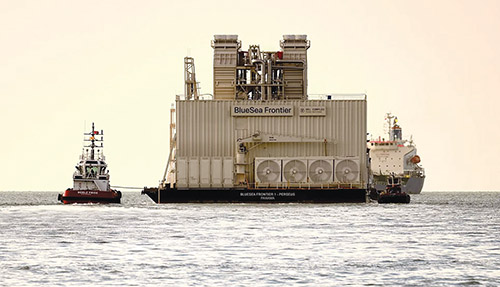
A sea-based floating data centre containing thousands of Nvidia GPUs raises questions over whether this sort of regulation could lead to the creation of ‘sovereign AI states’.
The BlueSea Frontier Compute Cluster (BSFCC), created by US firm Del Complex, is essentially a gargantuan barge housing 10,000 Nvidia H100 GPUs, all worth a combined $500 million. It floats in the middle of international waters.
In an announcement on X, Del said the floating data centre offers “industry-leading performance, advanced water cooling and solar power for environmental safety.”11 It will be complemented by “kinetic risk mitigation,” provided by onboard security.
This project points toward the eventual creation of ‘sovereign nation-states’ dedicated to AI development, especially if land-based governments begin regulation.
In its announcement on X, the firm said the tightly guarded barge could operate in international waters and thus be exempt from regulations.
Military Dimensions
Militaries around the world are already making some of the biggest strides towards transhumanism because of the advantages their ‘super soldiers’ would possess.
The US Defense Advanced Research Projects Agency recently issued a broad agency announcement on “Human Performance Enhancement.”12
According to the RAND report, “Technological Approaches to Human Performance Enhancement,” modalities for human performance enhancement can be grouped into three principal categories: Gene editing, applications of artificial intelligence, and networked technologies that are wearable or even implantable.13
For the US defence and intelligence communities, human performance enhancement offers “the potential to increase strength, speed, endurance, intelligence, and tolerance of extreme environments and to reduce sleep needs and reaction times – [and] could aid in the development of better operators.”
This follows a Pentagon-sponsored RAND report on human performance enhancement in 2021, which revealed that the US Department of Defense was investigating “making humans stronger, more intelligent, or more adapted to extreme environments.”
Indeed, it does seem that, just like the rise of the internet, AI advancement can’t be stopped – both in the military-industrial complex and private enterprise.
The door has been opened, but was it even designed to be closed? Where will this all lead? This is where the deeper questions come in.
p(doom): The Countdown
Artificial intelligence experts have been asking each other a question lately: “What’s your p(doom)?” The “p” stands for probability. The “doom” component generally refers to a sophisticated and hostile AI acting beyond human control.
If you have one, your ‘p(doom)’ is your best guess at the likelihood that AI ultimately turns on humanity, either of its own volition or because it’s deployed against us.
The scenarios contemplated as part of that conversation: biological warfare, the sabotage of natural resources, and more. These concerns aren’t coming from ‘conspiracy theorists’. Instead, there’s an emerging group of machine learning experts who worry we’re building “misaligned” and potentially deceptive AI.
They’re imagining an AI with a penchant for sleight of hand, adept at concealing any gap between human instructions and AI behaviour.
Like a magician chasing applause, AI is being incentivised to deceive us with in-built rewards that measure its outcomes. The destructive potential of a deceptive or misaligned AI hinges on how heavily we depend on it. As just noted, we are starting to depend on it a lot.
“The world I want you to imagine… is one where AI has been deployed everywhere,” Ajeya Cotra, a senior AI safety researcher at Open Philanthropy, told the ABC.
“Human CEOs need AI advisers. Human generals need AI advisers to help win wars. And everybody’s employing AI everywhere.”
This vision is not far out of the scope. In their research, Harvard Business Review recently concluded that AI can mainly outperform human CEOs in almost all metrics in September 2024, being described as “remarkable” in the results.14
Cotra calculates a 50 per cent chance we’ll get to the “obsolescence regime” (see box on right) by 2038. Experts believe it is only a matter of time before deceptions begin on a mass scale.
When confronted with this ‘p(doom)’ scenario, the consequences for humanity could be transformative – the stuff of biblical myth.
The Consequences of ‘Progress’
History began when humans invented gods, and will end when humans become gods.
– Yuval Noah Harari
In the era of transhumanism, technocratic elitists are looking to replace God, the Creator, with their own intelligent design.
You don’t have to be religious to appreciate the role the concept of a Creator plays in the construction of human rights. It is almost bigger than religion itself.
Men cannot decide on, alter or enforce something they did not create. By removing the religious framework, the technocrats have come to see themselves as the Creator – a (false) ‘higher power’ that endows humanity with rights.
A mass dehumanisation agenda, under the guise of ‘progress’, has led us to no longer believe we are the centre of reality – but a stepping stone for the machines to merge with.
This shift will ultimately occur, according to the ‘experts’, through biotechnological implementations, genetic modification, and robotic implants. For transhumanism, the quest to ‘transcend the human condition’ is a central aspect of their doctrine.
But why would they want to do this?
Well, every citizen is considered to be born with rights. In a future where humans are no longer considered to be ‘natural’, what would that mean for ‘human’ rights?
Indeed, by putting technocrats in the place of God, society is giving them the unaccountable authority to redefine human rights as they see fit from their position.
If, and when, humans become fully integrated with machines on a large scale, where will the technology end and the human begin?
Bioengineering can blur the lines of who or what is responsible for a person’s behaviour. Is it the human, the technology, or the humans behind the technology?
Who will own the technology inside us or the synthetically altered genes? Will human enhancement be reserved only for certain people?
Humanity could theoretically be split into different species depending on the types of genetic engineering that take place, creating a worldwide post-human caste system.
That is the consequence of such a maniacal obsession with ‘progress’, and societies across the world have learned of this for centuries.
Take the story of Prometheus, for example, which is one of the most important Greek myths. Prometheus, the Greek God of ‘Progress’, embodies the same post-human ideologies we see today, centred around ‘transcending the natural order’.
Today, this myth helps us reflect on transhumanism, a philosophy that views the human being as ‘something to be overcome’.15
Hesiod was one of the first poets to write the story of Prometheus. Far from heroising the figure, his version highlighted Prometheus’s transgression against the gods.
He believed that Prometheus had upset the cosmic order, which explained the imbalance and evils of the world. From this viewpoint, ‘progress’ is seen as synonymous with the decline of the human being. Does this sound familiar?
Look at how the ‘progressive’ mindset has already changed society. As a matter of fact, the ecological disasters generated in the last century do tend to show that our naïve trust in ‘progress’ had a dark side. Moreover, what’s ‘new’ isn’t always better.
Unbridled ‘progress’ breaks the natural balance of the environment, attracting all sorts of misfortunes to befall humanity. The transhumanists harness this philosophy to make strides towards a new reality each and every day.
But are technical improvements actually necessary for us to achieve and survive?
Is technological progress, the eradication of diseases, and the prolongation of life expectancy (such as Google’s efforts to ‘solve death’) sufficient to overcome natural obstacles so that societies can live happily?
Unfortunately, if it sounds too good to be true, it usually is.
Confidence that ‘progress’ itself will improve humanity is a naïve fantasy – just look at how unstable things like smartphones have made the world.
In their attempt to transform the human species forever, the transhumanist cult is playing with forces of the natural world that have been around for much longer than us.
Will society let the modern-day Prometheus cult alter what it truly means to be human?
Only time will tell.
Footnotes
1. forbes.com/sites/garthfriesen/2025/01/23/trumps-ai-push-understanding-the-500-billion-stargate-initiative
2. sony-asia.com/pressrelease?prName=open-competition-2023
3. eldagsen.com/sony-world-photography-awards-2023
4. digitalassets.tesla.com/tesla-contents/image/upload/IR/TSLA-Q2-2024-Update.pdf
5. msn.com/en-au/news/australia/robot-artist-makes-history-after-portrait-sells-for-more-than-1mil/ar-AA1tHTbs
6. reinsw.com.au/Web/Web/News/Media_Releases/2024/05-May/ai-board-advisor.aspx
7. roboticsandautomationmagazine.co.uk/news/healthcare/worlds-first-ai-hospital-with-virtual-doctors-opens-in-china.html
8. news.sky.com/story/uks-first-teacherless-ai-classroom-set-to-open-in-london-13200637
9. tottnews.com/2023/11/21/bill-gates-details-the-coming-rise-of-ai-agents
10. thenewdaily.com.au/news/2025/02/05/australia-bans-deepseek
11. techradar.com/news/the-role-of-tape-in-the-modern-data-center
12. sam.gov/opp/4f70483c0b4b49aeac299342a36af04d/view
13. rand.org/pubs/research_reports/RRA1482-2.html
14. hbr.org/2024/09/ai-can-mostly-outperform-human-ceos
15. tottnews.com/2023/02/19/transhumanism-and-prometheus
© New Dawn Magazine and the respective author.
For our reproduction notice, click here.