
From New Dawn Special Issue Vol 19 No 4 (Aug 2025)
“If black magic works, then materialism is its best cover of secrecy.”
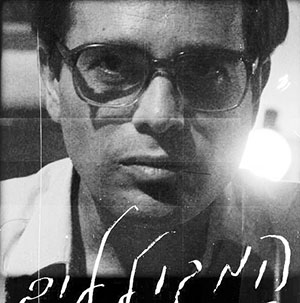
These were the incendiary words of Professor Moshe Kroy – Israeli philosopher, former Tel Aviv University lecturer, “rational mystic,” and eventually, a ghost in the machine of suppressed knowledge.
His assertion, buried in the faded xeroxed pages of a 1977 issue of Conspiracy Digest, suggested that secret elites in our world harness tools of occult power – black magic, telepathic influence, egregoric control – while promoting a public creed of scientific materialism.
In this dual strategy of concealment and monopolisation, Kroy argued, lies the key to understanding the deeper architecture of power. A power that engineers our economic, political, social and cultural systems – programming our very perception of reality.
Born in 1948, Kroy rose meteorically through the intellectual circles of early 1970s Israel with his philosophical tract Life According to the Intellect, a distillation of Ayn Rand’s objectivism into a system he termed “rational egoism.” But this was only the beginning. According to one of his students, around 1980, Kroy “had developed his own unique synthesis of Advaita Vedanta, [J.P.] Sartre, and [Edmund] Husserl’s phenomenology.”1
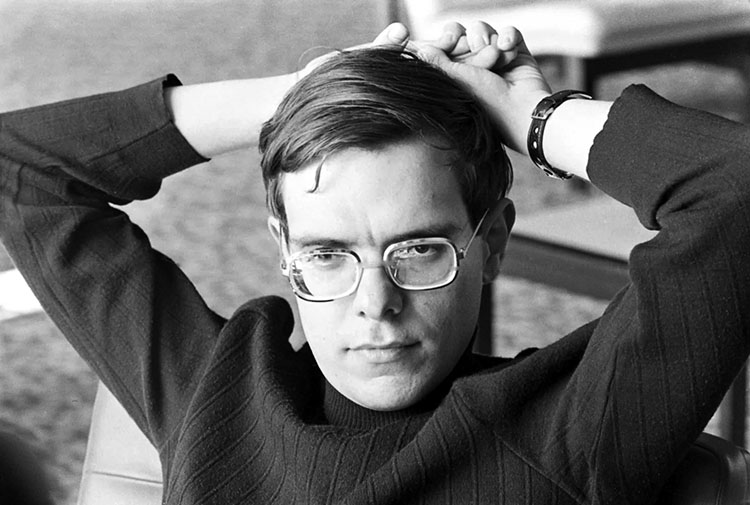
The most dangerous ideas Kroy ever penned were not in a university lecture or public seminar, but in a little-read article titled “Materialism, Occultism and the Suppression of Psychic Research.” In it, he mapped a structure of concealment so profound and so methodically engineered that it has all but vanished from public memory. That the article itself can no longer be found online – its citation ghosted from search engines – may speak to its paradigm-shattering power.
Kroy’s central hypothesis is disturbing in its simplicity: he writes, “Suppose that certain secret societies, concentrating on the ‘black arts’, did find some magical techniques which are effective. Suppose – say that they found a method – derived from older magical practices, of producing hypnotic trance at a distance – so-called telepathic hypnosis.”
To maintain political power and much more, these groups would have to do two things:
“A. The discovery is kept completely secret.
“B. The discovery is securely monopolised: No other group or organisation is in the position to rediscover it.”
The strategy they applied was scientific materialism.
Materialism & the Newtonian Paradigm
An Israeli TV series described Kroy as “a genius who paid every imaginable price in his uncompromising effort to reach the truth.”2 Indeed, he pushed past the limits of the materialist doctrine to discover forbidden worlds rarely explored by intellectuals and scientists. It may have led to his death.
Accounts by Kroy’s students describe a genius who explored a wide range of ideas. He seems to have exhausted the limits set by mainstream science and dived headlong into the ocean of spurned, forgotten and even dangerous concepts and philosophies that exist outside orthodoxy. Ideas and theories discarded by the Establishment as unproven or unprovable within the framework of materialism.
Kroy transformed from Rational Objectivist to Rational Mystic. He delved into Eastern and New Age philosophies, holding self-transformation workshops and teaching psychic self-development and protection. He even came to the attention of New Age thinker Ken Wilber, who praised his genius.
To understand how materialism could serve as a cloak for occult domination, one must consider the foundations of modern science. The prevailing worldview – commonly referred to as the Newtonian paradigm or Cartesian dualism – posits that reality consists of physical matter moving through space and time. Everything, including consciousness, is presumed to be reducible to atoms, neurons, and energy exchanges.
This worldview acts as a cultural enforcement mechanism. It defines the boundaries of acceptable thought and what constitutes ‘reality’. Belief in materialism is strengthened because dedication and commitment to its doctrine determine funding priorities, academic inquiry, and even approaches to psychology and mental health. Those who stray too far beyond its limits – mystics, psychics, pagans, shamans, or researchers of paranormal phenomena – are pushed into the margins, labelled cranks, cultists, pseudoscientists and “conspiracy theorists.”
Moshe Kroy recognised this with startling clarity.
The Intention of the “Conspirators”
In “Materialism, Occultism and the Suppression of Psychic Research,” Kroy begins by stating:
“A major stumbling block in the attempt to study the nature, purposes and tools of the conspiracy is the fact that such a study necessarily is done in a cultural context which, in turn, has already been largely shaped by the conspiracy. In other words, while the mere realisation of the existence and activities of the conspiracy has a largely liberating effect on a thinking individual, disclosing to him as it does the vast magnitude of the lies and deception incorporated in the various layers of the official culture, this liberating effect, in itself, may merely serve to create an intellectual vacuum.”
It should be noted that the publishers of Conspiracy Digest believed that “the Right-Left political-economic spectrum is an artificial concoction of the ruling class/conspiracy.” This is the context in which to understand Kroy’s reference to the “conspiracy.”
One of the most influential underground books of the 1970s was Gary Allen’s None Dare Call It Conspiracy. Kroy cites Allen’s argument that history is shaped by those who control political and economic structures. Ideas and ideologies are merely superficial tools in promoting politico-economic control.
“The struggle against the conspiracy requires liberation also from the deeper, however invisible, power of the conspiracy on our culture,” Kroy writes. “A conspiracy researcher, however observant, sharp and bold, is hampered to the degree that he accepts uncritically entrapment within an intellectual framework which was deliberately inspired by the conspiracy.”
Kroy challenges the assumption that modern science is an open and empirical enterprise. Instead, he saw it as a form of intellectual enclosure, maintained by a priesthood of credentialed minds, whose function is less to explore reality than to police its borders.
His article synthesises three points into a unifying hypothesis to expose the intention of the “conspirators.”
“I. The thorough insistence, and success, in which an intellectual academic ‘elite’ has made materialism, the doctrine that to exist is to be made of matter and energy, and to be located in space and move in time, the dominant premise of the culture.
“II. The fact that various circles and groups connected with the conspiracy had occult interests and practices, centring around certain secret, esoteric, mystical doctrines and certain hidden practices, involving black magic, as well as alchemy, etc.
“III. The fact that parapsychological and psychic research is largely considered by intellectuals and other ‘educated’ people to be charlatanism, unworthy of serious attention, inconsistent in its results, methodically loose, or just plain gullibility – to the extent that all the evidence which was generated through it can be ‘safely’ ignored.”
If a phenomenon contradicts the materialist paradigm, it is excluded not on the grounds of evidence, but by the paradigm’s dogmatic refusal to see outside itself.
This is where the brilliance – and danger – of Kroy’s theory emerges. He posits that the very people who shape this closed system of belief may themselves use the forbidden arts they publicly denounce.
“Does black magic work?” asks Kroy. “This is a very dangerous question to ask in a cultural context in which every ‘educated’ person knows that black magic contradicts the basic principles of science and so ‘could not work’…”
Black Mirrors & Secret Societies: Practitioners of the Forbidden Arts
Kroy proposes a speculative hypothesis that certain groups discovered powerful occult techniques that offer extraordinary control over populations, opinion leaders, and even entire governments. Its true power would lie not only in its use but in its concealment.
“Suppose that certain secret societies, concentrating on the ‘black arts’, did find some magical techniques which are effective. Suppose they found a method, derived from older magical practices, of producing hypnotic trance at a distance – so-called telepathic hypnosis. Clearly, such methods can have immense value in gaining political power, provided that two conditions are met: A. The discovery is kept completely secret. B. The discovery is securely monopolised: No other group or organisation is in the position to rediscover it.”
This can be achieved, says Kroy, by promoting “the culture of materialism, which implies that no magical technologies could be workable, a priori. You pretend to equate materialism with scientific spirit, etc. and stultify anyone who attacks it. Thus, you effectively stop others from following your trail by implying that no such trail could conceivably exist.”
Kroy explains that this strategy works in other domains. To preserve corporate secrets or to maintain a monopoly over any technological breakthrough, promote the idea that this kind of discovery is impossible.
Kroy offers this example: “Whoever has managed to develop a technology of space travel in a velocity which allows instant access to far galaxies, and wants it as a secret monopoly, would and should promote a theory claiming that, say, the ‘velocity of light’ cannot be exceeded in nature by any technology. In other words, relativity theory-type constraints on ‘what is possible’ can serve to cover a technology which involves doing what the theory implies is impossible.”
Which brings us to his next point, that “it can be expected… psychic research, as well as any technology or activity which would allow non-privileged, non-conspiracy individuals into the field of the ‘esoteric doctrines’, would be heavily suppressed…”
Kroy goes on to logically dissect the arguments made by defenders of materialism.
A 2009 interview with British evolutionary biologist Richard Dawkins revealed insights into the mindset of those who defend materialism and scientism. When radio host Prof. Hugh Hewitt asked whether Dawkins considered what existed “before the Big Bang,” he replied: “I don’t consider the question because I recognise that it’s an intuitively appealing question. I recognise that, along with everybody else, want to ask that question. Then I talk to physicists who say you can no more ask what came before the big bang than you can ask what’s north of the North Pole.”
A mental block inhibits a whole class of professionals from seeing beyond the limits of materialism – as if they are compartmentalised under a spell. Could this be caused by something more than stubbornness, ignorance and groupthink?
To secure this monopoly, you must inoculate the culture against even the possibility that such techniques exist. You achieve this, said Kroy, by establishing materialism as the cultural default, equating scientific scepticism with reason itself. Then you mock, marginalise, or professionally destroy anyone who strays beyond its limits – as Richard Dawkins is renowned to do. As a result, your rivals and the fields of sheep under your control remain ignorant of the magical universe – the realm of consciousness, will, spirit – and the dangerous keys that open portals to powers and principalities above and beyond this material world.
For Kroy, “an intellectual academic ‘elite’ has made materialism,” “the dominant premise of the culture” – “the doctrine that to exist is to be made of matter and energy, and to be located in space and move in time.”
Rites of Hidden Rulers: Ceremonial Magic
From the grimoires of Renaissance occultists to the secretive rites of the Hermetic Order of the Golden Dawn, the art of directing and controlling minds, influencing unseen forces, or attempting to contact gods (theurgy), has a history as long as mankind.
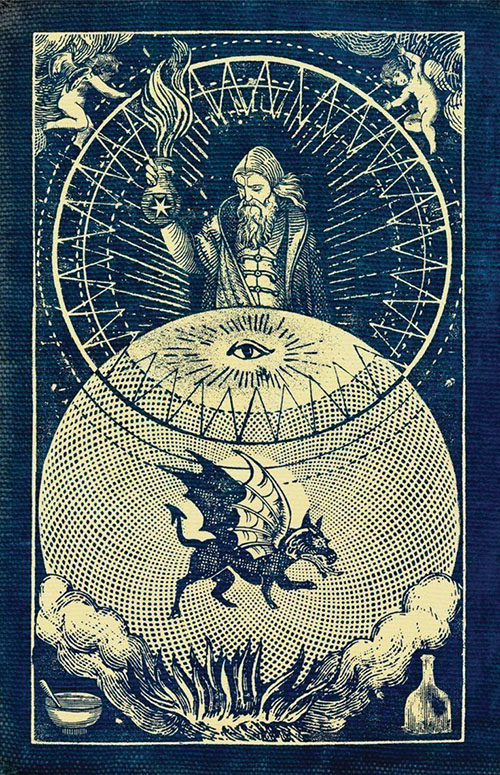
What is ceremonial magic? Several scholars suggest that it is essentially the use of rituals and techniques to invoke “spirits” or life forms from other dimensions or worlds, which can enter this world through specific rituals.
For example, according to the respected scholar of esotericism, Manly P. Hall, “a magician, enveloped in sanctified vestments and carrying a wand inscribed with hieroglyphic figures, could by the power vested in certain words and symbols control the invisible inhabitants of the elements and of the astral world. While the elaborate ceremonial magic of antiquity was not necessarily evil, there arose from its perversion several false schools of sorcery, or black magic.”3
“By means of the secret processes of ceremonial magic,” warned Hall, “it is possible to contact these invisible creatures and gain their help in some human undertaking… But evil spirits serve only those who live to pervert and destroy.”
In magical systems, symbols are weapons, intention is force, and belief is akin to architecture. The magician or ritual operator uses thought, image, and will to open portals in the mind – perhaps beyond it. To the outsider, it is dismissed as nonsense.
Ceremonial magic has always been a double-edged sword. While some traditions emphasise spiritual growth and enlightenment, others – particularly in the realm of black magic – seek domination, wealth, or control. And here lies Kroy’s most unsettling suggestion: that certain elites and groups, in the vein of “we know and they should be kept ignorant,” secretly practise these dark arts, even as they promote a worldview that discredits them.
Egregores, Watchers & Manufactured Minds
If the conspiracy that Moshe Kroy described is more than political, more than economic – if it is ultimately spiritual – then we must expand our vocabulary of power.
Enter the egregore, a concept from esoteric tradition that describes a psychic entity or group mind form created by collective belief and emotional energy. Once formed, an egregore can take on a life of its own, shaping thoughts, behaviours, even entire civilisations.

In his article “Understanding the Occult: What is an Egregore,” Theron Dunn defines an egregore as “an energised astral form produced consciously or unconsciously by human agency… usually an archetypal image produced by the imaginative and emotional energies of a religious or magical group.”4
Egregores – whether purely psychic, symbolic, or something more – are not neutral. Egregores of nationalism, egregores of religion, even the egregores of corporations: each compels action, embeds narratives, harbours defensive and offensive modes. One might say that our post-modern world is haunted by these ghosts of group minds.
Kroy’s insight here is chillingly prescient. By engineering culture to generate specific egregores while denying their reality, the elite magician both protects and weaponises arcane knowledge and occult techniques.
According to the Golden Dawn glossary, egregore derives from a Greek word meaning “watcher” and a “group egregore is the distinctive energy of a specific group of magicians who are working together, creating and building the same thought-form or energy-form.”
The strongest egregores are the oldest and are usually boosted by ‘magical force’ from powerful intra- and/or extra-terrestrial ‘beings’.
In his article, Kroy ponders that “UFOs make you wonder… if some political power would be somehow connected to some extra terrestrial civilisation as an ally, it would be in its best interest to slander and stultify anyone who claimed such a connection was possible.”
In biblical and apocryphal lore, particularly the Book of Enoch, the “Watchers” or Irim were angels – some faithful, others fallen – who interacted with humanity, imparting forbidden knowledge and fathering the Nephilim. These egregoric intelligences are neither metaphors nor myths, but active agents in our hidden history.
The Gnostic Christians suggested that two camps fight an ongoing spiritual war for our souls. The decisive question, Kroy might have asked, is not whether these beings exist but who is working with them now? Are we doomed as pawns in this game? Can we escape?
A Spell on You
Even today, more than 40 years after Kroy penned his article, with numerous independent studies confirming paranormal phenomena, the materialist mindset prevails.
Most scientists and ‘educated’ people don’t seem to understand the implications of quantum physics, which replaces the Newtonian model. According to Kroy’s hypothesis, a psychic barrier prevents the professional and ‘educated’ classes from drifting too far from the egregoric clutches of scientism.
As the philosopher and scholar of religion Jeffrey Kripal notes in The Flip, “one could write a very big book, even a small library of books, on all the scientists, engineers and medical professionals who have either reported robust anomalous phenomena or found them to be of extraordinary scientific significance.”5
Even as quantum physics upends Newtonian assumptions, and consciousness studies point to non-local mind, the public script remains unchanged: the physical material world is all there is. Magic is patent nonsense. The spiritual and subtle worlds are delusions.
But what if this denial is itself a spell?
In 1928, propaganda expert Edward Bernays wrote: “In almost every act of our lives, whether in the sphere of politics or business, in our social conduct or our ethical thinking, we are dominated by the relatively small number of persons… who understand the mental processes and social patterns of the masses. It is they who pull the wires that control the public mind, who harness old social forces and contrive new ways to bind and guide the world.”
This statement, widely quoted in studies of media control, takes on new dimensions under Kroy’s framework. If psychic structures, such as egregores, shape mass perception, then the true power lies not in what we are told, but in what we are prevented from conceiving.
Giordano Bruno & the Occult Psychology of Control
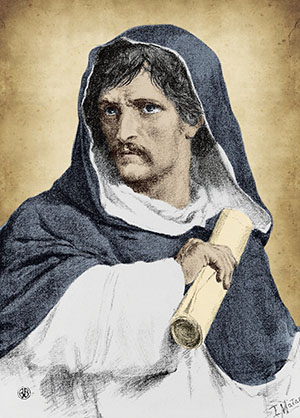
Centuries before Moshe Kroy issued his warning about the suppression of the paranormal, another philosopher lit a torch in the tunnels of human consciousness and paid for it with his life.
Giordano Bruno, a 16th-century Dominican friar turned heretic, mystic, and magus, was burned at the stake in 1600. The official charge was heresy. The real crime may have been the contents of his dangerous little book, written in Latin: De Vinculis in Genere – “On the Bonds in General.”
While Machiavelli’s The Prince outlined the manipulation of fear and statecraft, Bruno’s De Vinculis went deeper – into magic and its role in manipulation. It appears to accurately describe how modern politics and consumer culture operate, through psychological manipulation, using the bonds of desire. “The control of mass desire” – the “libidinal economy” notes one commentator – “is what mass politics is all about.”
An anonymous article about the book suggests that many Anglo-Saxon and Middle European historians and intellectuals regard De Vinculis in genere as a very clever and insightful political work.
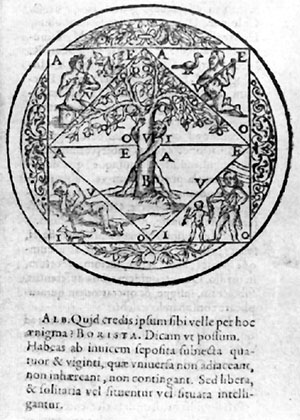
“The London School of Economics uses it as a core text because of its usefulness in understanding behaviour patterns in contemporary social life,” reads the article.6
Bruno argued that eros is the true binding force among humans. But those bonds, if skilfully manipulated, become chains.
According to the article, Bruno sees man as a being who “desires” completion beyond himself, a desire “primarily erotic – in the most spiritual and all comprehensive meaning of the word.” Eros, in Bruno’s philosophy, is a connective force that bridges instinct and mystical insight. It not only generates vivid mental imagery within the self and others, but also “kindles and spills over into the psyche of other persons.” Through this, eros becomes a powerful medium – creating “links and ties” between individuals, whether as lovers, friends, group members, or even between leaders and followers.
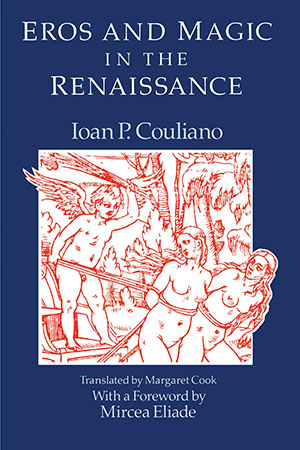
In his masterwork Eros and Magic in the Renaissance, historian Ioan P. Couliano writes that “the magician of De vinculis is the prototype of the impersonal systems of mass media, indirect censorship, global manipulation, and the brain trusts that exercise their occult control over the Western masses… Bruno’s magician is altogether aware that, to gain the following of the masses, like the loyalty of an individual, it is necessary to take account of all the complexity of the subjects’ expectations, to create the total illusion of giving unicuique suum. That is why Bruno’s manipulation demands perfect knowledge of the subject and his wishes, without which there can be no ‘bond’, no vinculum.”7
Eros is a magical force that infiltrates and enlivens our imaginations through symbols and images. Control the images and systems of thought – the imagination – and then apply occult techniques to manipulate groups or whole societies. Is it any surprise, then, that the London School of Economics – an institution deeply embedded in modern power structures – still uses De Vinculis as a “core text”?
The key point is this: Bruno’s text bases its arguments on the reality of magical (occult) forces, the exact same type of supernaturalism that was denounced and supposedly thrown into the ashcan of history with the triumph of modern materialist science.
In the new age of media saturation and algorithmic suggestion, Bruno’s text seems prophetic. Bypassing logic, directly targeting the unconscious, and riding the currents of erotic imagination and symbolic association, Bruno’s eros is filtered through screens, social media, celebrity culture, and synthetic desire. Every act of engagement, every click, every fear or fantasy amplified by the machine is another tether to an egregore whose name you do not know.
Technocracy and the New Black Magic: Surveillance, AI, and the Rise of the Golem
If black magic in the old world relied on incantations, talismans, and hidden rituals, its 21st-century incarnation is no less potent – only now, it is cloaked in code.
Ceremonial robes have been replaced by lab coats and tech start-up hoodies. But the goal remains the same: control minds, dominate reality, and reshape the soul.
In Kroy’s framework, what began as secret rituals in ancient temples migrated into silicon-based systems of governance. The black magician is now a systems architect, a biotech investor, a behavioural economist, an artificial intelligence engineer, a “world planner.”
The late Zbigniew Brzezinski, US geostrategist and former National Security Advisor, foresaw the outlines of this shift in his 1970 book Between Two Ages: America’s Role in the Technetronic Era:
“The technotronic era involves the gradual appearance of a more controlled society… dominated by an elite unrestrained by traditional values. Soon it will be possible to assert almost continuous surveillance over every citizen and maintain… complete files containing even the most personal information.”8
What Brzezinski called “technetronic” control, Kroy would likely have recognised as ritualised mind-shaping, now mechanised and made scalable.
Consider today’s technologies:
AI-powered surveillance systems that anticipate protest, dissent, and emotional tone.
Behavioural nudging algorithms embedded in digital platforms to shape decisions and purchases, and push political narratives and state/corporate propaganda.
Neural implants and bio-interfaces that blur the boundary between body and machine, consciousness and programming.
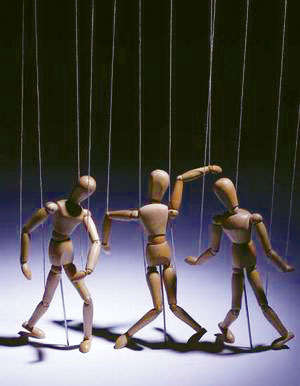
They are magical instruments – artificial egregores programmed with purpose, created by hidden hands. Their function is identical to that of black magic as described by mystics like Dion Fortune (Psychic Self-Defence) – the imposition of one’s will upon another through unseen forces.
“The most dangerous form of black magic,” warned Manly P. Hall, “is the scientific perversion of occult power for the gratification of personal desire.”
If the ancient Golem was a clay figure animated by sacred words to serve its master, then today’s equivalent is the technological construct animated by data, algorithms, and social engineering. It has no soul. It serves without question. And once built, it cannot be reasoned with.
But unlike the mythical Golem, this one is not merely a servant. It is the lens through which we view reality – filtering perception, rewriting memory, reinforcing belief. In this way, the modern Golem does not protect the village – it replaces it with a virtual model, one shaped entirely by those who cast the spell.
This is the sorcery of the 21st century. And materialism still remains its perfect veil.
Moshe Kroy’s Final Days & The Occult War for the Soul
“If black magic may work,” Kroy proposed, “while the conspirators both do their best to make us all believe… that it couldn’t possibly work… and at the same time deal in it themselves – well, that is a totally different proposition, isn’t it?”
In his later writings, Kroy spoke explicitly of the need to rediscover the self as spirit, not machine.
“If, indeed, materialism is a false absurdity and psychic research is valid,” Kroy wrote, “then the search for an authentic understanding of one’s own self… may be a very powerful tool of struggle against the conspiracy.”
In a culture that now reduces identity to data points, biology to code, and consciousness to electrochemical flux, the recovery of the spiritual self is not simply a metaphysical journey but an act of rebellion.
The occult war that Kroy hinted at – between those who invoke higher wisdom and those who exploit secret and even sacred knowledge – is reaching a crescendo. And the stakes are no longer theoretical.
The philosopher René Guénon referred to our current age as the “Reign of Quantity” – a world governed by metrics, mass, and measurement, where the qualitative dimensions of the soul and spirit are denied or derided. Guénon saw this as a symptom of a civilisational descent, a metaphysical degeneration masking itself as progress.
Charles Fort, the early chronicler of anomalous phenomena, was even blunter: “Mankind invented materialism to shield itself from what was being done to it – by coincidence, by forces, by powers – that it refused to understand.”
In late 1987, Moshe Kroy returned to Israel, no longer the young prodigy celebrated by Tel Aviv intellectuals but a man who had stared into the abyss – and reported back. He announced his latest discoveries and proclaimed the world is ruled by the forces of evil and that a final battle between good and evil is at hand. Reportedly suffering paranoia and pursued by the demons conjured during his adventurous life, he allegedly committed suicide in his Tel Aviv apartment in 1989.
“Moshe was indeed enigmatic to those who did not know him,” recalled Dr Joseph Chiappalone, an Australian medical doctor and esoteric writer who became a colleague of Kroy in Melbourne.
“But in reality he was a highly intelligent academic devoted to Truth and Wisdom. He was a non-Zionist Jew who had been expelled from Israel for protesting the atrocities committed by that State in the name of Zionism. His heroes were Jesus Christ and Sai Baba… He had been threatened with assassination if he ever went back [to Israel]. Mossad is nothing if not maleficently efficient.”9
Had he opened doors that others wanted sealed? Had he named the nameless, invoked forbidden truths, challenged egregores that guard the boundaries of our reality?
Or had the weight of knowledge simply become too much?
Regardless of the cause, Kroy’s legacy haunts the present moment. For the very systems he warned about – psychic suppression, full spectrum field dominance, the weaponisation of materialism – are now global and digitised. That control grid becomes our daily reality.
And yet, something else is happening.
The mechanisms of mass control are failing. Narratives – economic, scientific, political, social, spiritual – no longer inspire confidence. People are asking new questions, thinking new thoughts. Reports of the paranormal, near-death experiences, synchronicities, and psychic events are not only increasing – they are escaping the margins.
Is the old magic wearing off and the control system breaking down? Kroy would likely answer: Yes – and that is precisely why the system is panicking.
The rise of competing egregores – movements, ideologies, mass awakenings – signals cultural fragmentation and metaphysical turbulence. The battlefield has shifted. No longer confined to competing ruling class groups or underground journals, the war has gone public. The individual, once a pawn, is now a potential player.
The Way Out: Spirit, Sovereignty, and the Gnostic Revival
What, then, is the way out of this enchanted prison – a world where reality has been hacked by those who would have us deny the soul?
Moshe Kroy gave us a clue in his final written words:
“The search for an authentic understanding of one’s own self… as a spirit… may be a very powerful tool of struggle against the conspiracy.”
In other words, the only antidote to a world ruled by hidden magicians is the awakening of inner gnosis – the self-knowledge that one is not a machine, a statistic, or an algorithmic subject, but a sovereign, incarnated being endowed with the power to blossom consciousness, will, and purpose.
Materialism – so long used as a firewall – is cracking. Quantum physics has refuted classical determinism. Parapsychology, though marginalised, continues to produce data that defies the mechanistic model. Ancient traditions and indigenous ways of knowing, once dismissed as superstition and nonsense, are emerging as sources of healing, guidance and wisdom for today.
In his vision of the spirit as the core of human resistance, Kroy joins a long lineage across time. Their message, scattered across burned manuscripts, banned books, and suppressed teachings, remains remarkably consistent: you are more than flesh. You are more than thought. You are more than what they told you.
And the war – yes, the spiritual war – is not about saving the world, but about remembering who you are before the world was programmed into you.
In this war, only the awakened spirit is truly dangerous. And perhaps that, in the end, is why they feared Kroy – and us.
Author’s Note: This article, dedicated to the memory of Moshe Kroy (1948–1989), is based on two previous articles that appeared in New Dawn Special Issues Vol 12 No 3 and Vol 13 No 3.
Footnotes
1. www.kheper.net
2. ‘The Accursed’, Episode 3, www.imdb.com/title/tt4238712
3. sacred-texts.com/eso/sta/sta24.htm
4. theosophy.wiki/en/Egregore
5. The Flip: Epiphanies of Mind and the Future of Knowledge by Jeffrey J. Kripal, Bellevue Literary Press, 2019.
6. academia.edu/3989585/Reflections_on_the_De_vinculis_in_genere_by_Giordano_Bruno
7. Eros and Magic in the Renaissance by Ioan P. Couliano, University of Chicago Press, 1987.
8. Between Two Ages: America’s Role in the Technetronic Era by Zbigniew K Brzezinski, Praeger, 1982.
9. rense.com/general93/end.htm
© New Dawn Magazine and the respective author.
For our reproduction notice, click here.