
From New Dawn 182 (Sept-Oct 2020)
But to live outside the law, you must be honest
I know you always say that you agree.
– Bob Dylan, Absolutely Sweet Marie, 1966
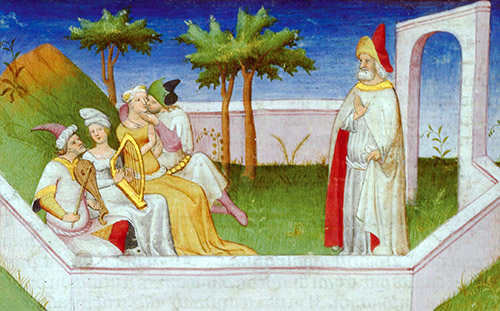
Whispered scenes of an inaccessible mountain pass filled with a Garden that resembles Paradise as described in the Quran. Drugged adolescent boys who were secretly carried there while unconscious awake to find themselves lying on golden couches, surrounded by streams of honey, clear water, and wine, with succulent fruits for the taking. And then the beautiful houris, those with lovely eyes, sensuously dancing, young women skilled in the arts of love initiating these young men in the true joys of Heaven. No virgins these, they are trained for pleasure. After four to five days in their company, the boys are drugged again with opium and hashish and carried back to the palace of the Old Man of the Mountain. Awakening in his presence, they describe to the court their experience and await their Master’s command. At the promise of return to that Garden, they will be willing to sacrifice themselves to his political plan.

And so the myth of Hasan-i-Sabah has been told for 700 years, brought to its perfection by the Venetian traveller Marco Polo. An earlier writer described the Master handing his disciple a golden dagger and identifying its target. While neither is certainly true, they are so tantalising as to be irresistible. I and many others were seduced by these stories into my lifelong interest in the Assassins. William S. Burroughs and Mick Jagger are two others who have been fascinated with this account, and the Assassins are mentioned in the writings of both Bocaccio and Nietzsche. (I give Marco Polo’s complete tale in an appendix to my book Hasan-i-Sabah: Assassin Master, along with numerous citations from the Quran describing that very Garden.)
Who was the real Hasan-i-Sabah and why does he matter? Curiously, while he died almost exactly 900 years ago (1124), his story encapsulates so much of today. The details of his political conflicts seem torn from this morning’s headlines, while his religious ambitions are practised in the daily spiritual life of countless people who may never have heard his name.
This is so because of the contact Hasan’s disciples had with the European Crusaders. The Crusades lasted from 1095 to 1291 and helped to intertwine the cultures of Christianity and Islam. The Knights Templar and the Syrian Assassins had a long series of documented historical interactions. The two groups of religious warriors had many similarities in their structure and the nature of their beliefs and values. Their common creeds of service to a higher truth, the righteousness of their cause, their shared appreciation of courage, discipline and loyalty were often more important than the apparent differences of their faiths. Abraham’s monotheism, after all, worships a God who is essentially the same in the three related religions of Judaism, Christianity and Islam.
The name ‘Assassin’ spread fear among contemporary rulers from China to England, especially in Muslim lands. Academics who preached against the sect were terrorised, as were clergy, generals, governors, mayors, and influential politicians and court advisors whose policies targeted the group. And there were many who did because the Assassins stood outside the political and religious order of their day. While the murder of individual enemies may be a distasteful thought, it is certainly a more humane way to conduct a war for survival than killing mass numbers of uninvolved civilians or soldiers who bear no policy responsibility. Unlike the behaviour of modern indiscriminate terrorists who kill fellow Muslims daily, Hasan-i-Sabah’s assassinations were few and laser-focused on policymakers only.
Hasan-i-Sabah was a rebel. He was the founder of the world’s most successful secret society, and he may truly be said to be characterised as a mystery wrapped in an enigma. He carved out an independent space for himself and his followers in the high Persian mountains. The Nizari Ismailis or Assassins defended and expanded their territory for 166 years. Their descendants today are led by their Imam, the Aga Khan, and are one of the most advanced and sophisticated Muslim sects on the planet – competently-led, broadminded, educated, and self-sufficient. They no longer practice the political policies of their medieval forefathers, instead substituting education, publishing, modern institution-building, cultural preservation, medical care, encouraging general prosperity, and offering social programs for their faithful.
Hasan himself was born to a well-to-do Shiite family in the northern Persian city of Rayy, near modern Tehran, a lively commercial hub of its day. It was a crossroads city of east and west, with a long, exotic, and interesting history. Travellers and merchants from India, China and Central Asia met Greeks, Romans and Egyptians. Shamans, Buddhists, Hindus, Muslims, Jews, Christians, Pagans of every stripe, Zoroastrians, Manichaeans and others passed through Rayy, trading and sharing their wares, practices and ideas.
Hasan felt the call of the spirit in adolescence and was introduced through friends to a minority Shiite offshoot group of schismatics called the Ismailis. They were estranged from the majority of Muslims, both Sunnis and Shiites. They were a breakaway sect whose beliefs in a spiritual leader called the Imam were primary. And they were considered heretical because the Ismailis had split on the identity of the seventh Shiite Imam and actually posited a Prophet beyond Muhammad, an absolute travesty according to orthodox Islam, whether Sunni or Shiite.
After being personally recruited by various representatives (dais) of the Ismaili faith for some time, Hasan’s resistance was worn down and he accepted their teachings, swore the oath of allegiance, and was soon promoted to a position of responsibility. This exposed him to what we might call the Mystery Traditions of antiquity. The Gnostic Ismailis believed in a Neoplatonic celestial hierarchy ruling life on earth and taught practices designed to allow the initiate to rise into higher consciousness and commune with such cosmic energies. It was a very different kind of faith and practice than the Arab tribal version of Islam that had conquered Persia some 400 years before Hasan’s birth.
Shiism and Ismailism were spread by conversion. And conversion involves dialogue, a mutual sharing of ideas and beliefs. This theme of transformation through give-and-take is crucial to an understanding of Hasan. Ideas totally foreign to either the Arab people or Islam itself become incorporated into Persian Ismailism by its contact with alien cultures. Mesopotamia is the cradle of Western civilisation and its rich spiritual beliefs were a key part of the Persian culture in which Hasan and Ismailism were active. The Zoroastrian Persians had no problem with the concept of semi-divine higher beings like the Imam, any more than the Egyptians of old would have questioned the divine status of the pharaoh, or Jews concerned with the elevated status of a prophet like Moses who spoke directly with God. Shiite doctrines like the sacred blood of the Prophet, transferred through Ali (his nephew) and Fatima (his sole surviving child and wife of Ali) to their descendants, echoed similar ideas of the House of David among Christians and Jews. Jesus carried the messianic legacy of the bloodline of David, the poet-warrior king of Israel. All historians discuss the input of Greek Hermetic ideas into Shiism and later Ismailism.
The third- through fifth-century writings of Greek Neoplatonic philosophers had been carried to Persia by fleeing monks after the sixth-century campaigns of Justinian had closed the pagan monasteries and outlawed religions other than Christianity. The Sasanian king Khosrow I welcomed them. Zoroastrianism was not incompatible with the concepts of a supreme, transcendent, and incomprehensible Deity – opening itself gradually through a refined descent through the levels of Being, that its essence could be better communicated with mankind. Though the Hermetic writings were lost to the West for a thousand years, Renaissance scholars like Marsilio Ficino and Pico della Mirandola gained access to them from Eastern sources and brought about a rebirth of esoteric wisdom in Europe.
Meanwhile in the East, Illuminist doctrines from various earlier heresies so altered mainstream Islamic beliefs that the resulting spiritual paths were nearly unrecognisable to orthodox Arab Muslims. These included tales of miracle-working Imams and other holy men. The eclectic doctrines that grew among the various Shiite/Ismaili groups included: belief in reincarnation and metempsychosis; deification of Imams and sometimes dais; intense speculations on the nature of God; attention to divination and prophesy; doctrines concerning the nature of the soul, death, the afterlife, and immortality; teachings on the cyclical nature of time and history; qabalistic investigations of the esoteric significance of letters and numbers; and occasionally, the overthrowing of traditional Islamic behavioural restrictions on sexuality, the use of intoxicants, and dietary limitations.
The Shia/Ismaili concept of the living Imam allowed for an emotional connection between the aspirant and his or her master that was not available to the more straitlaced Sunni acolyte. The ability to direct the disciple’s love of God through the spiritual master is an ancient practice. The teacher serves as the physical manifestation of the divine principle. Meanwhile, the anticipated redeemer or Mahdi awaits the divinely ordained moment for His appearance, silently guiding the Imam in his duty to shepherd humankind through the dark hours in which we must all spend our material existence. These hidden and speaking Imams are the personification of the metaphysical soul of the universe. They are wise enough to guide us all toward Truth. The Imam is sometimes referred to as the “speaking Quran,” for he alone can be trusted to separate the outer, exoteric teachings, or zahir, of the written text from its inner esoteric meaning, or batin, its essence.
Hasan-i-Sabah would learn from his Ismaili instructors that they had carried this reverence and appreciation of the Imam to the highest level of any Shiite sect; that the Imam enjoys the greatest amount of ilm or Gnosis, and that he can communicate this to the community. He would also have learned that the Ismailis analysed creation in vast cycles composed of incomprehensibly mysterious and profound cosmological eras, and of the energies operative in each. Ismailis viewed seven prophets (natiqs) as being charged with the guidance of humanity. The first six were Adam, Noah, Abraham, Moses, Jesus, and Muhammad. But Ismailis added a seventh, Ismail or his son Muhammad ibn Ismail, to this rarified group of world teachers. Hasan would have understood that accepting a prophet after Muhammad was an unforgivable blasphemy to orthodox Islam. His own capacity for independent thought must have been stimulated by this.
Each of the Prophets brought a code of behaviour, the sharia, to rein in the harmful tendencies and mischief normally associated with mankind. Sharia was not an example of success. Rather it was an admission that the higher message of the Prophet had reached its limit and rule-making became necessary.The Imam is a successor to the Prophet. He is charged with conveying the original message of the Prophet and with revealing reality (haqiqa) through the teaching. While the Prophet appears only periodically, the Imam is always present, otherwise the world would collapse.
Hasan would have been taught about the Final Judgment when the unredeemed and the ignorant are separated from those who had dared to perfect themselves and become the worthy companions of the Imam and his Truth. Hasan also understood that these teachings on the nature of the Ismaili beliefs needed to be conducted in silence and accompanied by ritualised personal pledges. How else could the Ismaili dais have been protected? How else could they know who to trust? How else could Hasan be expected to reach out to others and spread a fundamental heresy without some kind of oath-taking?
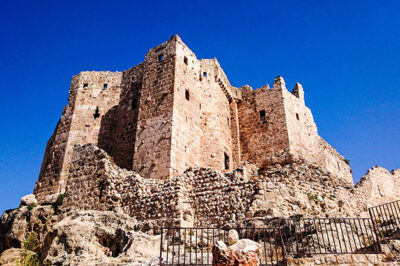
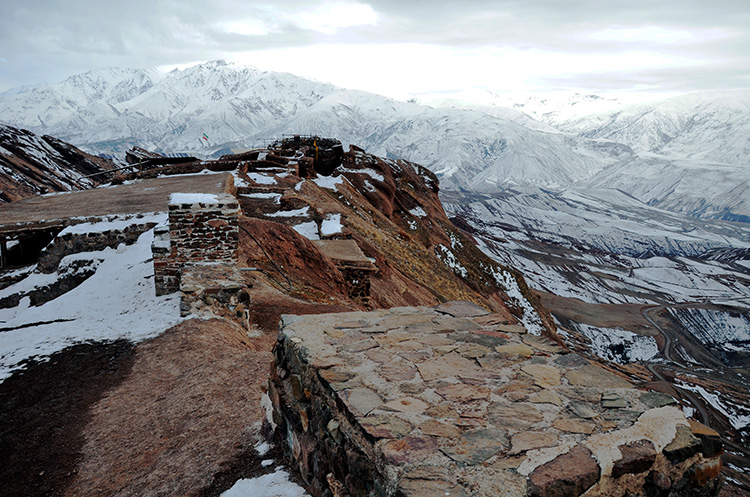
Several years after his initiation and initial training, Hasan was instructed to travel to Egypt where he strengthened his faith. The head of the Ismaili sect was the Fatimid Imam/Caliph al-Mustansir. This spiritual teacher was unique, chosen by God and inspired with the special wisdom and insight so that he could interpret complex doctrinal issues. Hasan attended a university for Ismaili missionaries for 18 months. Having some problems with the military dictator who had usurped the Imam’s power, Hasan left Egypt and returned to the Mideast. He travelled as a missionary through Syria, Israel, Iraq, and Iran for ten years and finally took possession of a mountainous castle/fortress known as Alamut in the year 1090. Strategically apportioned as a defensive structure, he improved it in such a manner that it long served his community and functioned as the headquarters for Ismaili offshoots in Syria, Afghanistan, and India. Hasan-i-Sabah was the original Old Man of the Mountain.
Several of the esoteric themes that are explored in my new biography of the Old Man include the concept of the Assassins as an initiatory society of graded spiritual ascent. Something secret, mysterious, and progressive took place in the conversion and initiation process administered by the Ismaili dais, and in the training program by which the dais were educated. This is undisputed by modern scholars, including the most orthodox and those most inclined to treat the Ismailis with the greatest deference and respect. We know that the Ismaili and Nizari mysteries included increasing revelations of the inner doctrine. We know they had a system of oaths to assure secrecy. As one who has spent his adult life studying and participating in hierarchical secret societies, I believe there is much to be said for the private, teacher-to-student communications about the nature of Truth. The idea of looking for esoteric meaning within scripture, exploring the higher reaches of philosophy to understand Truth, exploring numerology, Qabalah, and thaumaturgy, asking questions of commonly accepted ideas, seems a more than acceptable way for people to creatively expand their intelligence.
The Qiyama doctrine is another topic I explore in some depth. I believe it may have been one of the most profound and revolutionary concepts ever uttered and embraced by a religious community. The Qiyama declared the immanence of the “Inner Imam,” what Aleister Crowley called the “True Will” some 700 years later. The inner essence of an individual’s spiritual reality and personal source of guidance was asserted to be superior to any rule-making or forced adherence to outer forms of behaviour. This revelation was proclaimed by the fourth Lord of Alamut in 1164, some forty years after Hasan’s passing.
I also devote attention in Hasan-i-Sabah: Assassin Master to the drug issue and the derivation of the name Assassins from Hashish. Although forbidden in Islam, images of hashish and wine are shared by Sufis and countless others in the Mystery Traditions. Intoxication is a symbol or metaphor for the ecstatic experience of Divine Union. It is such an overpowering and disorienting phenomenon that it is often compared in the language of mysticism with drunkenness.

In closing, I would like to state that the primary thesis of my new book is Gnosis, the aspirant’s direct personal experience of God while within the human body. The knowledge of God transcends all the doctrinal rigours and hierarchies of all the established religions of the world through time. The celebrated Sufi mystic Mansur al-Hallaj (ca. 858–921) was suspected of being an Ismaili. He had acquired great influence among certain members of the Sunni royal family, and jealous enemies arranged his murder. He experienced a Gnostic union with God during which he was known to cry out Ana’l-Haqq, “I am the Truth.” His disciples went on to found a number of Sufi orders.
Hasan-i-Sabah: Assassin Master also includes the first English translation of Rashid al-Din’s 1310 version of the text of The Biography of Our Master. Mentioned and quoted repeatedly by all reliable authors on the Assassins, how it had not been translated before was a mystery that is now solved. There is also a translation of a purported letter exchange between Hasan and the Seljuk Sultan Malikshah in 1091. The book includes some 900 footnotes and nine detailed maps of the regions discussed in the text. With an extensive glossary of names and terms, a timeline, along with a comprehensive bibliography and index, one hopes it will prove a useful study guide for the interested reader.
James Wasserman’s Hasan-i-Sabah: Assassin Master, with a foreword by Tobias Churton, is available from all good bookstores.
© New Dawn Magazine and the respective author.
For our reproduction notice, click here.