

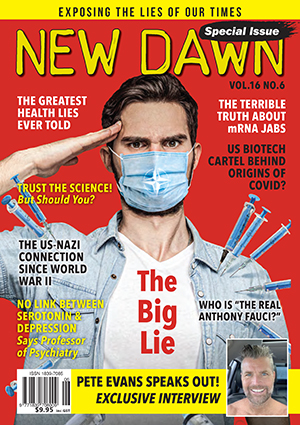
From New Dawn Special Issue Vol 16 No 6 (Dec 2022)
When it comes to our health, we are way too trusting of industries that are in business to earn a profit, often at our expense. We believe our health professionals’ primary concern is our well-being, not their wallets. We accept at face value anything told to us by “experts” in the media and vilify those who dare to question these experts, even when they lie.
Sometimes lies are nothing more than great marketing. For example, ever wonder why you are told to walk 10,000 steps a day? It came from a 1965 Japanese company called Yamasa Toki that introduced their new product, a step-counter called Manpo-Kei. This translated into “10,000 steps meter” and the company marketed their device with the slogan, “Let’s walk 10,000 steps a day,” which took off among Japanese walking clubs, and then, the world.
In this case, the end result was a positive and healthy one.
Not every health “lie” is.
Smoking Is Safe!
For decades, cigarette ads touted their product as healthy and sometimes included pregnant women and doctors puffing away. Cigarettes were all the rage until links between smoking and cancer got too big to ignore.
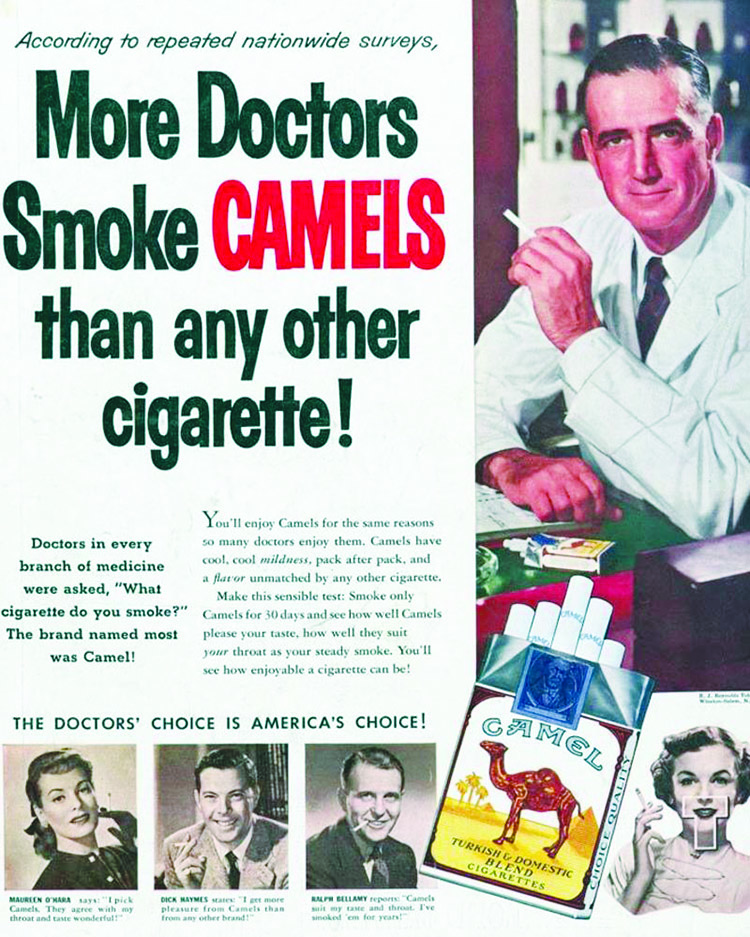
In 2006, Big Tobacco was in big trouble when the US District Court for the District of Columbia found tobacco companies guilty of breaking civil racketeering laws, marketing to children and minorities, and lying about the dangers of smoking. Judge Gladys Kessler wrote in her ruling, “Substantial evidence establishes that tobacco companies have engaged in and executed – and continue to engage in and execute – a massive 50-year scheme to defraud the public.”
Big Tobacco companies Lorillard, Inc.; Altria, owner of Phillip Morris USA; RJ Reynolds Tobacco, owner of Winston-Salem, who that year spent over $12.5 billion in advertising, were forced to admit they knew of the dangers, publish corrective and educational statements about the dangers of tobacco in national newspapers, and air corrective statements on American media five times per week for a year. They also had to affix a warning statement to a number of cigarette packs for two years and finance anti-smoking ads and campaigns.
Sadly, it was too late for the average 1,200 Americans dying of smoking every day or the millions who much later developed various cancers, heart disease, emphysema, leukaemia, reduced fertility rates, and nicotine addictions.
It was a Big Lie that woke many people up from decades of propaganda and manipulation as more research exposed the cancer connection, including to second-hand smoke. Unfortunately, it was not the only Big Lie.
Sugar Is Safe!
If cigarettes didn’t kill us, the side effects of a diet rich in this product might.
Sugar.
The average adult in the United States consumes the most sugar, coming in at 126 grams daily. Germany is right behind with 102 grams. [The average Australian consumes 60 grams.] Children in the US alone consume about 17 teaspoons of sugar each day up until the age of 19.
Sugar goes by many names including high fructose corn syrup, dextrose, sucralose, and maltodextrin and is found in processed products and treats, but also in many foods you might never suspect, such as “natural” salad dressings, sauces, baby foods, and more. It has been directly linked to inflammation, cancer, heart disease, diabetes, kidney disease, rising obesity in adults and children, and other illnesses, yet for decades it was celebrated as healthy.
Instead, the bulls-eye target was on something humans had consumed for hundreds of years without the proliferation of heart disease, obesity, or cancers.
Fat.
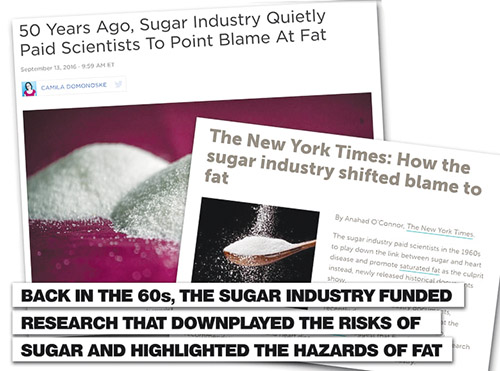
During the 1960s, the sugar industry paid scientists to perform research studies that played down the links between sugar and heart disease and instead placed the blame on saturated fats, according to internal industry documents published in 2016 by JAMA Internal Medicine. These documents showed a five-decade-long collection of research into nutrition and heart disease, accusing saturated fats as the main culprit behind heart disease while conveniently exonerating sugar.
According to the 12 September 2016 New York Times “How the Sugar Industry Shifted Blame to Fat” by Anahad O’Connor, this was a concerted propaganda campaign that involved the Sugar Research Foundation paying three Harvard scientists to publish a review on sugar, fat, and heart disease that featured hand-picked studies minimising the links between sugar and heart disease and promoting the links between fat and heart disease. Coca-Cola also paid millions of dollars in funding to researchers to downplay the links between sugar and obesity.
These faulty and fraudulent industry-sponsored studies became the foundation of a decades-long propaganda push to eliminate fats from our diet and push “healthy” low-fat foods. Carbohydrates in cereals and treats were fine, but a good piece of steak from the local butcher would clog your arteries and send you to the ER. Because the propaganda campaign was so pervasive and those scientists who questioned the narrative were ignored or silenced, people bought it and consumed sugar to the detriment of their health.
In “Big Fat Lies – A Half Century of Sugary Propaganda Has Made Us Sick” by Brian Krans for Healthline, the sugar industry bought up the advertising necessary to drive home their skewed research. Krans wrote that “Big Sugar” often restructured conversations around health and choice by establishing front organisations to steer the dialogue in their favour. These front organisations used names that made them sound scientific and pro-consumer and paid consultants to speak at conventions and testify at public hearings.
“During the 1960s, the sugar industry steered public policy away from recommending reduced sugar consumption for children because it caused cavities. Like the tobacco industry, it was able to protect itself from damaging research. It achieved this by adopting a strategy to deflect attention to public health interventions that would reduce the harms of sugar consumption rather than restricting intake.”
The 2016 JAMA Internal Medicine paper raised even more alarms, according to “50 Years Ago, Sugar Industry Quietly Paid Scientists to Point Blame at Fat” by Camila Domonoske for the 13 September 2016 NPR. JAMA drew on internal documents indicating the Sugar Research Foundation wanted to “refute” concerns about sugar’s possible role in heart disease. The SRF sponsored the research by Harvard scientists and the prestigious New England Journal of Medicine, then published the research in 1967 without disclosing the sugar industry’s funding. The NPR story quotes John Hickson, then SRF vice president and director of research, as having inserted into one document his recommendation that the industry fund its own research studies. “Then we can publish the data and refute our detractors.”
The following year, after several scientific articles were published linking sucrose and coronary heart disease, the SRF quickly approved the above literature review project and paid approximately $50,000 for the research supporting their pro-sugar goals. Studies that went against their message were dismissed for a variety of trivial reasons, such as one study that found a health benefit when people ate less sugar and more vegetables, dismissed on the grounds that such a dietary change was “not feasible.”
The Harvard researchers who turned their focus on the dangers of fats ironically used the “same kind of epidemiological studies they had dismissed when it came to sugar,” Domonske wrote. Their conclusion was that cutting out all fat was the best dietary intervention to protect someone against coronary heart disease.
Heart disease is the number one health-related killer and has been for a long time.
Statins Are Safe!
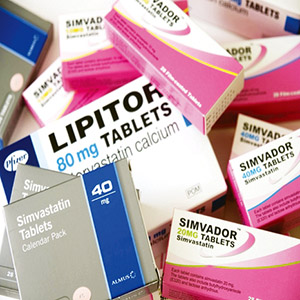
Another great lie was told to millions of people who believe if they don’t take statins, they will die of a heart attack. They believe this because their doctors tell them so and because television ads (in the USA) by pharmaceutical companies scare them into asking their doctors if “such and such drug is right for me.” In the year 2019, sales of the statin Lipitor made Pfizer Pharmaceuticals over $2 billion.
When saturated fat became the enemy, the debate over cholesterol as a heart disease indicator gained ground, with the narrative that too much cholesterol clogged arteries and caused heart attacks and strokes.
According to Dr Joseph Mercola in a 16 August 2020 analysis, “Research Confirms Statins Are a Colossal Waste of Money”:
“The food industry shifted away from saturated fat and cholesterol to improve public health, and the medical industry has massively promoted the use of cholesterol-lowering statin drugs for the same reason. Despite that, the rate of heart disease deaths has steadily risen.”
The mastermind behind the low-fat, low-cholesterol connection was American physiologist Ancel Keys, who in 1958 conducted his “Seven Countries Study” to create the saturated fat myth. In the study, he claimed to find a correlation between total cholesterol concentration and heart disease but was later found to be cherry-picking data. It was revealed he excluded data from 16 countries that, when added back in, eliminated all associations between saturated fat and mortality and instead proved those who ate the most saturated animal fat tended to have lower incidences of heart disease.
But it was too late. Big Pharma jumped on Keys’ study and ran with it. The American Heart Association, Proctor & Gamble Co, and the Center for Science in the Public Interest, all jumped on board and promoted the fallacy for decades, ignoring numerous studies disputing older data and other factors that cause heart disease, such as high blood pressure, stress, inflammation, poor diet, and sedentary lifestyle, and passing over more modern research showing that the more LDL, “bad” cholesterol, is lowered, the greater the risk of heart attacks and strokes.
Mercola notes a number of studies showing statins do not work as promised and that saturated facts are not the evil enemy. “A 2010 meta-analysis which pooled data from 21 studies and included 347,747 adults, found no difference in the risks of heart disease and stroke between people with the lowest and highest intakes of saturated fat.” He cited additional studies and analyses showing the same, including a 2014 meta-analysis of 76 studies by Cambridge University that found no basis for advising low saturated fat consumption to lower cardiac risk.
A 3 August 2020 Science Daily article, “Doubt Cast on Wisdom of Targeting ‘Bad’ Cholesterol to Curb Heart Disease Risk,” cites an analysis that same year published in BMJ Evidence Based Medicine that stated: “Setting targets for ‘bad’ LDL cholesterol levels to ward off heart disease and death in those at risk might seem intuitive, but decades of research have failed to show any consistent benefit for this approach.”
Sometimes the lies are told in stealth mode. For example, during the January 2021 COVID media storm, writes Mercola, “a study published in the journal Atherosclerosis quietly revealed that people taking statin medications had a higher rate of cardiovascular events than those who were not on statins.”
Medical News Today published a June 2016 story by Ana Sandolu, “Statins May Double the Risk of Type 2 Diabetes,” that statins might help heart disease but at the cost of rising rates of the chronic condition. The research, led by Victoria Zigmont, a graduate researcher in public health at Ohio State University in Columbus, appeared in the journal Diabetes Metabolism Research and Reviews. “The analysis revealed that people who took statins were more than twice as likely to receive a diabetes diagnosis than those who did not take the medication. Additionally, people who took statins longer than two years were more than three times as likely to develop diabetes.”
Statins continue to be handed out like candy, despite side effects that include muscle stress, pain, fatigue, and weakness, including sharp cramping and tendonitis, which can lead to myositis (inflammation of the muscle) and rhabdomyolysis (severe muscle damage, cell death, kidney failure, possible death). They also raise blood insulin levels. Statins can trigger insulin-related issues and increase the risk of new-onset diabetes for those people taking higher dosages of statins after a heart attack or surgery. They are linked to brain fog, impaired concentration, memory loss, cataracts, dementia, mood changes and mood disturbances, and increase the risk of obesity, ironically which can lead to heart disease and strokes. They also deplete the body’s natural stores of CoQ-10, which is critical for heart health.
5G is Safe!
In December 2019, a broad coalition of scientists, researchers, doctors, and advocates signed a National 5G Resolution letter and sent it to US president Donald Trump demanding a moratorium on 5G until further studies on the potential hazards to humans and the environment could be fully undertaken by independent scientists not linked to the telecom industries. The letter referenced published studies that clearly demonstrated harm to human health, bees, the environment, wildlife, trees, and birds from existing technology and showed that the increases needed to accommodate 5G would be even more disastrous.

A petition signed by 26,000 scientists and countless others who opposed 5G was also sent in 2018 to the United Nations, WHO, the European Union, the Council of Europe, and the governments of all nations. The first paragraph stated:
“We the undersigned scientists, doctors, environmental organisations and citizens from (…) countries, urgently call for a halt to the deployment of the 5G (fifth generation) wireless network, including 5G from space satellites. 5G will massively increase exposure to radio frequency (RF) radiation on top of the 2G, 3G and 4G networks for telecommunications already in place. RF radiation has been proven harmful for humans and the environment. The deployment of 5G constitutes an experiment on humanity and the environment that is defined as a crime under international law.”
One of the main concerns is 5G’s reliance on the bandwidth of the millimetre wave – MMW, known to penetrate 1 to 2 millimetres into human skin tissue, and that sweat ducts in human skin can act as antennae when in contact with MMWs. The symptoms of such exposure include burning sensations, pain, eye problems, altered heart rate, arrhythmias, and suppressed immune functions. With 5G set to act like an EMF blanket, one can only imagine the symptoms of longer-term exposure.
In “5G Danger: 13 Reasons 5G Wireless Technology Will Be a Catastrophe for Humanity,” Makia Freeman says that 5G dangers include, but are not limited to:
Damage to sweat ducts from the broadcast frequencies that could alter the human skin itself.
Dangers from premature aging and injury to the body, the brain, fertility, hearts, and DNA from the way EMFs activate the body’s VGCCs – Voltage-gated calcium channels.
Damage from pulsed wave radiation is far worse than continuous radiation.
Damage from deep EMF penetration when cell phones are held close to the brain.
Close proximity to the 5G towers causes negative effects in humans.
The same frequencies used in 5G are used in riot control and crowd dispersal directed energy weapons.
The MMW frequencies are both mutagenic (causing DNA damage) and carcinogenic (causing cancers).
Insects, birds, and children are the most vulnerable to 5G frequencies because of their body size.
Other Lies They Told Us – Fluoride is Safe!
Since the 1950s, the US Public Service endorsed adding fluoride to public drinking water for supposed benefits to public health, despite earlier 1945 studies not yet reaching any conclusion. Since then, numerous studies have proven fluoridation lowers IQs in children. The US National Institute of Environmental Health Science funded the “Bashash” study, published in 2017, that showed for each 1-milligram per litre increase in fluoride in pregnant women’s urine, there was an associated drop in her child’s IQ of four to five points. Canadian researchers found that bottle-fed children in fluoridated communities had an average of nine points lower on IQ tests than those in non-fluoridated communities. An earlier 2012 meta-analysis by the Harvard School of Public Health and China Medical University found evidence that fluoride negatively affected cognitive development in children.
Pesticides Are Safe!
In 2018, major lawsuits were filed against Roundup, a herbicide (weed killer) made by Monsanto (now owned by Bayer). Dewayne Johnson, a school groundskeeper who developed non-Hodgkin’s lymphoma after prolonged exposure on the job, was awarded hundreds of millions in damages. There are now more than 11,000 pending lawsuits against Bayer/Monsanto over the use of Roundup and the key ingredient, glyphosate, a known carcinogen.
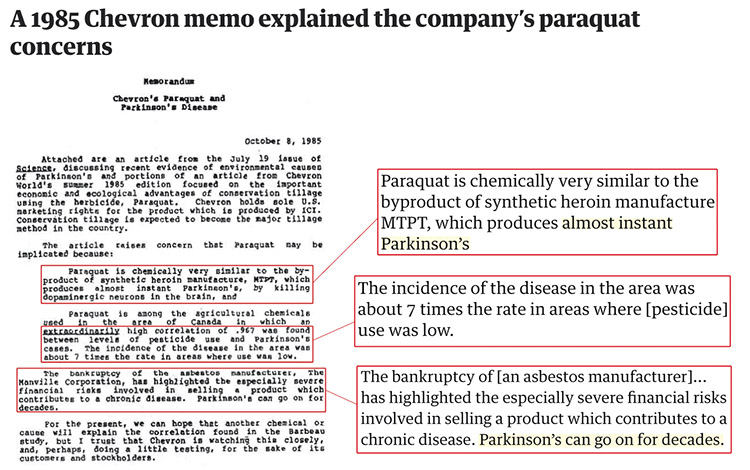
On 21 October 2022, The Defender featured a story by Carey Gillam, “50 Years of Secrets: How Chemical Giant Syngenta Hid the Truth About a Dangerous Weedkiller.” Gillam documents how Syngenta manufactured and marketed paraquat, a widely used weed killer. The company’s internal documents reveal it was aware their product’s long-term use was linked to Parkinson’s Disease.
Hundreds of internal corporate records also uncovered conversations between scientists and executives dating back to the 1950s.
“The documents also lay out how Syngenta crafted strategies to defend paraquat and counter independent researchers who were finding more and more evidence that paraquat may cause Parkinson’s, including development of an ‘influencing’ strategy ‘that proactively diffuses the potential threats that we face’…”
Sound familiar?
A Depressing Lie
There is mounting evidence that a low serotonin level is not the main cause of depression as we have been told for decades. But don’t tell that to the makers of antidepressants called SSRIs, selective serotonin reuptake inhibitors, who rake in billions of dollars, convincing millions of people they need to take drugs like Zoloft, Prozax, or Lexapro.
Irving Kirsch – associate director of the Program in Placebo Studies and the Therapeutic Encounter at Beth Israel Deaconess Medical Center and Harvard Medical School and a long-time critic of antidepressants – told Newsweek: “People do get better on the drug – but in the vast majority of cases it’s not because of what’s in the drug. There are other treatments that are at least equally effective, and that don’t carry the risks.”
The small benefits seen in some drug trials are due to emotional numbing, the “flatlined” symptom many on SSRIs report. This numbing effect comes at a steep price, however, as it also prevents you from experiencing emotional highs and does little to counteract the loss of energy, interest and motivation that are so characteristic of depression.
A systematic review published in Molecular Psychiatry on 20 July 2022 concluded: “The main areas of serotonin research provide no consistent evidence of there being an association between serotonin and depression, and no support for the hypothesis that depression is caused by lowered serotonin activity or concentrations. Some evidence was consistent with the possibility that long-term antidepressant use reduces serotonin concentration.”
Using these drugs long-term will likely make you more depressed! Not to mention the long list of side effects including suicidal ideation in children and young adults.
Take Back Your Health!
Dr Leland Stillman, author of the new book Dying to Be Free: How America’s Ruling Class Is Killing and Bankrupting Americans, and What To Do About It, warns that “people are being really exploited by the medical system… The [conventional] model is to turn you into a recurring revenue stream, where you’re renting your body from Big Pharma.”
“It’s one of the most disillusioning things, as a practitioner, to realise that so many people are not actually invested in their wellness,” laments Stillman.
The lies, myths, and half-truths only work if we believe and accept them. Instead, we should believe, as Stillman does, that an entirely new healthcare system can and is being built on maintaining health rather than managing disease.
Sources
https://careygillam.substack.com/p/50-years-of-secrets-revealed
www.sgtreport.com/2022/10/antidepressants-rarely-outperform-sugar-pills/
www.newsweek.com/2022/09/30/antidepressants-work-better-sugar-pills-only-15-percent-time-1744656.html
www.thedailybeast.com/big-tobaccos-biggest-lies
www.globalresearch.ca/5g-danger-13-reasons-5g-wireless-technology-will-be-a-catastrophe-for-humanity/5680503
www.1news.info/health-news/how-conventional-medicine-kills-and-what-to-do-about-it-1290461
https://jamanetwork.com/journals/jamainternalmedicine/article-abstract/2548255
www.medicalnewstoday.com/articles/325567
www.npr.org/sections/thetwo-way/2016/09/13/493739074/50-years-ago-sugar-industry-quietly-paid-scientists-to-point-blame-at-fat
www.nytimes.com/2016/09/13/well/eat/how-the-sugar-industry-shifted-blame-to-fat.html
www.peoplespharmacy.com/articles/why-doesnt-lowering-ldl-cholesterol-save-more-lives
www.sciencedaily.com/releases/2020/08/200803184143.htm
https://tobacco.stanford.edu/antismoking/anti-industry/industry-lies
© New Dawn Magazine and the respective author.
For our reproduction notice, click here.