

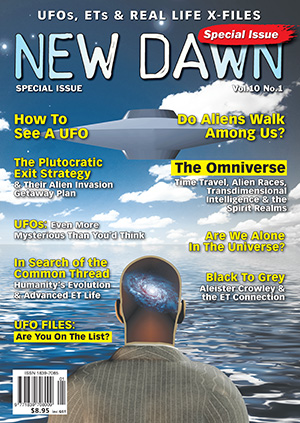
From New Dawn Special Issue Vol 10 No 1 (Feb 2016)
Reports of Unidentified Flying Objects (UFOs) have fascinated me since early childhood. I’ve spent many a night lying on the deck of my childhood home, staring at the sky and waiting – no, hoping – for something ‘strange’ to happen. As Jung wrote, UFOs are symbols of powerful processes in our obfuscated psyche, which explains people’s fascination with them.
Later in life, what was a childhood fascination became a more serious, scholarly interest. I’ve read much of the literature on UFOs just to become highly disillusioned with what people make of the phenomenon and the evidence. Today, I am very critical – even cynical – of much of what takes place within ‘UFOlogy’. I hold the opinion that the field is riddled with fantasies, delusions and outright deception aimed at commercial gain or personal fame. So much so that, if not for the work of one man – a voice of reason and integrity in a morass of hysteria – I would have dismissed the whole affair once and for all. This man is French UFO investigator Jacques Vallée.
What I find refreshing in Vallée’s work is his readiness to follow the evidence wherever it leads. Most ‘UFOlogists’ today seem to hold the opinion that UFOs are material spacecraft from another star system. This is the so-called ‘Extraterrestrial Hypothesis’ (ETH) and its motivations are clear: in a field already characterised by weirdness, the last thing investigators want is to compound the weirdness by proposing a hypothesis that doesn’t fit neatly into our mainstream materialist worldview. But the evidence doesn’t support the ETH at all. In Vallée’s own words:
The accumulated data base exhibits several patterns tending to indicate that UFOs are real, represent a previously unrecognised phenomenon, and that the facts do not support the common concept of ‘space visitors’. Five specific arguments… contradict the ETH: (1) unexplained close encounters are far more numerous than required for any physical survey of the earth; (2) the humanoid body structure of the alleged ‘aliens’ is not likely to have originated on another planet and is not biologically adapted to space travel; (3) the reported behaviour in thousands of abduction reports contradicts the hypothesis of genetic or scientific experimentation on humans by an advanced race; (4) the extension of the phenomenon throughout recorded human history demonstrates that UFOs are not a contemporary phenomenon; and (5) the apparent ability of UFOs to manipulate space and time suggests radically different and richer alternatives.
So if the ETH doesn’t hold up in view of the evidence, how else can we make sense of UFOs? I have extensively elaborated upon it in my earlier book Meaning in Absurdity. In this essay, I’d like to offer a different spin on my hypothesis.
Before I can do that, however, I need to share with you my view of the fundamental nature of reality: I believe all reality – including our bodies – is in consciousness, not consciousness in our bodies. As such, consensus reality is an imagined story emerging from obfuscated, collective parts of our psyches, like a shared dream. Our individual psyches are thus dissociated ‘alters’ of a single consciousness – which I call ‘mind-at-large’ – underlying all known and unknown reality. Consensus reality is a particular ‘dream’ of mind-at-large. I am well aware that this view sounds peculiar at first sight, but essays 2.1 and 2.2 of this book [Brief Peeks Beyond] substantiate it in depth. Here, all I ask is that you temporarily suspend your disbelief and entertain this view for the sake of argument.
If mind-at-large can dream an entire reality and also has the potential to split itself into dissociated alters, then nothing precludes the possibility that multiple dreams may be unfolding concurrently in mind-at-large. Allow me to unpack this: as mentioned above, each person is a dissociated alter of mind-at-large, partaking in a collective dream that we call consensus reality. Our individual psyches unite at a deep, obfuscated level, and the dream of consensus reality is imagined at that unified level. That’s why we are able to share the dream. But perhaps there are multiple, hierarchical, nested and parallel levels of dissociation and alter formation. Perhaps our individual psyches unite not at the ground level of mind-at-large, but at an intermediary level that is itself dissociated from other intermediary levels. We human beings may be alters of a meta-alter, and there may be multiple, parallel meta-alters in mind-at-large. As a matter of fact, there may be meta- meta-alters, and meta-meta-meta-alters, etc.
So the hypothesis is that, as our consensus reality is the dream of a meta-alter in mind-at-large, other meta-alters are having other dreams in parallel to ours. Each of those dissociated dreams is a reality in its own merit. Multiple, perhaps countless dreams are unfolding in the hierarchy of dissociation of mind-at-large, somewhat analogously to the parallel universes that physicists like to talk about. Each of these dreams has its own storyline: its own internal logic, physics, history and living inhabitants.
And here is where UFOs and ‘aliens’ come into the picture. Have you ever had a dream in which an event in the waking world penetrated the dream without waking you up immediately? For instance, I once went to sleep with the window of my hotel room open while on holidays abroad. In the middle of the night, while I lay asleep, there was a storm and some drops of rain began landing on my bare feet. The wind was also moving the curtains about, which caused some noise in the room. I was dreaming whilst this was happening. At some point in my dream, I found myself walking on a beach with my feet in the surf. The feeling of wetness on my real-life feet morphed seamlessly into the feeling of dragging my feet in the seawater. The sound of the wind and moving curtains inside my hotel room morphed seamlessly into the sound of waves breaking on the beach. I realised all this because I woke up in the middle of it and, for a few brief seconds, could simultaneously feel the surf and the raindrops landing on my feet; I could simultaneously hear the wind in the room and the waves on the beach. During those brief moments, I knew that these experiences, while different, were in a way also the same. The ‘dream’ of waking life had penetrated my nightly dream.
This is the key: dissociated dreams can perhaps – under exceptional, delicate circumstances – penetrate each other. Separate storylines can momentarily overlap and cross-influence one another. When that happens, the protruding element from a source storyline – say, the raindrops in my hotel room – gets ‘dressed up’ in an image that is amenable to integration into the destination storyline – that is, the surf in my dream. Indeed, there were no raindrops in my dream; just surf. There was no perceptible wind in my dream; just waves. The protruding element isn’t perceived as it appears in its source storyline, but in an alternative form characteristic of the storyline it penetrates. In a sense, the protruding element gets ‘hijacked’, co-opted by the narrative it penetrates so to become an integral part of it. Yet, the underlying, intrinsic attributes of the protruding element remain the same and are accommodated by the form it acquires in the destination storyline: the wetness of the raindrops was preserved in the form of surf; the oscillating, flowing sound of the wind and curtains was preserved in the form of waves. Although the form these protruding elements acquired inside my dream was very different than their original form, their intrinsic, fundamental attributes were preserved.
By now, I’m sure you’ve already guessed where I am going with this: what if UFOs and aliens are protruding elements of parallel ‘dreams’ unfolding in mind-at-large, which penetrate our consensus reality and acquire a form amenable to integration within it? It isn’t then surprising that this acquired form should resemble advanced versions of concepts we are familiar with and can place within our storyline: spaceships, anthropoid life forms, medical procedures, computer technology, etc. These acquired forms often look internally inconsistent, cartoonish or even absurd simply because they aren’t the original forms of the protruding elements; instead, they reflect a rather precarious accommodation, in our own storyline, of the intrinsic attributes of something that fundamentally transcends our logic and physics. Here, I suggest, lies the reason for the ‘high strangeness’ of UFO and so-called ‘alien abduction’ phenomena.
If even a very small percentage of reported UFO and ‘alien abduction’ cases are valid and accurate, we have no alternative but to envision rather unusual, speculative hypotheses for making sense of it. The high-strangeness character of the phenomenon demands no less and this is what I attempted to offer here. Alternatively, we can simply deem all the evidence to be invalid and sleep more easily at night.
Extraterrestrial Life: Implications for the Materialist Paradigm
There has been growing expectation among scientists that extraterrestrial microbial life will be discovered in our solar system within the next few decades, perhaps in one of the moons of Jupiter or Saturn. I’ve asked people close to me whether they thought this would be a paradigm-breaking event, and the response has been mostly in the ‘no’ camp. Such a reaction is completely understandable: scientists have been acknowledging for years that life may be common and widespread in the universe, so why would its discovery in a neighbouring celestial body break any paradigms? Nonetheless, I think we are overlooking something crucially important here, which has vast implications for how we look upon ourselves and reality at large.
Our culture’s mainstream view is that life is a mechanistic process explainable entirely by the known laws of physics. In other words, life is merely an epiphenomenon of dead matter. There is supposedly nothing to life but the same movements of subatomic particles behind erosion, crystallization, combustion, the weather, etc. As such, life is allegedly no different than erosion or crystallization, except in that metabolism operates faster. Biological organisms are mere ‘robots’, entirely analogous to a computer. Life is believed to have arisen by mere chance, through the random collisions of atoms and molecules in a primordial chemical soup on primitive Earth. So the question is: if biology were discovered in a celestial body next door, would that raise new and difficult questions for such a mechanistic view of life? I think it would.
Nobody knows today how life could emerge from dead matter. There are dozens of theories and even more loose avenues of speculation, but no one has ever managed to re-create life from dead matter – a process called ‘abiogenesis’ – in a laboratory. Therefore, there is just no proof that life could ever have arisen from non-life through purely mechanistic means. Yet, mechanistic abiogenesis is indispensible for materialism. Without it, materialism would fall apart, for it would fail to explain that which conceived materialism in the first place: human life.
The problem is that, not only do the different structures necessary for metabolism need to arise concurrently in an organism, very complicated mechanisms for the replication of these structures – that is, reproduction – need to arise along with them. Otherwise, life would pop into existence just to disappear again. Francis Crick, the Nobel Prize laureate and co-discoverer of DNA, once thought it impossible for the self-replication mechanisms essential to life to arise spontaneously, mechanistically, from a chemical soup on primitive Earth. He thought the complexity required was just too great. Although Crick later felt that he had been a little too pessimistic in his original assessment, the key point still stands: mechanistic abiogenesis, if at all possible, is extraordinarily unlikely.
Now, how does this tie in with the possible discovery of extraterrestrial microbial life? Well, if we were to find independently-arisen life in our immediate cosmic neighbourhood – right here, next door – the obvious implication would be that abiogenesis is a very common occurrence in the cosmos. After all, what are the chances that a rare event would happen, independently, twice within the same star system? But if it’s common, then life can’t be the kind of accidental, mechanistic phenomenon that it is purported to be by materialist science. Mechanistic abiogenesis, after all, can at best be extraordinarily rare; if at all possible. The discovery of a second instance of abiogenesis in our solar system would, therefore, force us to consider the possibility that life is the expression of yet-unrecognised but intrinsic organising principles in nature. It would force us to consider the possibility that nature is, in a way, meant to produce life. This, by any measure, would indeed be a paradigm-breaking conclusion.
Reprinted with permission from Bernardo Kastrup’s book Brief Peeks Beyond: Critical essays on metaphysics, neuroscience, free will, skepticism and culture (Iff Books, 2015), and available from all good bookstores & online retailers.
© New Dawn Magazine and the respective author.
For our reproduction notice, click here.