The
central figure in the ancient Mexican rebirth rituals was the 'Sovereign
Plumed Serpent' Quetzalcoatl — the god-king of the golden age who
had died, the legends said, but who would one day return. The well-known
physical descriptions of this 'once and future king' which the myths
relay — tall, white-skinned, yellow-haired and bearded — make him
sound like a Caucasian...
— Graham Hancock, Heaven's Mirror
It
was 1519 — the year that dramatically changed the course of history
for the people living in the newly ‘discovered’ Americas. Cortez, the
Spanish conquistador, and his motley band of buccaneers and mercenaries
had just landed and were about to embark on a great adventure, in search
for gold and precious gems. They found more treasure than they ever
dreamed of, but also unexpectedly, an advanced civilisation.
Disembarking from their ship at a point somewhere
close to where modern day Mexico City is situated, they discovered
a country populated with people who called themselves Aztecs. The
organised armies of the Aztecs, and their Emperor Montezuma, first
met the Spaniards not far from the coast. The encounter was friendly
and Cortez and his men were invited back to Montezuma’s palace.
Before Cortez and his men entered Montezuma’s palace
they had to cross several inner yards with fountains squirting crystal-clear
water into the air. Their way led them through great chambers with
ceilings panelled in aromatic woods and beautifully carved. Incense-burners
spread a pleasant and pervasive scent.
Above the main entrance to the palace the Spaniards
found a device known to them from home: an eagle with a panther in
its talons.
In the antechamber to the Emperor’s hall the Spaniards
were greeted by members of the nobility, who took off their shoes,
hid their robes under a cloak of the coarsest cloth, and then, barefoot
and with downcast eyes, stepped humbly into their emperor’s presence.
According to historical accounts, a murmur of surprise
rose from the ranks of the Spaniards as they finally stood before
Montezuma: The Emperor was sitting on a throne, just as their own
rulers did — and the courtiers paid their respects before the
throne in the same way the Spaniards would have done at home. They
were to see much more than this that would remind them of home.
Montezuma was wearing a cloak with a girdle, sandles
with gold soles and fastened by gilt straps. His cloak and sandles
were embroidered with pearls and precious stones. The Emperor was
tall, slim, and about forty years old. He had black, straight hair,
a thin beard, and his skin was paler than that of the other Indians.
Although the Spaniards would not have realised its
significance, Montezuma wore on his head the Aztec’s greatest treasure:
a magnificent head-dress of feathers containing the long tail-feathers
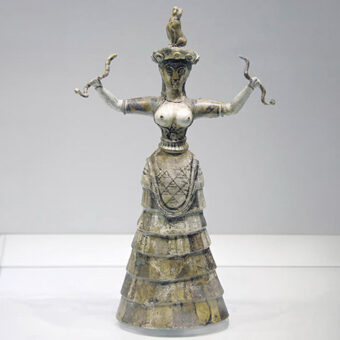
of exotic birds. Similarly, and almost certainly not coincidentally,
a Cretan prince wears a crown of lilies with a plume of peacock feathers
on a coloured six-foot frieze of stucco in the Palace of Knossos (Crete,
1650 BC).
What amazed the Spaniards the most was the numerous
similarities in custom and insignia between the Aztecs and the Old
World. Throne and litter (entourage), sceptre and crown, flowing drapery,
purple, heraldic beasts — all existed in both their worlds. Were these
parallels just coincidence, or had there been prior contacts between
the two worlds in the distant past? Before we examine this question,
first let us travel back and imagine what it must have been like in
the Aztec capital of Tenochtitlan, 1519 AD.
The
Great City of Tenochtitlan
In Historia Verdadeira Da La Conquista Bernal
Diaz, who accompanied Cortez on all his expeditions, wrote:
And we saw so many towns and villages on the surface
of the water and many more still on the mainland, we were seized
with wonder, and we said, it must be magic...for everywhere great
towers, temples and pyramids rose out of the water; many a soldier
thought he must be dreaming.
And Cortez himself records in surprise:
You find houses like those kept up by apothecaries,
where you can buy medicinal potions ready for drinking, ointments
and plaster. You see barber’s saloons where you can take a bath
or have your hair cut. You come across houses where you can eat
or drink against money.
The city of Tenochtitlan had about 60,000 houses
and 300,000 residents. The Spaniards strode along the wide streets
with huge mansions built of a red porous stone, nearly all having
roof-gardens full of luxuriant plants. The streets were swept clean
and well-washed. Strong pipes carried fresh drinking water from the
mountain of Chapultepec right into the middle of the city.
At the height of its prosperity, it was then a lively,
teeming city, with arsenals, granaries, an aviary, an enclosure for
wild animals looked after by keepers (just as in the zoos of our day),
many fountains and fish-ponds, large reservoirs set in chequered marble.
There were residences for state visitors, schools, special blocks
for priests’ living quarters, and other large buildings. Littered
across the city you could see the tops of temple pyramids. The largest
pyramid was situated in the town of Cholula, half as tall as the Great
Pyramid of Giza, but measuring twice as long.
The
Market Place
Of the wonderful market at Tenochtitlan, Bernal Diaz
writes:
When we reached the square called Tlatelolco we
stared in amazement. Not only at the mass of people and the profusion
of goods but also at the orderliness that reigned in everything,
because we had never seen the like of it before.
Cortez was so struck by the market that he wrote:
“There is...still another market, twice as large as Salamanca’s and
entirely surrounded by arcades.”
The Spaniards could not say enough about this fantastic
spectacle, the tens of thousands who went there daily. The men wore
cloaks slung over one shoulder and tied round their neck; their robes
were adorned with wide belts, fringes, tassels, and all sorts of
jewellery.
The women wore several skirts, one on top of another, with very ornate
ribbons and beautiful embroideries. Many had their faces covered with
thin veils made from aloe fibres or rabbit wool. All the women wore
long plaits.
Everything that was manufactured in the Spaniard’s
world was to be had in this market of Tenochtitlan.
There were special stalls for Cholula’s jewellers
and potters, Azcapotzalco’s goldsmiths, Tezcoco’s painters, Tenayuca’s
stone-cutters, Xilotepec’s hunters, Cuitlahuac’s fishermen, Quauhtitlan’s
basket- and chair-weavers, Xochimilco’s florists.
There were a great variety of curios you could buy
there: golden fish with little scales of gold, golden birds with golden
feathers and movable heads, vessels made from all kinds of wood, varnished
or even gilt, bronze axes, warriors’ helmets with crests of animal’s
heads, quilted cotton waistcoats for the warriors, feather armours,
swords with obsidian blades, razors and mirrors from cut stone, hides
and leather goods of all sorts, tame and wild animals.
In fact, delicate artistry reached such a high level
in Aztec civilisation that a life-size human skull was carved out
of a solid piece of crystal. This famous piece of work now resides
in the British Museum.
At the food-stalls mountains of poultry, fish and
game were being offered, a luxuriant array of vegetables, maize, baker’s
wares, bread, cocoa, and Pulque, an intoxicating drink. There
was also a profusion of flowers, beyond anything the Spaniards had
seen.
The fairs of ancient Crete and Egypt must have been
rather similar; as for clothing, what the noble Indians wore was very
like the attire of the ancient Greeks; we know about it from the chronicler’s
descriptions and in particular from the drawings in an old manuscript
to be found in the Madrid Museum.
Indians
Ate With Spoons and Forks
Plates, spoons and forks did not come into
general use in Europe till the late sixteenth century. In the Indian
civilisation, however, these requisites had been in use for at least
1000 years before the Spanish reached their shores.
Pierre Honore, in his book In Quest of the White
God, elaborates:
According to the Spaniards — who watched
Montezuma when he was their prisoner — the Emperor used to
eat alone. Hundreds of dishes had been prepared for him in earthenware,
gold and silver bowls. His favourite dishes were kept hot for him
in special vessels. He sat on a big cushion on the floor, with a
low table in front of him. Plates and cups were made of pottery...He
also owned a golden set, which was used on holy days. Torches of
resinous wood lit the large room where the Emperor took his meal.
Five or six of his intimate councillors stood in silence at the
far end of the hall during the meal...
After the main meal there was bread, cakes and
pastries of all kinds, which were baked by the girls in the hall
itself; for instance rolls and ‘waffles’. Then the Emperor would
drink his ‘chocolate’, viscous like honey, from a gold mug, and
use a gold spoon for it. After dipping his hands in the water, which
was brought him in a silver bowl, he smoked his pipe and let himself
be entertained by conjurers, jugglers and clowns. Then he had a
siesta, which was followed by receptions for dignitaries and emissaries.
They would appear before him with lowered eyes, wearing a hirsute
gown, barefooted, and walk backwards when they left his presence.
The procedure was similar at the table of the Incas
of Peru, where there were also spoons, and plates and cups made
of pure gold. So here were these requisites being used before they
had come into use in Europe. But, even more surprising, they were
quite current in the ancient civilisations of Egypt and Crete. The
Egyptians had spoons 3,000 years before the birth of Christ. Assuming,
therefore, that these utensils were at one time brought into the
New World [Central/South America] from the Old [Europe/Mediterranean],
they could only have come out of one of the very ancient civilisations.
According to all the chroniclers’ accounts, the Aztecs
had created an advanced and thriving civilisation, on par with civilisations
like that of Mycenae, Crete, China, Rome, Phoenicia and Sumeria.
The Spanish were soon to discover that the Aztecs
were not the only people existing on the continent. The remnants of
even earlier peoples were found.
We now know of the great empires of the Mayan, Tultecs,
Zapotecs, Tarascans, Olmecs, and on the Peruvian plains that of the
Chimu, and in the Andes, probably the earliest and greatest of all,
the Chavin. All existed either simultaneously or followed each other
from about 1100 BC until the tradition was crushed by the arrival
of the Spanish.
As the Spanish slowly moved south on their search
for gold and precious stones they were still to encounter another
great thriving civilisation, this time in Peru.
The
Incas
After subjugating the Aztecs, the Spanish still dreamt
of discovering the legendary ‘Eldorado’, or City of Gold.
Pizzaro,
the leader of the Spanish expedition, sailed south from Panama in
1531 and on the evening of the 15th of November, 1532, the Spaniards
entered Cajamarca, the residence of the Incan ruler. Fortunately for
the Spanish, the empire was reeling from internal strife and conflict.
Upon first seeing the Incan ruler Atahualpa, the
Spanish were amazed to see the use of a litter, and we still have
a picture of it. He also wore purple, as did the Aztec emperor. For
solemn occasions the Incan ruler held a golden sceptre as large as
a halberd. His big leather shield was adorned with a heraldic bird,
a falcon.
We know both throne and sceptre as emblems of royal
dignity not only from the Aztec and Incan empires, but also from drawings
on ancient Mayan vases and the painted friezes found on many Mayan
temples.
On their heads the Incan priests wore something like
a tiara, decorated with a golden sun. The Incas therefore recognised
the Spanish bishops with their mitres as the high priests of the new
religion.
When the Spanish marched towards the Incan capital
Cuzco, they were surprised to find road engineering on a vast scale.
All the Spanish chroniclers stated that the roads were better than
those of ancient Rome, nor had they met such magnificent roads in
any European country.
But the Incas had something the Aztecs did not have:
scales of balance. Measurements are the foundation of all science.
The Incas used beam scales, like those of the ancient Romans. There
was another similarity with the old Romans: The division of the Incan
army into units of tens, hundreds, and thousands, just like the legions
of Rome. The Incas also used the decimal system and the old Sumerian
sexagesimal system of measurement by six, twelve and sixties. The
decimal system is over 4,000 years old. It was already known in Egypt
as far back as that, and later, around 1700 BC, in Crete. The Greeks
adopted it from there, the Romans from the Greeks, and subsequently
reached all of Europe.
In the Incan empire every citizen was classified
by age according to the decimal system starting with babies and ending
with centenarians. The Incas had taken it from the ancient people
of Chimu, who had long been subjected to them; the Chimu had been
familiar with the decimal system centuries before the Incas appeared.
On entering Cuzco the Spanish saw another thing which
was familiar to them: nearly all the Indian dignitaries had turbans.
People are shown wearing turbans in paintings and statues of the Hittites,
the Babylonians, the Egyptians. All predate our era.
Some of the Spanish had an odd experience in Cuzco.
Everywhere in the Incan empire they were greeted
and addressed as ‘Viracocha’. Hearing the word again and again, they
at first took it for a form of salute and had no idea of its meaning.
In Cuzco they learnt that it was the name of the great god who the
Indians say came in the dim past and brought them all their knowledge.
The
Great ‘Viracocha’
Pierre Honore relates a remarkable incident that
occurred in Cuzco:
...the conquerors heard about the temple which
had been erected outside the town to the god who was greater than
all other gods. A party of them hurried off there, hoping to find
an immense store of gold. They came to the temple of Viracocha,
a one-storeyed building about 125 feet by 100. They went in and
entered a maze of passages: there were twelve narrow passages going
round the building. They made their way from one into another, and
finally penetrated to the sanctuary, a small room paved with black
slabs.
On a little dais on the far wall there was the
figure of a man. When they stood before it even the wildest, roughest
and most hardened veterans took their caps into their hands and
hastily crossed themselves: they knew that figure from all the churches
and chapels in Spain. It was an old man with a beard, standing erect,
holding a chain in one hand; the chain was round the neck of a fabulous
creature which lay before him on the ground. It was a statue of
St. Bartholomew.
When they had recovered from their surprise they
slowly filed out into the passage again. They found no treasure
here; the great temple contained nothing but the statue of the god...
(In Quest of the White God)
This was not the only strange experience the Spanish
had. The legend of the bearded White God appeared everywhere they
visited and conquered.
The Tultecs and Aztecs of Mexico called him Quetzalcoatl,
the Incas called him Viracocha. To the Maya he was Kukulcan, who brought
them all their laws, also their script, and was worshipped like a
god by the entire people.
The
Legend of the ‘White God’
They could do practically anything, nothing seemed
too difficult for them; they cut the greenstone, they melted gold,
and all this came from Quetzalcoatl — arts and knowledge.
— Fray Bernandino Sahagun
The numerous legends of the great White God say that
he brought the Indians all their sciences, knowledge of engineering,
laws, and their higher level of civilisation.
As Quetzalcoatl, he taught the people morality, gave
them wise laws, and showed them how to till the land. He forbade human
sacrifice and preached peace. Men were no longer to kill animals,
even for their food; they were to live on fruit and vegetables.
This golden age did not last long, for (say the legends)
a demon plunged Quetzalcoatl into sin, debauchery and the neglection
of his religious duties. Quetzalcoatl was so full of grief and shame
for his misdeeds that he left the country with his followers. According
to other legends, he boarded a ship on the shore, which sailed back
with him to the land he had come from. But before his departure he
promised to return.
As for South America, one of the Spanish chroniclers,
Cieza de Leon, records the appearance of a man with a beard by Lake
Titicaca long before the time of the Incas. He was a mighty man who
taught the people everything to do with law and civilisation. He was
the creator of all things and commanded men to be good to one another
and live without violence.
Everywhere in the Indian states of Central and South
America, and even some parts of North America, the legend of the White
God is known, and it always ends in the same way: The White God left
his people with a solemn promise that he would one day come back.
The legend, however, was one of the main reasons for the quick downfall
of the Indian states. The people had the image of the White God so
firmly fixed in their minds that they immediately accepted the Spaniards
as the White God’s followers who had returned.
Prophecy
Comes True
According to Pierre Honore, the time of the expected
return of the White God was remarkably similar to the arrival of the
Spanish.
The Aztec priests in Mexico had worked out that
their White God, who had left them in the year Ce-acatl (1 Reed),
would also return one day in the year Ce-acatl. In the Aztec calendar
this year Ce-acatl recurs every fifty-two years. Before every such
recurrence the stars and other portents were carefully observed,
and each time the priests predicted whether the White God would
return on the first day of the new cycle.
By a strange coincidence it was just before a new
cycle started that word got round among the Aztecs of ‘water houses
with swan wings’ cruising off their shores. Soon after the new year
‘1 Reed’ began Cortez landed on the coast of Mexico. Even the date,
the day of the White God’s return, tallied exactly with the one
the priests had worked out from their ancient records: the White
God would return in the year 1 Reed on the day ‘9 Wind’. The date
by our reckoning was April 22nd, 1519, Thursday of that year.
The White God who had come to the Indians so long
ago had worn a black beret and a black gown. Cortez wore both these,
and he landed at almost exactly the spot where the White God had
once bidden his people farewell... How could the Indians doubt that
he was the god, returning to take possession of his former realm?
But the white men with beards were a motley crowd
of mercenaries and adventurers, to whom life was cheap; they came
with fire and the sword. The credulous Indians took their sufferings
at the Spaniards’ hands as a judgment from the White God, and this
allowed a handful of adventurers to destroy the high civilisation
of an entire continent.
Sacrifices
Repugnant
However, with this in mind, we cannot ignore the
brutal and bloody human sacrifices carried out on a large scale by
the Indians in the temples of war-deities.
An increase in wars and feuding between neighbour
Indian states had given rise to the worship of warrior gods, to the
detriment of the high religion handed to them by the White God. At
the time of the arrival of the Spanish in this new land, human sacrifice
of thousands of enemy victims had become the order of the day. The
chroniclers described visiting these temples of sacrifice where the
victim’s heart was ripped asunder and the blood ran like a river.
The Spaniards felt morally justified in destroying
what they called a barbarous society. Nevertheless, a crime was committed
by the Spaniards and the zealous Catholic bishops that fared with
them, when thousands upon thousands of Indian religious, scientific
and historical documents were systematically burnt. Also, the near-total
destruction of buildings, temples and even houses was expeditiously
accomplished in an effort to wipe out all traces of idolatry.
On the destruction of the Aztec cities, Bernal Diaz
wrote: “Everything lies shattered on the ground, and not a thing is
left standing upright.”
For the Indians, the White God had returned. Yet
this time, instead of bringing knowledge and civilisation, these ‘White
Gods’ had brought suffering and total annihilation.
Who
was the White God?
There is now very little left of these once great
civilisations of the Americas. Of original Indian documents, only
a few remain. How can we be certain that the legend of the White God
is true?
There is no reason for the chroniclers to consistently
invent stories. Moreover, one of the chroniclers, Don Fernando, was
a descendant of Montezuma. He records that when Montezuma was crowned,
the priests addressed the traditional warning to him:
Remember that this is not your throne, that it
is only lent to you and will one day be returned to the one to whom
it is due.
Thus, when the Spaniards landed, Montezuma was convinced
the White God was returning to reclaim this throne.
Soon after the arrival of the Spaniards, Montezuma
made a speech to his ministers and high dignitaries:
You know, as I do, that our ancestors did not hail
from this country we live in, but came here from a far distant land,
led by a great prince. This prince then left the country again with
only a few of his followers, but returned a long time afterwards.
He saw that our ancestors, his subjects, had built towns, had chosen
wives from the daughters of the country, and had had children by
them; that they had settled in their new land and would not go back
with him, their prince. Since they no longer wanted him as their
ruler, he went away alone, announcing that he would one day in the
remote future either return himself with an immense army or send
someone in his name to take back what was his due.
You know too that we have always been expecting
him. All we have heard about the foreign commander and his emperor
who has sent him to us across the great sea, from the direction
where the sun rises, the direction in which that great prince of
our ancestors once went back — all that makes me believe
this is assuredly the great master we have ever been expecting....
A confirmatory note is the account of Montezuma’s
statements upon meeting Cortez. To the Spaniard he said:
For a long time and by means of our writings, we
have possessed a knowledge, transmitted from our ancestors, that
neither I nor any of us who inhabit this land are of native origin.
We are foreigners and came here from very remote
parts. We possess information that our lineage was led to this land
by a prince to whom we all owed allegiance (vasalage)....We believe
and hold as certain that he [the Spanish King] must be our rightful
prince...
The Incas also regarded the Spanish in a prophetic
light.
Cusi Hualpa, an old Inca general, described an assembly
of Incan nobility to his nephew, the chronicler Garcilaso, who recounted
a speech by the Incan ruler:
Our father, the sun, has revealed to me that after
the rule of twelve Incas, his children, men of a kind unknown to
us, will come into our country and subjugate our states. Without
doubt they belong to the people whose men were sighted off our coast....Let
me assure you that these strangers will come into our country and
fulfil the oracle.
Of vital importance is the writings of the native
historian Don Fernando de Alva Ixlilxochitl. He was able to collect
evidence from Indians in other parts of the continent that also confirms
what both the Incas and Aztecs claimed.
Of the Tultecs, who were in 1519 only a memory, Don
Fernando writes:
...And the Tultecs...came to these parts, having
first passed over great lands and seas, living in caves and passing
through great hardships, until getting to this land. (Primera
Relacion)
The same accounts appear again and again, too many
to record in this article, and correlate too closely to be ignored.
Modern historians still choose to reject this evidence and the likelihood
that inter-cultural links were established between the Old and New
Worlds. They prefer the ‘progressive’ view of history where cultures
developed ‘separately’, from primitive tribalism to a more complex
city-state structure. Of course, they always add that this progression
all happened because of ‘economic necessity’.
Therefore, modern historians reject these legends
and turn a blind eye to the innumerable cultural similarities between
these two worlds. Is it academically correct to ignore the obvious
though? Take the Mayan language.
The
Maya Spoke Cretan?
A most remarkable discovery has been made in comparing
Mayan glyphs with that of alphabets from the Old World.
In referring to the illustration you will note the
very close likeness of both Mayan and Cretan Linear A scripts. Cretan
Linear A script, appearing in 1700 BC, was later simplified into what
is termed Linear B script in approximately 1450 BC. It is also known
that the Phoenician script descended from Linear B type and thus the
similarities between Phoenician and Mayan scripts is very obvious.
Therefore, Cretan Linear A script, used in the Cretan
world (and probably surrounding areas) before 1450 BC, must have been
transferred to the New World before this date (or vice-versa). Was
it transferred by the ancient peoples of Crete? After all, the Mayan
legends state that Kukulcan, their White God, taught his people the
script he had brought with him.
Moreover, according to the Spanish conquerors, what
language did the Incan royals and all the country’s notables speak,
which neither the people nor the interpreters could understand? Perhaps
this was the ancient Cretan language.
Clearly, many cultural influences from the Mediterranean
and European regions reached the Indian civilisations very early in
history.
Apart from the similarities we have already mentioned
is the question of the Indian’s religion, and its origins. Again,
we see many correlations.
Religion is the centre and core of a civilisation.
In any culture, the style of architecture, of painting, the system
of law, the structure of society, and the music are recognisably related
to each other and that society’s past. This does not occur by chance.
In Michael Coe’s book, The Mayan Scribe and His
World, he states that there “...was a single, unified body of
thought in Meso-America — Mexico and South America —
which we would call a Mesoamerican religion.” Certainly a unified
body of thought was extent, but a ‘Mesoamerican religion’?
Sun-Worship
As we have seen, the White God brought the Indians
a complete civilisation. And he also brought them a knowledge of the
Solar Tradition, or worship of the Sun, as the symbol of the Almighty
Creator. Pyramids, historically, were built in honour of the Sun God
and were used for religious ceremonies. The numerous pyramid temples
built throughout the Indian civilisations bear close resemblance to
the pyramid structures of Egypt and Mesopotamia.
Sun-worship was the dominant religious influence
in all advanced cultures during the long period before Christ. Jesus
the Christ is recognised as reinstating the Solar Tradition, after
a period of spiritual decline and decadence, much like the times we
live in today.
We can safely assume that sun-worship was brought
from the Old World to the New World at some time by the legendary
White God. Therefore, Michael Coe’s assertion that a ‘Mesoamerican
religion’ existed throughout the Indian civilisations is incorrect.
Their religion, at its very core, we find is essentially identical
to all sun-worshipping religions. Certainly the exoteric (outer) form
of their religion might well have been quite different to that of
other religions of the Old World at the time. Let’s take a look at
some of the exoteric religious practices of the Indians at the time
of the Spanish conquest.
Baptism
The most remarkable thing the Catholic priests discovered
after the Indians were conquered was their affinity with the stories
and customs of the Bible.
They described a ‘baptism’ in one of the temples
of Tenochtitlan, when a child was sprinkled with water and given a
name, just as in the churches of the Old World. The priest said: “Take
and receive, for on this earth you will live on water, water makes
you grow and flourish, water gives us what we need for our life —
receive this water.” The Aztecs also used incense (so did the Incas).
They received large quantities of resin for incense, as can be seen
from their tribute lists.
The Spaniards saw the Aztec priests ‘forgive sins’.
At this ceremony small pieces of bread were distributed among the
faithful in the temple. They ate the bread in a very devout manner,
thereby propitiating the gods — so one of the Indians explained
the ceremony. In the time of the first Spaniards a form of ‘confession’
was still going on in the Indian temples; they watched the priests
blessing a marriage, saw the sacred crosses in the temples, and heard
of the White God of the Indians, said to be born of a virgin of immaculate
conception.
When Spaniards eventually settled — as priests,
‘civil servants’, or judges — they became more familiar with
Mayan customs, and made some new and astonishing discoveries. The
Maya were still celebrating their age-old festivals in the same way
as they had done for centuries; these were strangely like the festivals
of the Catholic world, and even fell on almost the same days. The
16th of May, for instance, was for the Maya the day when the waters
were blessed; in Europe it was the day of St. John Nepomucen (patron
saint of Bohemia), saint of the water. The 8th of September for the
Maya was the birthday of the White God’s mother — in Catholic
countries it is the day of the Blessed Virgin’s birth; and the White
God’s birthday was celebrated on the 25th of December. On the 2nd
of November, when Catholics even today visit the cemeteries to put
flowers on the graves of their dear ones, the Maya used to go to the
graves of their dead and decorate them with flowers.
This is not to say that the Indians were some sort
of Catholics (although this cannot be ruled out entirely as we know
that there were many expeditions from the Old to the New World after
Christ). Many of the holy days mentioned were of significance to the
so-called ‘pagan’ peoples of the Old World before the advent of Catholicism.
It can be shown that the 25th of December is the date of birth for
many pre-Christian Solar deities in the Old World.
Of course the Mayan may still have ‘fitted in’ these
holy days later on, but the fact remains that these days existed on
their calendars. There are too many parallels to ignore.
The
Los Lunos Tablet
The discovery of the Los Lunos tablet in New Mexico,
USA, signified a turning point in the debate over early voyages to
the Americas. The inscription on the tablet has been found to be a
summary of the Ten Commandments from Exodus 20:2-17. E. Raymond Capt
in his Missing Links Discovered, says that the inscription
is an “example of early Hebrew script resembling Phoenician writing
(circa 1000 BC) under Greek influence.”
Another script on a stone discovered at Bat Creek,
Tennessee, USA, was verified by the respected scholar Dr. Cyrus Gordan
as authentic Hebrew. The latest dating for this inscription place
it at approximately 1650 BC, raising the obvious implication that
early Hebrew voyages to the Americas had occurred well before Columbus.
Some writers have even raised the notion that the
White God was Jesus Christ, or one of his close disciples.
In her fascinating book He Walked the Americas,
L. Taylor Hansen quotes tribal legends telling of a White Prophet,
perhaps an Essene, an early follower of Jesus, who roamed through
North and South America preaching Divine Truth, healing the sick and
teaching all men the arts of peace. The Chippewas described him as
bearded and pale of feature with grey-green eyes, copper-coloured
hair, arrayed in a long white robe and wearing golden sandals. Of
course, these legends could have been modified at a later date so
that the White God was transformed into the figure of Jesus.
More complications arise when one considers some
of the recorded traditions of the Indians. The highland Guatemalan
traditions were recorded in 1654 and state that: “These [the ancestors]...were
the three nations of Quiches, and they came from where the sun rises,
descendants of Israel, of the same language and the same customs.”
(Title of the Lords of Totonicapan, 1953) Again, we still must
consider the possibility that convenient modifications were made to
these traditions.
Conclusion
What we have attempted to show in this brief outline
is that a high Mesoamerican (Indian/New World) civilisation existed,
and that its origins are not so much fiction, as the evidence of its
beginnings and the influences upon it can be traced. At its peak,
the Indian civilisations must have rivalled those of the Old World
such as the Cretan, Phoenician, Hittite and even Roman.
In making comparisons between the Indian civilisations
and the Old World, we also have noted the many similarities and correlations.
Evidence abounds that inter-hemispherical contacts took place many
times, possibly over a period of more than 1000 years. It is such
an absurdity that all our modern history books still contain the error
that Christopher Columbus was the first man to discover America. That
tide may gradually turn in the future. Some scholars have now recognised
that America was visited by the ancient Libyans (Phoenicians), Cretans,
a variety of Asian peoples, Africans, the early Hebrews, and even
Sumerians.
A most intriguing aspect of Indian civilisation was
the widespread belief in the White God who would one day return. The
prophecy was suddenly and devastatingly fulfilled with the arrival
of the Spanish — a mere coincidence, or the fulfilment of a
promise made by a mighty man with great foresight?
Were the Spanish the descendants of the peoples of
the so-called White God, and if so, would they have destroyed this
civilisation so viciously, if bloody human sacrifices were not occurring?
Although we cannot answer these questions, the wonderment and curiosity
over these fantastic civilisations will not cease.
If we are to learn anything from this article, then
it should be that human history has not simply moved from primitive
man to ‘intelligent’ 20th century man. Real ancient history tells
us that there did indeed exist great and wondrous civilisations in
humanity's dim past. Our age may be advanced in the material and technological
realm, but the peoples of antiquity placed spiritual awareness above
such considerations. Quality of life was embraced and enhanced. Maybe
20th century humanity can still learn lessons from vanished
civilisations,
before it is too late. The past still has much to teach the present.
It is precisely within this context that we should
view Mesoamerican civilisation.
|