|
GO
TO PART ONE
By
ANDREW COLLINS
What was the fate
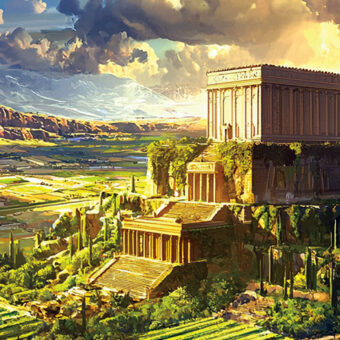
of Egypts Sphinx-building Elder culture? The Edfu Building Texts
are specific on what became of at least some of the divine inhabitants
of Wetjeset-Neter and its sacred domain. They say that, at the end
of their time, the Shebtiu "sailed" away to "another
part of the primeval world" where they could "continue their
creative task" undisturbed. Further evidence that these mythical
beings were mariners or navigators comes from the fact that one Shebtiu
is named as "the sailor", while, collectively, the followers
of an individual known as the Falcon are referred to as "the
crew".
Yet where might they have gone? For where
did they set sail at the end of their time in Egypt? What we know is that the earliest
known evidence for primitive agriculture anywhere in the world comes from the Nile valley
communities between the thirteenth millennia BC and sometime around 9500 BC. It is then
that it disappears from Egypt altogether, and does not reappear until around 5500 BC, some
4000 years later. Why did it suddenly cease and, more pressingly, what became of the prime
movers behind this enormous change from simple hunter-gatherer to domesticated farmer?
We know from the research of respected
Egyptologists such as Fekri Hassan of University College, London, that between 10,500 and
9500 BC the Nile Valley suffered repeatedly from extreme flooding on a massive scale. This
alone might have forced its inhabitants to seek new territories in which to continue their
agricultural lifestyle. Yet if they did start anew elsewhere, is it possible to trace
their destination?
Gateway to Eden
The emergence of the so-called neolithic
age marked the transition of the palaeolithic hunter-gatherer into a more settled way of
life where instead of moving from place to place, human kind began working in co-operation
with nature. The key element of this major change in lifestyle was, of course, the
development of agriculture and animal domestication, which necessitated the establishment
of more permanent settlements where a community could work together to produce enough food
and livestock to sustain itself through the winter months. Removing the element of
uncertainty from the daily lives of the inhabitants enabled the neolithic peoples to start
developing technical capabilities and regulate their lives for the first time.
This, at least, is the orthodox view of how
the gradual change from palaeolithic to neolithic began in a humble manner, sometime after
the end of the last Ice Age. Yet there are major flaws in this supposition, for it is
clear that the transition from hunter-gatherer to settled farmer did not occur everywhere
at the same time. Indeed, it would seem to have emerged first in one region alone, and to
have remained in virtual isolation here for at least 1000 years before spreading very
slowly outwards.
The genesis point of the so-called
neolithic revolution is the fertile river-valleys of the Upper Euphrates of northern Syria
and eastern Anatolia, modern-day Turkey. Here from around 9500 BC onwards, evidence for
the cultivation of wild cereals, as well as animal husbandry, starts to appear at
important sites such as the extensive "farmers village" at Tell Abu
Hureyra on the Upper Euphrates in northern Syria. Similar to the Nilotic communities of
Egypt, evidence of cereal cultivation has come from the discovery here of stone pestles,
rubbing stones and milling stones. In addition to this archaeologists also found an
abundance of seeds from three different types of cereal grains two of which had
previously been grown by the Nilotic communities of palaeolithic Egypt.
The clear fact that agriculture appears in
the Near East around the very same time that it vanishes from the Nile valley is striking
and cannot be overlooked. In my opinion, there seems to be a direct link between these two
quite different farming regions separated by several hundred miles, and the most obvious
solution is the transmission of agricultural knowledge and skills through the migration of
individuals from Egypt to the Near East.
So is it possible that some of the
remaining Elders departed Giza for the fertile valleys of the Upper Euphrates carrying
with them their technological capabilities, sometime around 9500 BC? Let us look a little
more closely at the emergence of civilised society in the Near East.
In the 4000 years following the emergence
of the neolithic age in the Near East around 9500 BC, so many advances were made in this
region, long held to be the cradle of civilisation and the biblical land of Eden (also
known as Dilmun in ancient Mesopotamian, ie. ancient Iraqi tradition), that something
rather unique seems to have occurred.
This isolated region has produced the
oldest evidence for the use of beaten and smelted metal, the fashioning of linen cloth,
the use of fired pottery, the domestication of fruits and vegetables, the production of
alcohol in the form of a type of retsina wine, the introduction of writing and the use of
bartering tokens. All these advancements were made first in the fertile valleys of
northern Syria, south-eastern Turkey and northern Iraq a vast and very desolate
area known today as Kurdistan, home to the much-troubled Kurdish peoples.
More particularly, the first neolithic
communities of the Upper Euphrates were able to fashion and drill necklaces of agate beads
up to 5 centimetres in length as early as 7000 BC. The level of technical sophistication
necessary to drill holes less than 5 mm in diameter, and up to one inch (2.5 cm) in depth
at either end of a long slim agate bead no more than 7 or 8 mm in thickness, is almost
beyond comprehension. To drill similar holes in agate today requires the use of a highly
specialised diamond-tipped, tungsten carbide drill, and even this has to be constantly
cooled by running water. Yet despite this, these beads have been found at a number of
sites in the Near East.
No one has satisfactorily accounted for why
the neolithic revolution began where it did a puzzle that prompted Mehrdad R.
Izady, the Professor of Near Eastern studies at New York University, to speak of the
neolithic explosion in the Near East as a "stage of accelerated technological
evolution", prompted by "yet uncertain forces".
What kind of "uncertain forces"
had Professor Izady been alluding to here? Were they changes in regional flora and fauna,
brought on by post-ice age climate changes conducive to the gradual emergence of a
cultural revolution, or was it the sudden appearance in the region of highly organised
individuals who brought with them an entirely new style of living? Professor Izady is
happy to accept the latter solution as a very real possibility.
Might these talented individuals have been
the final remnants of Egypts Elder culture, who are likely to have been responsible
for the emergence of agriculture and technology along the Nile valley? Was it them who
helped catalyse the neolithic revolution an event which eventually led to the
genesis of civilisation among the foothills and plains of ancient Iraq some 5500 years
later? Could we find any real evidence to suggest that the earliest peoples of the Near
East were descendants of those who supposedly built the Sphinx sometime between 10,500 and
9220 BC?
Worshippers of the Stars
Searching through the religious traditions
of the Mandaeans, a neo-Babylonian tribal-based religion found mostly among the Marsh
Arabs of southern Iraq, I discovered something of immense value to this debate. The
Mandaeans believe that their distant ancestors came originally from a mythical location
known as the Mountain of the Madai, located to the north or north-east of the city of
Harran. As modern Altinbasak, this ancient religious centre of great learning lies just
over the Syrian border in south-eastern Turkey on a tributary of the Euphrates river, some
78 miles (125 km) distance from Abu Hureyra, where the earliest evidence of agriculture in
the Near East was found.
The Mandaeans also claim that the Mountain
of the Madai is not the true place of origin of their race. They say that their
most distant ancestors came originally from Egypt. One Mandaean manuscript even
speaks of "the interior of Haran (ie. Harran) admitting them" upon their arrival
in this land, shortly after which they "entered the mountain of the Madai, a place
where they were free from domination of all races".
More significantly, various words found in
the language of the Mandaeans have clear Egyptian roots. They include the name of a
creator god named Pthahil. He is simply a rendition of the Egyptian god
Ptah, who was said
to have fashioned the first humans on a potters wheel at the beginning of time.
Another word is the root ntr, which in Mandaean means "to watch",
"watch-houses" or "watcher", a term used to express supernatural
beings who live in their conception of heaven. This same root word is Egyptian where it is
used to denote a divinity or god.
The Mandaeans were an offshoot of
star-worshipping peoples who inhabited Harran in south-eastern Turkey from the earliest
times through to the Middle Ages. They too placed a great importance on Egypt, and it is
known that from the early second millennium BC they would make pilgrimages to the Great
Sphinx at Giza, where they would leave votive stones in honour of the leonine monument.
This practice continued through till medieval times, for the eleventh-century Arab
geographer Yakut el-Hamawi tells us that in his own day the Sabians made pilgrimages to
both the Great and Second Pyramids of Giza.
To the Mandaeans and their cousins the
Sabians, Egypt appears to have been seen as some kind of ancestral homeland where their
earliest forebears lived before their arrival in the Near East. Such assumptions were,
however, pure speculation. What was really needed was much firmer evidence for the
existence in the fertile valleys of the Upper Euphrates of a high culture that rose to
prominence soon after 9000 BC and whose style of architecture matched that found along the
Nile valley. Only then could it be said that the original gods of Eden had been found.
Birds to Men
Such evidence came to my attention in late
1996, when I was notified of the recent discovery at an archaeological site known as
Nevali Çori, situated near Hilvan in south-eastern Turkey. Here had been discovered an
extraordinary temple dated to 8000 BC. This so-called "cult building", as German
excavator Harald Hauptmann of Heidelberg University named it, featured beautifully carved
megalithic blocks that once supported a wooden roof, as well as a perfectly-levelled floor
made of "terrazzo", a mixture of lime and mortar, and a huge gateway composed of
two 3-metre high megalithic pillars. On these in low relief were human forms with long
flowing hair and five-fingered hands resembling the belly flippers of an amphibian
(Nevali
Çori was lost in 1992 when the recent completion of the Ataturk Dam caused the rising
waters of the nearby Euphrates river to flood the site).
A very similar temple complex is to be
found just 60 miles (100 km) away to the north-east at a neolithic site known as
Çayönü. A cult building there also has a terrazzo floor, while another contains upright
megaliths and a flag-stone floor similar in style to the Valley Temple of Khafre at
Giza.
On a more disturbing note, clear evidence of macabre blood rites and human sacrifice have
been unearthed both at Çayönü and Nevali Çori, making it clear that its ruling elite
were not simply benign wisdom bringers.
Similar to Gizas sacred domain during
the epoch of the First Time, Nevali Çoris elite group of priest-shamans adorned
themselves in garments of bird feathers, in particular the vulture the symbol of
the cult of the dead in neolithic times. An extraordinary number of statues and carvings
depicting bird-men, or figures adorned with feathers, have been found in association with
the cult building from its very earliest phase, which Carbon-14 testing has revealed was
as early as 8400 BC. There is every indication that these individuals were the ruling body
behind many of the neolithic communities, and that they were indeed the direct descendants
of Egypts Elder culture.
More
significantly, Nevali Çoris
cult building constructed at a time when stone age man is thought to have only just
emerged from his primitive hunter-gatherer lifestyle is precision aligned to the
south-west. This in itself should set alarm bells ringing among the archaeological
community. Yet this south-westerly orientation seems more than simply an aesthetic effect
to line it up with the distant Euphrates river, as has been suggested.
The primary chaos out of which the Near
Eastern cultures of the foothills and plains first emerged was viewed mythologically as a
huge sea-monster or primeval dragon called Tiamat or Kumarbi. Legend spoke of the physical
world being fashioned from the body of this mythical creature, while the tears that flowed
from its eyes went to form the water-courses of the Euphrates and Tigris rivers. Both
Tiamat and Kumarbi bore a celestial counterpart seen as forming the stars of the
constellation known as Cetus the great whale or sea-monster which swam in
the celestial form of the Euphrates river. In astronomical terms, this string of 34 stars,
stretching between the front paws of Cetus and the left-foot of the giant Orion, is known
as the starry stream of Eridanus and the River of the Night. The whole area of
south-western sky in which these constellations are placed was known in Babylonian times
as the Gate of the Deep, beyond which lurked the dark primeval waters of chaos with which
Tiamat had threatened to drown the world before the current world age.
By using computer
calculations, it can be
established that at dawn on the spring equinox in 8000 BC, Nevali Çoris cult
building would have been aligned precisely towards the stars of Cetus which would have
hung low in the south-western sky. Furthermore, it can be ascertained that the Euphrates
river would have aligned with its own celestial counterpart, the Eridanus, at the same
moment. Did these primitive constellations have some kind of special meaning to the
inhabitants of Nevali Çori? Let us look again at its quite specific orientation precisely
towards the south-west.
Turning to Home
Places of worship in the Jewish and Moslem
faiths are orientated towards their greatest religious centres synagogues face
Jerusalem while mosques face towards Mecca. Could it be possible that the designers of
Nevali Çoris cult building orientated it towards not just the direction most
associated with their own myths and legends, but also the homeland of their earliest
ancestors in other words Giza in Egypt? Further computer
calculations, taking into
account the curvature of the earth, showed that the bearing of Giza from the position of
Nevali Çori is 221.8º, a full 1.8º out from the 223.6º orientation of the standing
monolith and a massive 3.1º if we take into consideration the orientation of the cult
building itself.
If the alignment linking Nevali Çori with
Giza is valid, then it suggested that its priest-shamans really did see the south-west as
the direction most associated with the creation of their world. The fact that this
imaginary line stretches across the waters of the eastern Mediterranean Sea is also
perhaps significant. With Egypt as their ancestral homeland, this journey across the
waters through the Gate of the Deep could have been compared with the emergence of cosmic
order out of the primeval waters that had threatened to engulf the world at the beginning
of time. Having conquered the face of the deep, in other words the Mediterranean
Sea, to
arrive in the Levant, the surviving Elders, as the first gods of Mesopotamia
(ie. ancient Iraq), would have been seen as initiating a new world age. In this mythical
epoch, mortal
kind were seen to have lived alongside their immortal teachers utopic memories that
led to much later legends concerning this paradisaical realm, known in Hebrew as Eden and
in ancient Mesopotamian as Dilmun, both connected with the territories located between the
headwaters of the two great rivers the Tigris and Euphrates. There
is, however, one
further link with Egypt.
The Dusky Monster
In an important work on ancient Euphratean
star-lore written by Aratus, a noted Greek astronomer and poet who lived around 270 BC,
the sea-monster Cetus is referred to as "the dusky Monster" a name that
was said to express "the blue-black of the nocturnal sky". To the Sumerians it
was known as kumar, "dusky", from which derives the name
Kumarbi. In
Aramaic Hebrew, which is a Semitic language linked closely to Akkadian, the same word root
becomes akem, "to be black" and "sunburnt". In the Egyptian
language, this becomes kem, "black", or kemet, meaning "black
land" the name given to ancient Egypt by its own people.
Mythological legend asserts that this name
refers to the black silt left covering the first land, ie. Egypt, after the waters of Nun
receded from the primeval mound at the beginning of time, reflected in the very real
alluvial deposits left covering the Nile valley after the yearly inundation.
More curiously, the word kem was
used to denote "the end of a period, completion, a finish", while kemet can
also mean "to end, to bring to an end". These definitions imply a completion to
a period or cycle of time. Is it possible that kemet was the name originally given
to Egypt as the primeval homeland by the descendants of the Elder gods who entered the
Near East around 9500 BC? Was the name an abstract memory of the muddy deposits that were
left covering large parts of the Nile valley following the constant series of high floods
during the eleventh to tenth millennia BC? Did it also preserve a memory of the
culmination, or conclusion, of this chaotic period of floods and destruction?
If these thoughts are correct, then it is
likely that these memories were carried into the Upper Euphrates region by the last Elder
gods and kept alive by the priest-shamans of the neolithic communities. Even down to the
second millennium BC, the Semitic peoples living in the ancient city of Harran in south
eastern Turkey recalled a more direct relationship between their most distant ancestors
and kemet, the black land beyond the Mediterranean Sea.
The Birth of Sumer
In the opinion of archaeo-logists and
historians alike, the city-states of Sumer constitute the earliest known civilisation of
the Old World. Yet their first beginnings were among the mountain communities of the
Zagros and eastern Taurus, where the neolithic revolution had begun 5000 years beforehand.
From its first beginnings in the foothills and plains of northern Syria and Iraq, as well
as south-eastern Turkey, the civilisation of Sumer and Akkad grew over a 2000-year period
to become the most sophisticated society on earth. The number of firsts
attributed to the Sumerians is virtually endless. They designed the first coloured
pottery. They conducted the first medical operations. They made the first musical
instruments. They introduced the first veterinary skills and developed the first written
language. They also became highly accomplished engineers, mathematicians, librarians,
authors, archivists, judges and priests. Yet despite all this no one is quite sure who the
Sumerians were or why they would appear to have evolved so much faster than any other
race.
There is ample evidence to show that the
innovative capabilities of the Sumerians derived from what they inherited from their
mountain forebears, such as the ruling elite of the so-called Halaf and Ubaid
cultures.
These were a priestly caste identified from among the anatomical remains discovered at
various sites across the Near East. Not only did they bear genetic
similarities, in that
they were an elite family group, but they distinguished themselves from others of the
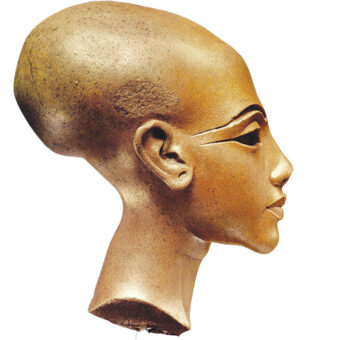
different communities by elongating their heads through deliberate skull deformation
during infancy, causing the eyes to appear slanted and giving them an overall striking
appearance. These individuals are represented in abstract form in religious
art, and were
clearly seen as having long serpent-like faces. Furthermore, in similar with the
priest-shamans of Nevali Çori and the divine inhabitants of Wetjeset-Neter in the Edfu
Building Texts, these individuals adorned themselves in ceremonial garments made of
feathers. It was from this elite group of priest-shamans, very possibly the direct
descendants of Egypts Elder gods, that the old world gained its knowledge or
civilisation.
Return to the Source
Completing the cycle is the fact that the
forerunners of the earliest Mesopotamian peoples would seem to have entered Egypt from the
Levant during predynastic times, sometime between 4500 and 3500 BC. They helped initiate
the Pharaonic age which began with the institution of the First Dynasty of a united Egypt
around 3100 BC. In many respects, this migration to Egypt seems to have been like some
sort of return to the source a return to an ancestral homeland left behind as much
as 5000 years beforehand.
In Pharaonic Egypt all the ideas of those
who had preserved the seed of the Elder culture were finally realised and put into effect.
Although the indigenous peoples of the Nile valley might have been the direct inheritors
of the Elder gods ancient legacy, which seems to have included the art of sonic
technology, these individuals were most probably just small religious groups who kept
alive archaic traditions at cult centres such as Giza. Alone they could do very little.
They had no real influence over the ruling tribal dynasties and were not in a position to
re-ignite the splendour of their divine ancestors. Yet with the aid of incoming
architects, craftsmen, designers, religious leaders, as well as a new ruling elite, they
were now able to begin the process of continuing the glories of the Elder culture, which
had dispersed to various parts of the globe many thousand of years beforehand.
Imhotep was the architect of the first ever
stone pyramid built at Saqqara during the Third Dynasty for his king, the mighty
Djoser.
Its stepped design is very reminiscent of the seven-tiered ziggurat structures of
Mesopotamia, while the façades of the temenos walls that surround the pyramid complex are
strikingly similar to the exterior walls of cult buildings in ancient Iraq the
temple of Enki at Eridu being a prime example.
Yet the greatest significance of this
external influence on the architecture of ancient Egypt is the sheer fact that within just
150 years of Djosers reign, it had led to the Elder cultures surviving
technological capability being combined with local building skills to produce what is
arguably the worlds greatest architectural achievement, the Great Pyramid. This
monument was the crowning glory not only of Egypt but of everything that had been secretly
kept alive since the age of the netjeru-gods, the epoch of the First Time. The
precision science, geometry, orientation, stone cutting, hole drilling and architectural
planning of the Great Pyramid was the result of a legacy preserved not simply by the wise
old priests of Egypt, but by a number of diverse cultures across the Near East. Their most
distant ancestors were the neolithic gods of Eden, whose own forebears had left Egypt for
the fertile valleys of eastern Anatolia during the wide-scale floods that engulfed Egypt
between 10,500 and 9500 BC. It is to these unique individuals, the living descendants of a
divine race with a lifestyle that would seem almost alien today, that we owe the genesis
of civilisation.
Further
details see Andrew Collins' web site.
|