It
doesn’t take a crystal ball to discern that ours is a chaotically
dysfunctional world. To point the way toward a solution
does, however, require someone with a sense of vision that
transcends the present-day labyrinth of commercialised and
egotistical dead ends. A visionary is simply someone who
can see beyond these ordinary confines, and a prophet is
someone who can read the “writing on the wall” that most
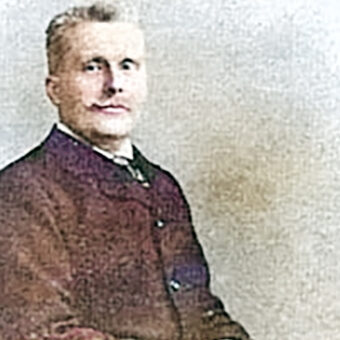
people pass by without ever looking up to notice. Dr. José
Argüelles, aka Valum Votan, is both a visionary and a prophet.
Argüelles began working as an art historian and artist in
the late 1960s, and his creative sensibilities contributed
greatly to an ability to peer through the veils of maya
that opaquely shroud the modern realm. But alongside an
artistic outlook, he also bears the mind of a scientist
– just not the type of narrow-minded positivistic scientist
that has come to exemplify the term in the West. Argüelles
is a “whole-systems scientist,” and here again visionary
skills come into play. In order to understand the complexity
of life on Earth, and to recognise the deleterious factors
that have put the entire biosphere in increasing jeopardy,
the old reductionism and scientism of the West must be abandoned
in favour of a more all-encompassing knowledge.
As the following interview demonstrates, José Argüelles
has always welcomed new experiences. He and his wife Lloydine
have travelled the globe to share their insights, always
on the frontlines of the effort to expand consciousness
and awareness. And among many other achievements, Argüelles
is also the author of a series of seminal works, the most
well-known of which is probably The Mayan Factor: Path
Beyond Technology (1987). It was here that he first
revealed the understandings he gleaned from a deep study
of Mayan time science.
His latest endeavour, Time and the Technosphere: The
Law of Time in Human Affairs (2002), may be his most
crucial. In it, Argüelles looks at recent human events and
worldwide developments from his whole-systems vantage point.
With the courage to face an apocalyptic diagnosis, he offers
evidence that the Earth has come to be dominated by the
“technosphere,” an envelope of inhuman mechanisation that
practically has a mind of its own and has us careening toward
a cataclysmic future.
But despite the bleak circumstances we now find ourselves
in, Argüelles’s message is one of hope. The shattering “Inevitable
Event” of September 11th, 2001 – seen almost simultaneously
by a vast section of the world’s population via high-speed
electronic media – represented a rupturing of the technospheric
bubble, and therefore an opportunity for humans to establish
a genuine alternative paradigm on a global scale. This is
where the World Thirteen Moon Calendar Change Peace Movement
steps in, offering a vision and a model for a new time.
As Argüelles persuasively
argues, it is largely dissynchronous timing standards that
have kept human beings off-balance and alienated from the
natural cycles of the Earth they inhabit. The worst culprit
is the Gregorian calendar, and by extension the “12:60 frequency”
that it fosters – together these have become, in essence,
the inescapable time clock of globalist capitalism. But
is there really no escape? Through the medium of his work,
and through the example of a life artistically lived, Argüelles
points the way to a new beginning. The choice is in our
hands, and now it is truly a question of time.
–
Michael Moynihan
Michael:
The best description for you and your work might be
that of a “visionary.” When and how did you first realise
that your interpretation of larger events was something
you felt compelled to communicate to others?
José:
I always knew I was an “outsider,” to use Colin Wilson’s
phrase. But it wasn’t until after I experimented with LSD
that I realised I was a visionary. That was back in 1965
and 1966. I then felt compelled to express myself, first
in painting. I did a series of paintings which came to be
known as “The Doors of Perception” (Humphrey Osmond himself,
who coined the word psychedelic, gave those paintings
that name). But I saw that as fantastic as painting was,
it was a limited medium in terms of audience. And besides,
visionary artists – really visionary artists – don’t usually
get much exposure in their time. Especially me – I made
it a point of never signing my painting because I felt I
was simply the channel, the cosmic ballpoint pen, drawing
down the visionary flow from the cosmic realm of endless
archetypal form. And I also wanted to get away from all
this individualistic ego trip of modern art and artists.
“Ownerless in the ownerless land of vision,” I used to say
to characterise my attitude.
Because of this I also knew that I would have to tackle
the medium of the written word to get out my message. My
vision and message were always very simple. History is a
fall from grace. We are at the end of time and the end of
history. Therefore a renewal of vision, the Great Return,
the creation of the Great Work of the Art of Harmony must
be reestablished in order to save fallen humanity from the
graceless state of merciless materialism and the fragmented
exhaustion of the profane order of mechanised history. By
the time I was 28 or so I felt very compelled to get out
this message. I envisioned a monumental work dealing with
this issue to be entitled Art at the Dawn of a New Magic.
I also knew my trip was so far out that the only way I could
establish credibility was to get a Ph.D. So I did. My thesis
was turned into a book, my first book, Charles
Henry and the Formation of a Psychophysical Aesthetic (1972).
Sounds pretty academic, but look at the very first words
in my very first book, and you’ll see the theme from which
I have never veered: “Many are the attempts that are made
and the words that are spoken with regard to the age-old
ideal of harmony: the union of all faculties, of all senses,
of all knowledge. The highest dreamers would proclaim that
the true art and science are one…”
Michael:
Could you tell us a bit about Charles Henry and what
drew you to him and his ideas?
José:
Charles Henry was a French psychomathematician born in 1859
and who died in 1926. During the 1880s his ideas of a “scientific
aesthetic” were a great influence on what came to be known
as the post-impressionist painters, especially the pointillist
Georges Seurat. That is actually how I came to discover
Charles Henry, when I was in Paris doing my Ph.D. research
on neo-impressionism in 1965 and ’66. I discovered LSD at
the same time, and as I read some of Charles Henry’s later
works, I thought his theories on sense impressions, perceptions
and consciousness confirmed my psychedelic experiences.
After the LSD I found the art history neo-impressionist
stuff a bit tedious, and so I decided I would forget it
and paint instead. But something about Charles Henry intrigued
me.
I decided to delve into him a bit further, and decided that
I would get my Ph.D. after all, but my thesis would be on
this enigmatic, little-known explorer of consciousness,
Charles Henry. I had the feeling that he was a special type
of incarnation, like a French reborn sufi-saint or some
kind of bodhisattva who was carrying on the tradition of
the “invisible college” and St. Germain, setting out a bunch
of clues that only I could decipher and decode. His last
works were on the nature of consciousness, specifically
“Post-mortem survival and the Nature of Consciousness,”
in which he wrote: “Death is but a physiochemical change.
It is only after death that I will truly begin to amuse
myself.” I also found it interesting that he was talking
about synergy and synergetics well before Bucky Fuller,
a fact I brought to Fuller’s attention in some correspondence
with him in 1969. That was a good thing because Bucky answered
back and agreed that it must have been Charles Henry’s post-mortem
synergetic thought form that he received in 1927, when the
idea of synergetics first came to him. That connection was
very fruitful, because Bucky also suggested to me the idea
of a psi bank around the Earth in which all of the ideas
and thoughts of all the ages keep recirculating. I knew
he was right. Anyway, that gives you some idea of Charles
Henry and my process.
Michael:
Given your non-materialistic outlook, was entering the
academy to obtain your Ph.D. a bit like diving into the
belly of the beast?
José:
Well, kind of. But I knew that it was my survival. I got
my B.A. degree from the University of Chicago as well, and
found out that all I could do was get a job as an insurance
salesman. That really didn’t cut it for me. I knew I was
made for other things. That was back in 1961. I seesawed
between being a full-blown beatnik on the road or going
back to school. So I ended up going back to the University
of Chicago for a degree in art history. I had to be on good
behaviour because I had actually been thrown out of the
undergraduate program in 1960 for being a full-blown beatnik,
accused of being the ringleader of a pot-smoking set of
thugs meant to undermine the freshman women. But in this
life you have to experience everything and academia was
part of that experience. As William Blake put it, “The road
to the palace of wisdom is paved with excess.” I was as
good an academic as I was a beatnik, in fact I really excelled.
But I knew by my inner guidance, it was but a means to an
end – discipline, for sure, to keep my many-levelled mind
on track, and credibility for something I knew not yet what.
Michael:
Getting back to the subject of your early paintings,
some people will be familiar with them due to their appearance
in your book Mandala. How would you characterise
the relationship between your own artistic endeavours and
these traditional forms? Did one inform directly the other?
José:
Actually the mandala principle seemed to be a very natural
and inevitable consequence of the psychedelic experience,
affirmed for me by my studies of Charles Henry and my free-form
exploration at that time of Tibetan mysticism. I never thought
of the mandala form as particularly traditional, but instead
rather timeless. I thought of using the Doors of Perception
and other large mandala-style paintings to create an actual
environment where someone could sit and experience this
timelessness, get lifted from their ego and see the white
light. In 1971, when I finally met a real Tibetan, Chogyam
Trungpa Rinpoche, who ended up being my friend and teacher
for the next sixteen years, he took a good look at my paintings,
and with a sly grin looked at me and said, “I see you already
know all about tantra.” I think tradition is good if it
gets you to that place of timelessness and self-transcendence.
That’s what Trungpa meant by his comment. There are many
ways to get to the same place. But you should also know
I stopped painting mandalas around 1973. I started to do
one, and I said to myself, “What does the world need with
another gimmick?” I didn’t paint like that again for almost
another 20 years, though I have done a lot of other artistic
things.
Michael:
From a few of the comments you’ve been making, I get
the feeling you don’t place any great emphasis on the modern
obsession with “originality” and novelty, which fuels so
much of the commercial art world.
José:
No, I don’t. Modernist “originality” is a fall from the
sacred into the profane, the exaltation of ego. There is
a true originality, but that is what is usually called revelation.
That is, revelation that is genuine and is meant to light
a new path for a fallen humanity. I think the true artist
is meant to be a creative channel and not an inventor of
cheap tricks or clever mannerisms.
Michael:
Chogyam Trunga is well known as one of the first people
to bring Tibetan Buddhist teachings to a contemporary Western
audience. In your mind, what are some of the most important
aspects of his legacy?
José:
Trungpa Rinpoche was a truly interesting human being. As
much as he was a teacher of the way of “crazy wisdom,” he
was also an artist at heart. His two greatest legacies were
his emphasis of mindfulness training and his vision of dharma
art – art as everyday life, but an everyday life in which
the sacred is the normative experience. Here we can define
the sacred as being the sense of awe that breaks your heart,
that touches and moves you mysteriously and poignantly even
though and maybe just because it is an ordinary experience
of reality. But you cannot have dharma art without mindfulness
training, meditation without an object. So art is how you
organise your life moment-to-moment with an all-consuming
awareness or sense of mindfulness. Take nothing for granted.
Elegance and a simple sense of ceremony transform your everyday
environment and place you in cosmic harmony – dharma art
is the ceaseless expression of the universal norm of existence.
Michael:
As part of living a creative existence outside the workaday
world, you and Lloydine spent years travelling the globe
and interacting with people to share your visions and ideas.
Surely this was also part of your own fulfillment of “dharma
art.” What lessons did you learn from the experience?
José:
Yes, for over a decade beginning late in 1991, we have been
galactic peace mercenaries bringing the message of the new
time, a message of peace through time. We were “commanded”
to take the tools and research of our investigation into
the natural timing frequency as represented by the Mayan
calendar to all the peoples of the world. We did this essentially
without any visible means of support. And we did this always
without asking for monetary recompense for delivering our
message that the old time was over, and that a new time
is already prepared. In this way when we said our message
was the truth we were not compromising it by asking for
money.
The truth cannot be bought or sold, and we stuck to this
premise. It took us on a mighty trail of adventures, too.
We had some patrons from time to time give us support. But
we had to go places where we had never been. We had to go
Berlin and Russia after the end of the Cold War, we had
to travel throughout Latin America. We were in South Africa
and Egypt, India, Hong Kong and Japan. Much of the time
we spent living with the people who shared with us their
lives, their food, their dwellings. Our dharma art and mindfulness
training was our survival. It allowed us to blend in and
participate fully in the various cultures as if we were
natives. It was also really helpful not to ask for anything.
It doesn’t do you any good to be a fussy vegetarian in a
culture that survives harsh winters on mutton. Our task
was to see if people from different cultures could not only
understand our message, but act on it as well. In the presentation
of our message, art was of supreme value.
I always play my flute, and together we do a prayer to the
seven directions that is a simple ceremonial piece of art.
We also always present the banner of peace to show that
we are emissaries of peace through culture and that we are
to demonstrate a new positively constructive approach to
peace. We found that people generally respond very positively
to this kind of approach. As a result we have been privileged
to have many, many cultural experiences that even natives
of some countries rarely have. For instance, we were taken
deep inside the Ise shrine in Japan as special guests, and
attended a special performance of bugaku (ancient
court music and dance). I was even able to play my flute
– a Japanese Shakuhachi – in the ceremonial grounds, which
is usually not allowed even for Japanese. You see, when
you practice living art as everyday life, it creates a path
of genuineness and gentleness which people are often very
willing to accommodate.
Michael:
Somewhere along the way you encountered the work of
Nicholas Roerich, the Russian painter, poet, and traveller
into the Himalayas. When did you become aware of him?
José:
Back in 1967 when I was teaching art history at Princeton,
I was looking for signs of Tibetan art wherever I could
find them in New York City. And I found that one of the
places was the Roerich Museum on the upper West Side. I
liked his paintings and read about him, becoming aware that
he was an early explorer of Tibet. I realised what an interesting
artist he was, having designed the stage sets for Stravinsky’s
Rite of Spring and then gone on his various pilgrimages.
Michael:
Julius Evola once wrote that Roerich’s images convey
a spirit capable of awakening a “primordial and powerful
sensation that has been buried in the subconscious due to
the restless and prisonlike life of the modern Western world.”
What meanings did his paintings evoke for you?
José:
Sacred awe and visionary splendour. A universalism of cultural
or spiritual values as well. His writings on art show that
he was seeking to restore the sense of the sacred to the
modern world. I became aware of his work with the Banner
of Peace sometime not too long after that. Roerich’s idea
of peace through culture I found of enormous value and easy
to integrate into my perceptions of the purpose of dharma
art. Trungpa used to say, “The artist has tremendous power
to change the world.” But how? The Banner of Peace seemed
to provide a way of making a change by promoting a broad
scale revolution of cultural values.
So it was that early 1980s, my wife Lloydine and I decided
to resurrect the idea of peace through culture, especially
the Banner of Peace. In 1983 we incorporated it into our
creation of the Planet Art Network (PAN). The original idea
of the PAN was to create a network of artists – creative
thinkers of every kind – who would become a force for creative
non-political change in the world, or who would show the
world that change can be attained through creative means
and that political change could be superseded by something
far more inspiring. However, the principle notion of Planet
Art is that the Earth itself is a work of art, and that
the next evolutionary wave of art – beyond modernism – would
be the realisation and fulfillment of the Earth as a work
of art.
In
the 1990s when we became totally involved in the Thirteen
Moon Calendar Change Peace Movement, we moved the Banner
of Peace and the Peace through Cultural initiative into
the forefront of our peace plan. The Banner of Peace is
now one of the official emblems of this Movement. Intended
to protect cultural monuments in times of war, we now view
the Banner of Peace as the symbol meant to protect the biosphere,
the cradle of culture currently very seriously threatened
by the war of globalisation.
Michael:
The difference between artists and politicians seems
fundamental. Generally two artists can mutually respect
one another and find common ground beyond whatever differences
they may have. But people who are driven by or infused with
materialistic political ideologies become like automatons,
unable to acknowledge anything that doesn’t fit into their
“correct” worldview. Not surprisingly, most artists want
nothing to do with politicians – even less so since the
latter are beholden to money values rather than creative
values. How do you see a chance for creative values to take
precedence in the world, given these circumstances?
José:
First of all we must see a further breaking down of all
values and institutional structures which will continue
to diminish the credibility in the way we have been doing
things as a species. This process is already occurring and
manifests as the increasing social, political and military-terroristic
chaos so rampant in the world today. When people talk about
the end times, well these are the end times. But it is only
the end of the corrupted world, the end of the world as
we know it, and to paraphrase R.E.M., we feel fine. Why?
Because this means that a new world is already being born,
a world which will inevitably and of necessity see a radical
pole shift in values. If the predominant value of the corrupt
world is “time is money,” supported by ruthless military
supported monetary politics, then the new value system will
be characterised by “time is art.” It is the difference
between a value system stressing quantity of material abundance
and a value system emphasising spiritual and aesthetic quality
as the standard of life. This change is already in the evolutionary
program of the biosphere, the evolving system of life on
earth.
We have reached a critical stage in which we are faced with
planetary suicide – genocide – or planetary renewal. The
system of life on Earth can only go in the direction of
planetary renewal which means a total change in direction
and way of life of humanity. This is already being prepared
for and the first step will be a change in the timing frequency
by which the human species governs itself. Currently the
dominant order is governed by an anachronistic, irrational
and irregular timing device, the Gregorian calendar, which
has had and continues to have a debilitating effect on the
mind and moral sensibility of the species. Combined with
the mechanisation of time through the clock, and the worship
of money as the be-all and end-all of existence, this has
created an out-of-control species no longer in tune with
nature or the natural order. Once this change of timing
frequency is made and the species is returned to the harmonic
order of natural time, artistic and cultural values will
very soon supersede the witless determinism of monetary
politics. Do not doubt it: the sentiment and comprehension
for making this change, as well as the instrument for implementing
this change – the 13 Moon/28-day calendar – are now a growing
force throughout the world.
Michael:
Recently you travelled to the Altai region, where Roerich
had explored three-quarters of a century ago. What brought
you there, and what significance does a remote place such
as Altai have for an increasingly globalised world?
José:
Actually we had received an official invitation from the
government of Altai to be special guests and to share our
message with the people. When The Mayan Factor was
published in Russian, it reached the hands of some shamans
in Altai – it is an autonomous republic, member of the Russian
federation, with only 205,000 people on 92,000 square kilometres.
Anyway, between the shamans and contacts that had already
been made through official representatives of Altai government
in one of our more recent trips to Russia, we were then
ready to visit. We found it an interesting opportunity because
our trip was timed precisely 75 years after the Roerichs
had passed through Altai on their famous expedition Altai-Himalaya,
1926-28. In fact we visited the Roerich Museum, the house
where Roerich had stayed, facing Mt. Belukha, the highest
mountain in the Russian Federation, precisely on the day
he had first arrived there 75 years earlier.
Set between Khazakstan, China, Mongolia and Russia, Altai
is an amazing piece of territory. There really is only one
city, if you can call it that, Gorno-Altaisk, and once you
leave that place, you enter a country that you didn’t think
existed anymore on this planet. Endless valleys with wild
horses roaming freely as if it were still 30,000 years ago.
We visited shaman elders and little villages that are literally
off both the beaten and the unbeaten paths. People were
always already waiting for us. They knew who we were. And
they shared with us many interesting aspects or facets of
their history, a history that traces back to the stars.
Some of the shamans felt the cosmology of The Mayan Factor
confirmed or was even identical to their cosmology.
But they were also feeling the pressures of the globalised
world. A highway from China to Russia was in the works when
we were there. We were in strong support of the government
declaring the entire region a biospheric reserve. The thinking
there is already advanced in this direction.
We proposed the establishment of an International Foundation
for Peace through Culture that would help establish Altai
as a biospheric reserve, preserving the land and the culture
in its entirety, and providing a world model for other cultures
or peoples who wished to learn from this model. We presented
this idea to the national Parliament and we know that it
is still being discussed. It is interesting that among some
of the shamans and locals, Roerich is not greatly liked.
They feel that he was exploiting the people and the culture.
And we have experienced some of that too, though we are
still in communication through our representative there
with key elders. Even now, the people of Altai are in the
struggle between preservation of traditional values and
the encroaching technosphere.
But of all the places I have been, Altai is the most magical
and incredible. It is truly another world, a doorway into
timelessness. And I was very fortunate to have met so many
of the holders of the ancient culture. One shaman, Anton
Yudanov, gave me a topshure – a two-stringed fretless
Siberian guitar – which I have treasured and learned how
to play, singing spontaneously my own forms or versions
of shaman rock and shaman blues. I truly pray that Altai
will be preserved and stand as a model for the rest of the
world as culture living in harmony with the biosphere.
Michael:
You’ve spoken of spiritual convergences there that indicate
a “sign of the coming of Shambhala.” Can you elaborate on
what you mean by this?
José:
Altai prides itself on the fact that Islam, Christianity
and Buddhism all exist there side by side. One shaman we
visited showed us a diagram in which the three religions
are represented by signs from playing cards – Christianity,
clubs; Islam, hearts, and Buddhism spades. Next to these
three signs are two diamonds. These represent the old and
the new shamanism of Altai. The new shamanism is called
Ak Burkhan or the white faith and though it was introduced
over two hundred and fifty years ago, it only became official
in 1904. Through Ak Burkhan the prophecies of Shambhala
or Belevodye, the White Land, are maintained. The spiritual
convergence of Buddhism, Islam and Christianity is certainly
one of the signs of the coming of Shambhala.
Trungpa Rinpoche, as you know, also taught much about Shambhala,
which can also be said to represent a spiritual harmony
of the different traditions of the world religions. In Altai,
however, there is no question that the native religion,
Ak Burkhan, is a great factor in creating a sense of harmony
with the land, as well as a spiritual harmony. At different
points in our visit to Altai witnessing the dancing and
the throat singing to the accompaniment of the topshure,
it felt like the living culture of Shambhala was still shining
through.
Michael:
Certainly the culture of Shambhala does not operate
according to Gregorian time, or what you call the “12:60
frequency.” A major theme of your new book Time and the
Technosphere concerns the discovery of the Law of Time.
Can you briefly expound upon what this means?
José:
The Law of Time is a fundamental law, like that of gravity.
And just as no one knew about that law until Newton discovered
it, so it is with the Law of Time. That also means that
the Law of Time, like gravity, has always operated – it
is fundamental to the universe. We just didn’t know about
it until now. I wouldn’t have known about it if I hadn’t
delved so deeply into the mathematics behind the Mayan calendar.
To test it out, Lloydine and I began to live the cycles
of that calendar: 13-day cycles, 20-day cycles, 52-day cycles.
That changes your life. We had begun doing that before the
Harmonic Convergence in 1987, and continued doing that in
the years just after. Then, as destiny would have it, we
found ourselves in Geneva, Switzerland one cold and dreary
Sunday – December 10, 1989, to be precise. To entertain
ourselves we decided to take a busman’s holiday and visit
the Museum of Time. After two or so hours looking at one
archaic proto-clock after another, leading from the cuckoo
up to the pendulum clock and then on down to digital quartz
and cessium timepieces, we had a grand “Aha!” This place
should be renamed the Museum of Mechanised Time! Because
we had been living the Mayan cycles we had a contrast, both
experientially and mathematically, by which to evaluate
what we were experiencing in this Museum.
We knew immediately that there are two timing frequencies.
The natural one codified by the Maya we understood to be
the frequency 13:20; the artificial one canonised in this
museum we knew to be the 12:60 – the irregular 12-month
calendar and artificial, mechanised 60-minute hour. We understood
that the combination of these two timing standards unconsciously
accepted by the human species established an artificial
timing frequency which regulates the human race today in
virtually every aspect of its existence. Since time is fundamentally
of the mind, this 12:60 frequency has produced a species
whose system of operations is a mechanised irregularity.
And since a calendar is the macroprogram that governs a
people or a culture, this means that all of these mechanised
irregularities are programmed into that calendar. No wonder
there are so many problems and no solutions! Change the
calendar and you’ll change the program.
The Mayan calendar cycles summarised by the mathematical
ratio 13:20 we understood to represent the natural timing
frequency which is the universal factor of synchronisation.
Yes, the chief quality of natural time is synchronisation!
That is why the ancient Maya operated with as many as seventeen
different calendars. We are all fascinated by synchronicity,
which is an anomaly only because we live a life of mechanised
irregularities. But in the natural order of time, synchronicity
is the norm. This also defines a whole order of reality,
the synchronic order. This is fundamentally the fourth dimensional
order of reality which regulates the third dimensional plane
of existence. But we have a hard time dealing with this
or knowing about it because our minds are so conditioned
to artificial time which is linear and anything but synchronic.
You can see what a dilemma this is. For this reason we immediately
understood as well that to get the human race back on course,
the first step would be to change the calendar, to replace
it with a calendar of perfect harmony so the human race
could straighten its mind out again. The means for doing
that is the absolute perfection of the Thirteen Moon 28-day
Calendar – 364 days 52 perfect weeks, plus a 365th Day Out
of Time for forgiveness, and to give expression to “time
is art.” Celebrated on old Gregorian July 25, this past
year alone more than 500 Day Out of Time celebrations occurred
planet-wide.
That gets us to the other aspect of the Law of Time, and
that is its formulation: T(E) = Art, energy factored by
time equals art. That is to say, because time is the universal
factor of synchronization – the ratio constant 13:20 – everything
participates in a natural elegance. There is no such thing
as an ugly sunset. Spiders and scorpions have their aesthetic
elegance. Beauty is the basic norm of the universe. That
gets us back to that dharma art thing. Only modern man has
lost this innate artistic sensibility and prefers three-legged
pink poodles to the real thing. Artificial time deforms
the mind; mechanisation dehumanises it. Art and beauty really
will save the world, but only if humanity returns to living
in the perfect harmony of the Thirteen Moon Calendar and
thus becomes synchronised again with the whole of the universal
order of the cosmos. Then art as everyday life will be natural
and inevitable – how can harmony do anything but enhance
itself and produce more harmony? This is the point of what
we call the Great Calendar Change of 2004 – July 26, 2004,
to be precise. People get ready, there’s a new time a-coming…
it is humanity’s last best hope, the untried solution: get
a new calendar.
Michael:
There are apocalyptic warning signs all around us –
a glance at a daily paper will confirm that. You don’t shy
away from the reality of our precarious situation, yet you
also offer a message of hope. How can people rise above
the sort of nihilistic, numbed state that the powers-that-be
seem to want everyone to remain in?
José:
Well, most people have a hard time accepting that it really
is the end times, that they are living in the middle of
the apocalypse. That’s why they are numbed-out and that
is what keeps them numbed-out. They don’t want to face it,
and certainly the media isn’t going to tell them to face
it. Instead the media thrives on fear and violence and so
the whole syndrome is self-perpetuated. From the point of
view of the Law of Time this is the inevitable conclusion
to absolute entrainment in an erroneous timing frequency
which only produces increasingly dissynchronous states of
mind. People have to understand this fundamental point.
Because when you do, you also realise there is a solution,
a radical fundamental change. Yes, so radical that it will
end history. But if we don’t end history, history will end
us.
Ever since 1990 when we realised that the calendar change
was the only solution, the first step toward getting out
of an otherwise “geocidal” dead end, we have been promoting
this change. At first it was very difficult. People would
say, “How can a calendar have an effect on my mind?” or,
“How could changing the calendar change anything?” or, “We
tried that already.” Not really. The first calendar change
movement that was promoted by the League of Nations did
not succeed – it floundered on the Day Out of Time issue,
which we have now proven to be a day of universal harmony
– so that means we never really tried the calendar change
as a solution. People have to understand that the Gregorian
calendar is the world’s most insidious dogma, that this
calendar is a tool of the Vatican, and that therefore, the
Vatican maintains mind control over the human species with
this calendar. And everybody knows that it is irregular
and irrational as well – so why still follow it?
By 1993 we knew we had to get serious with promoting the
Thirteen Moon Calendar, and so we gave birth to the World
Thirteen Moon Calendar Change Peace Movement. We saw the
calendar change as the perfect opportunity to declare world
peace, call for a universal cease fire, begin a disarmament
process and also call for a work stoppage so as a species
we could begin to shift priorities. My optimism comes from
the fact that in less than a decade the use of the Thirteen
Moon Calendar has spread to some 54 countries and the Day
Out of Time has become very widespread as a Planetary Festival
of Peace and Culture. The previous calendar change movement
was a top-down thing. We knew that our efforts had to be
a people’s revolution. Bob Marley sings, “It takes a revolution
to make a solution,” and that’s so true. If enough people
from many different countries and cultures are already following
this calendar, then when we got to the point of notifying
the world leadership it will be backed up by the people.
Not that we haven’t already presented this to the U.N.,
the Vatican, and many other top leaders. But that has been
a matter of course. If we hadn’t done that we wouldn’t be
doing our jobs. Of course the Vatican chose to conceal our
information and ultimately ignore it. Kofi Annan, however,
did give us a positive letter of support. But of course,
no one wants to take personal responsibility. So we say,
that’s OK, show us a better, more comprehensive solution.
We are ready anyway, and everyone who knows that this is
real and true is getting ready to say goodbye to the Gregorian
calendar and its self-fulfilling apocalypse in 2004 and
walk right into a time of peace and harmony. If the rest
of the world wants to join, it is an open invitation. Leave
the old time and enter the new time. It is the only sure
way to rise above the numbed-out nihilism of the decade
without a name. Besides, the Mayan prophecy says that 2012
is the end of the cycle, and if we want to get there in
one piece, we have to shift gears now. Believe it or not,
to paraphrase Crosby, Stills, Nash and Young, I know we
will “get back to the garden.”
By the way, all of this calendar change activity is also
a Mayan prophecy. In that regard, I am nothing but a messenger,
and as a messenger, my name is Valum Votan, Closer of the
Cycle. I would be avoiding my responsibility if I didn’t
mention that. Thanks for the opportunity. I hope you have
found this to be an interesting interview.
Further
information on the New Time and the work of Valum Votan
can be obtained from:
Foundation
for the Law of Time
PO Box 513
Brightwood, Oregon 97011
USA
Tel: +1 503 622 1976
Fax: +1 503 622 0198
Email: foundation@tortuga.com
www.tortuga.com
______________________________________________________________________________
Michael
Moynihan is a writer, artist, and publisher. He is co-editor
of a new annual journal TYR: Myth—Culture—Religion, published
in Atlanta, Georgia. He regularly contributes to cultural
and music periodicals.